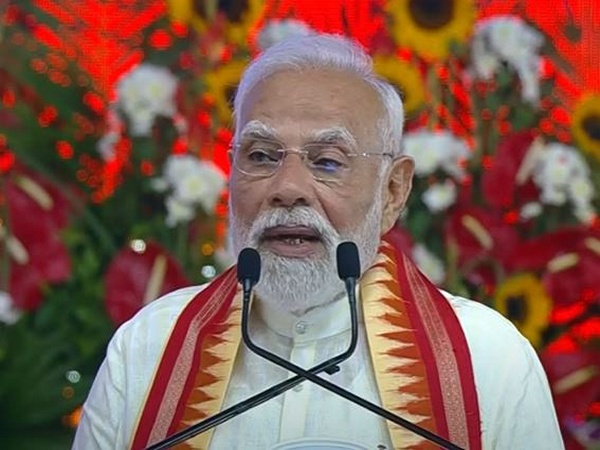
Prime Minister Narendra Modi has reaffirmed his unwavering faith in the people of India, stating that a Swadeshi (indigenous) and Aatmanirbhar (self-reliant) Bharat will form the foundation of a developed India, or Viksit Bharat, by 2047. He emphasised that every citizen will increasingly adopt the mantra of ‘Vocal for Local,’ supporting indigenous products and practices.
The statement came during a major event in Ahmedabad marking 20 years of urban transformation under the Viksit Gujarat, Viksit Bharat initiative. In the presence of Gujarat Governor Acharya Devvrat, Union Jal Shakti Minister C.R. Patil, and senior state ministers Kanubhai Desai, Rushikes Patel, and Jagdish Vishwakarma, the Prime Minister dedicated development projects worth ₹5,477 crore across Ahmedabad, Gandhinagar, and Mehsana.

City-Wise Breakdown of Projects:
Ahmedabad: Received projects worth ₹3,125 crore, including a ₹608 crore electricity distribution project by UGVCL, slum redevelopment under PM Awas Yojana (Urban) at Ramapir Tekra costing over ₹133 crore, commissioning of 66kV substations at Chandkheda and Gota, and the inauguration of the Viramgam-Khudad road. Foundation stones were laid for a stormwater drainage system, a Stamps and Registration Bhavan, and the expansion of Sardar Patel Ring Road to six lanes.
Gandhinagar: Inaugurated and laid foundation stones for projects worth ₹555 crore.
Mehsana: Projects worth ₹1,796 crore were dedicated, including ₹1,404 crore in railway development, flagging off of two trains, ₹221 crore in UGVCL works, and ₹171 crore in roads and building projects.
Championing Swadeshi and National Pride
Speaking from Nikol in Ahmedabad, the Prime Minister highlighted the festive enthusiasm of Ganesh Utsav and the simultaneous launch of transformative projects. He said it was a privilege to dedicate these initiatives and called on citizens to use festivals as an opportunity to support indigenous goods. From the land of Mahatma Gandhi, he urged people to make a conscious shift to ‘Made in India’ products for household use, gifting, and celebrations.
He likened the spirit of Aatmanirbhar Bharat to Gandhi’s vision of self-reliance, drawing parallels with India’s recent Operation Sindoor, a demonstration of national strength. He appealed to shopkeepers and traders to pledge not to sell foreign goods and to proudly promote locally made items.
The Prime Minister referenced Gujarat’s legacy, calling it the land of two Mohans: Lord Krishna of Dwarka and Mahatma Gandhi of Sabarmati. He said India continues to grow stronger following the paths shown by both.
On Operation Sindoor and National Security
PM Modi highlighted Operation Sindoor as a symbol of India’s resolve, stating that it showcased the military’s strength and the nation’s firm commitment to justice. He recalled India’s swift retaliation to the Pulwama attack, neutralising terrorist elements within 22 minutes, and said this mission proved that India spares no enemy—even those hiding in the depths. He called Operation Sindoor an embodiment of the power and will of Sudarshan Chakra-dhari Mohan (Lord Krishna).
Gandhiji’s Legacy and Betrayal of Ideals
The Prime Minister also criticised those who, while using Mahatma Gandhi’s name, neglected his core ideals of self-reliance and cleanliness. He claimed that India was kept dependent on foreign imports for 60–65 years and accused earlier governments of corruption in imports even while in power. He noted that Sabarmati Ashram stands as a witness to this neglect.
India’s Path to Self-Reliance and Development
He asserted that today’s India is rooted in Aatmanirbharta, powered by farmers, fishermen, small businesses, and livestock rearers. Gujarat, he said, plays a pivotal role, having built a foundation over two decades. The state has become India’s manufacturing hub—from producing electric locomotives in Dahod to exporting railway coaches and manufacturing cars, motorcycles, aircraft components, and semiconductors.
Gujarat’s industries in textiles, pharmaceuticals, gems and jewellery, and renewable energy continue to fuel India’s economy. The PM Surya Ghar Yojana has made rooftop solar accessible, drastically reducing electricity bills.
Connectivity and Urban Renewal
Modi outlined the transformation of Gujarat’s infrastructure over the last 2–3 decades—from a single red bus to electric buses, BRTS, and Metro in Ahmedabad. In 11 years, the state has added 3,000 km of railway lines, with most electrified.
Housing projects have improved living standards, replacing slums with permanent housing, including gated communities for the underprivileged. The PM recalled his Red Fort speech where he vowed to prioritise the marginalised. Through the PM SVANidhi scheme, 17 lakh street vendors—many in Gujarat—have benefited from access to credit.
Growing Middle Class and Global Recognition
He stated that 25 crore people have moved out of poverty in India—a shift acknowledged by global economists. The rising middle class is India’s new strength, and the government is supporting it with income tax relief up to ₹12 lakh and upcoming GST reforms to benefit businesses and consumers during festivals.
He contrasted the Ahmedabad of the past—once called “Gardabad” for its dust—with the clean, modern city it is today. Iconic sites like the Sabarmati Riverfront and Kankaria Lake are now symbols of the city’s transformation. Ahmedabad, India’s first UNESCO World Heritage City, is also emerging as a cultural and tourism hub, hosting major concerts and sporting events.
India’s Global Rise and Space Achievements
He praised India’s rising global stature—from surgical strikes and Operation Sindoor to achievements in space exploration. India planted its flag on the Moon’s Shiv Shakti Point and sent astronaut Shubhamshu Shukla to the International Space Station. The Gaganyaan mission and India’s own space station are in progress, reflecting national ambition and capability.
Chief Minister Bhupendra Patel’s Remarks
Gujarat Chief Minister Bhupendra Patel credited PM Modi’s leadership for transforming Ahmedabad into an economic and urban model. The projects launched under Viksit Gujarat are fulfilling the goal of “Earning Well, Living Well.” He highlighted Gujarat’s commitment to development-oriented politics and its celebration of 2025 as Urban Development Year.
Congratulating the armed forces on Operation Sindoor, he said India’s decisive response to terrorism is setting a ‘New Normal,’ powered by Make in India weaponry. He added that Aatmanirbhar Bharat has evolved into a mission for a modern, self-reliant, globally competitive nation. The vision of ‘Vocal for Local’ and ‘Local for Global’ is accelerating the adoption of startups, MSMEs, handicrafts, and rural industries.
Patel said the people of India are confident that under PM Modi’s leadership, India will become the third-largest economic superpower. He lauded Gujarat’s transformation—from the swift clearance of the Sardar Sarovar Dam to advanced projects like the Bulk Drug Park in Bharuch, Electric Locomotive Factory in Dahod, and the world’s largest Hybrid Renewable Energy Park in Kutch.
On the housing front, Gujarat has delivered 15 lakh pucca homes, including 1,450 inaugurated at the event. Citizens now benefit from improved rail, road, electricity, and water infrastructure. With ₹1,404 crore invested in railway projects, Vande Bharat trains launched, and 87 Amrit Railway Stations under development, the state is poised for further growth.
Looking ahead to Gujarat’s 75th anniversary in 2035, Patel said these milestones mark a significant step toward realising the vision of Viksit Gujarat for Viksit Bharat.
Event Attendees
The event was attended by Ahmedabad Mayor Pratibha Jain, Chief Secretary Pankaj Joshi, DGP Vikas Sahay, senior officials, MPs, MLAs, AMC officials, and a large gathering of citizens.