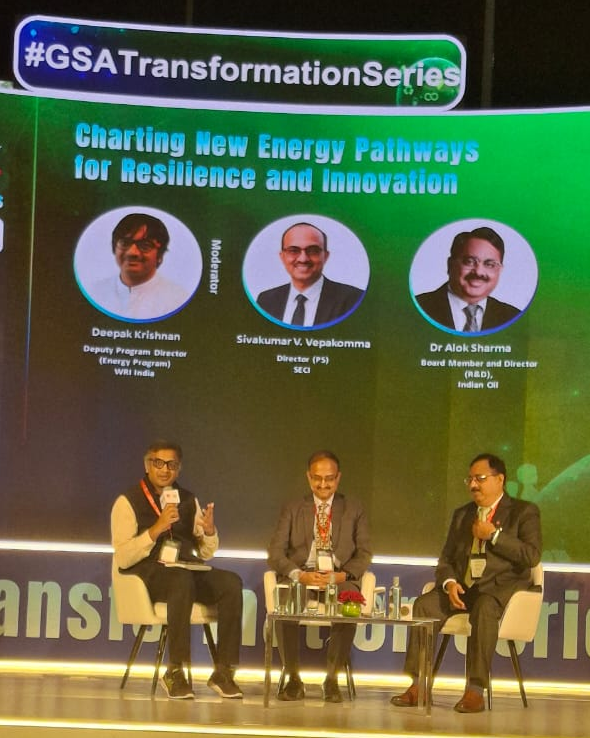
At the ET Edge #GSA Transformative Series, policy leaders and changemakers deliberate on the significant role of Corporate Social Responsibility (CSR) and India’s clean energy transition, both critical pillars in the journey towards a ‘Viksit Bharat’.
Gyaneshwar Kumar Singh, Director General & CEO, Indian Institute of Corporate Affairs, Ministry of Corporate Affairs, said that CSR should not be viewed from the prism of deficit financing. “The core purpose of CSR is to give back to society in a meaningful way,” he said. Singh said that the current allocation of CSR funds towards research and development (R&D) remains significantly low. “India must urgently reimagine CSR, channelising it into R&D etc,” he said.

Speaking on green energy transition and the emergence of biofuels in India’s sustainability roadmap. Dr Alok Sharma, Director (R&D), Indian Oil Corporation Limited (IOCL), spoke about the company’s pioneering work in developing biomass specification processes for green hydrogen production.
“Indian Oil, as the largest producer of hydrogen and ethanol, is now focusing on green hydrogen. While we explore alternative resources to reduce costs, challenges like storage and transportation remain. Alongside this, with a target of 31 GW of renewable energy by 2030, we are also expanding our extensive network of 15,000 charging stations to support India’s energy transition,” he said.
He added that Compressed Biogas (CBG) is an area where a lot of focus is required, as it provides a viable pathway to green hydrogen.
Dr Sharma touched upon India’s remarkable achievement in the ethanol blending programme. “India has successfully achieved 20 per cent ethanol blending, much ahead of schedule, which demonstrates both policy intent and industry capability,” he said.
“We are working on ethanol-to-jet fuel. Ethanol will take centre stage in the energy transformation journey,” he said.
The importance of conducive and stable policies was reinforced by Harsh Joshi, Chief Operating Officer, ONGC Green. He shared ONGC Green’s ambitious vision of achieving 10 GW of green energy capacity by 2030.
However, he advocated for robust policy frameworks to support ambitious targets.
“Structured policies are the need of the hour for all renewable energy segments,” he said, while strongly advocating for single-window clearances for solar, green hydrogen, and other renewable energy projects. Such reforms would significantly reduce project delays, improve investor confidence, and accelerate execution on the ground.