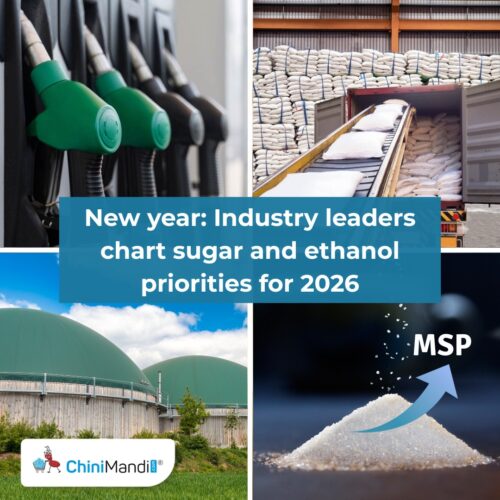
As the industry steps into 2026, industry leaders are looking ahead with a mix of optimism and strategic focus. From calls for a hike in the minimum selling price of sugar and revisions in ethanol procurement prices to demands for additional sugar export quotas, the year promises significant policy and market developments. Industry is also keeping a close eye on export parity scenarios, while initiatives such as trials for 20% ethanol in marine fuels and exploring biogas opportunities signal a transformative path for the sector. With these priorities on the agenda, stakeholders are keenly shaping the roadmap for growth, sustainability, and enhanced competitiveness in the year ahead.
ChiniMandi spoke with leading voices across the sugar and ethanol industry to capture their expectations and priorities for 2026. They shared insights on sugar pricing, ethanol procurement, export opportunities, and emerging initiatives such as marine fuel ethanol trials and biogas projects. Their perspectives highlight both the challenges and opportunities the sector faces in pursuing growth, sustainability, and competitiveness.

Calls to raise sugar MSP

Speaking on the demand to hike the minimum selling price (MSP) of sugar, Prakash Naiknavare, Managing Director of The National Federation of Cooperative Sugar Factories (NFCSF), said, “It has been ages since the industry has been seeking rise in sugar MSP based on following logically justifying reasons. 1) As per the provision in notification on sugar MSP, time to time review with rise in cane price is required. Cane price gone up by 26% while linkage of sugar MSP hasn’t happened. 2) Market, consumers, producers have accepted ex mill price of ₹40+/kg for the last two years. 3) There’s no adverse impact on inflation or consumer price index.”
Revision of ethanol procurement prices and allocation

On ethanol procurement prices and allocation, Deepak Ballani, Director-General at the Indian Sugar & Bio-energy Manufacturers Association (ISMA), said, “India’s sugarcane ethanol ecosystem has demonstrated its capacity, commitment, and alignment with national energy goals through significant investments and timely scale-up. What is needed now is a calibrated policy response – one that aligns ethanol procurement prices with rising cane costs and parity in ethanol allocation to sugarcane feedstock. With fair pricing, equitable allocations, and a clear roadmap beyond E20, the sector can fully utilise its installed capacity, ensure timely payments to farmers, stabilise sugar markets, and continue contributing meaningfully to India’s energy security and rural prosperity.”
Demand for additional sugar export quotas

The sugar industry has also called for additional export quotas. G.K. Sood, Independent Director at JK India eAgriTech Ltd. and Chairman of K N Agri Resources Ltd. and MEIR Commodities Ltd., said, “The sugar industry has rightly demanded permission to export another 5 lakh tonnes of sugar, over the 15 lakh tonnes already permitted. Reports suggest that mills have already contracted 2 lakh tonnes for exports, of which nearly half the quantity is expected to be shipped by the end of December 2025. There was a widespread comment that the export quota given as early as November was futile, given the low global prices. To these doubters, my answer is, firstly, price cycles of a commodity should not inform the policy. If the supply-demand balance sheet permits exports, the policy should permit it. Secondly, it is the function of the markets to resolve distortions, such as surpluses or shortages, which are transmitted through price signals to producers and consumers. The $ 30/MT increase in the nearby month futures price in the last two months is one such market action.”
He added, “The current year’s sugar SnD permits 20 lakh tonnes of exports. It should be allowed. Better still, we should have sugar exports on OGL as the design of the sugar industry is of perennial surplus, barring years of drought. In such years, an export quota system may be introduced, with a minimum quota of 5 lakh tonnes. I have a word of advice for mills here, do not be greedy in asking for a premium for exports over domestic prices. You lost 2 lakh metric tonnes of export sales last year due to greed. You are again doing it. Please work toward realising the full potential of exports. The export quota is just about 5% of sugar output. If the export quota is fully utilised, it will keep even domestic price for over 95% of the sugar you have to sell in the domestic market, stable, contributing to your profitability.”
Export parity and market scenario

Speaking on sugar export parity and scenario, Michael McDougall, Managing Director, Paragon Global Markets, LLC said, “As of close Friday, the #11 sugar market is down 21.24% (19.26-15.17). This is the worst yearly performance since 2017, when the market fell 25.42%. Consumers are rejoicing this year, but then again the commercial gross long as shown by the commitment of trader’s position, has been trending higher for the last five years, so perhaps they aren’t rejoicing so much.”
“But let’s look forward toward 2026. The year after 2017, the market fell 18.325% in 2018, so will we see a repeat? An 18% drop would take us down to 12.40, but some have been talking 10 cents since the Brazilian sugar dinner in October. I’m not sure of their rational, as the last time we fell to 10 cents (and below), we were in the midst of a global pandemic which had crude oil prices falling into negative territory. I dare say costs of sugar production have risen since 2020. Interest rates have gone from 0.25 to 3.75% A significant increase. No, the drop in 2017 and 2018 was because global supply demand showed a surplus of 8.2 MMT. This year we have a surplus of around 2.5MMT and 26/27 is so far looking slightly less than that at around 2.2 MMT. It could be less if the sugar mix in Brazil falls from this year’s 51.12%. In addition, EU+UK production area could drop for the second year in a row, and cane farmers in Thailand could lower cane area and switch to cassava, due to more attractive prices. One wildcard that could show up in the second half of 2026 is a return of El Nino,” he further added.
He highlighted that the one exception to potentially falling production is India who should have a larger crop due to increased cane area. This could mean an increase in Indian exports for the 26/27 season on top of the current 25/26 season of 1.5 MMT. Then again exports for this season could be increased between 500 to 1.0 MMT as the crop is confirmed. The problem that Indian mills have is being able to export their sugar given the current low international prices vis-a-vi with Indian internal sugar prices. The current breakeven looking at the price in raw terms is 18.55, or a 22% premium to current New York prices. However, if we look at Low Quality Whites, (LQW) the breakeven price is $418 a ton. That is getting competitive with Brazilian 150 ICUMSA sugar in consuming countries close to India, like Afghanistan, and Sri Lanka. If international prices rally further, then Eastern African market come into view as well. Will this export availability slow or curb the market rise? That might depend on weather in Brazil over the next three months. If rainfall is below normal, that could compromise to some degree Brazil’s upcoming 26/27 crop. In that case Indian’s exports might be welcomed.
Emerging opportunities in ethanol and biogas
Recently, the West Indian Sugar Mills Association (WISMA) has recommended initiating trials for 20% ethanol in marine fuels. It stated that these emerging applications could conservatively absorb 40-50 crore litres of ethanol and lay the groundwork for broader adoption in shipping sectors.

Atul Mulay, President of Praj Industries Ltd., said, “India’s ethanol blending programme has demonstrated how clear policy direction, domestic feedstock, and indigenous technology can come together at scale. The next logical step is to build on this success and extend a similar framework to the diesel segment. Clean, alcohol-based fuels suited for diesel and marine applications can enable meaningful emission reductions while leveraging existing agricultural strengths. Initiating structured trials—especially in diesel blending and marine sector—will be critical to establishing performance, safety, and standards, and to creating a credible pathway for cleaner fuels in India’s diesel ecosystem.”

Anilraj Pise, Managing Director of Raj Process Equipments and Systems Pvt Ltd., highlighted biogas opportunities for the sugar sector. He said, “The sugar industry is no longer limited to the production of sugar alone. Over the years, it has developed into an integrated agro-industrial sector producing sugar, ethanol, power, and various by-products. With increasing focus on sustainability, waste management, and renewable energy, the sugar sector has significant opportunities in the field of biogas and allied value-added products. One of the major by-products generated in sugar complexes is spent wash, which is produced in distilleries during ethanol manufacturing. Spent wash contains a high organic load and, if discharged without proper treatment, can cause serious environmental pollution. Anaerobic digestion of spent wash provides an effective solution by converting the organic matter into compressed biogas (Bio-CNG). Bio-CNG is a clean and sustainable alternative fuel, especially for transportation, and contributes to reducing dependence on conventional fossil fuels.”
He added that apart from CBG, the residue left after biogas generation from spent wash still contains valuable nutrients, particularly potassium. The potash present in spent wash can be effectively recovered after biomethanation. During the biomethanation process, organic matter in spent wash is converted into biogas, while the mineral nutrients, especially potassium, remain in the digested spent wash. This biomethanated spent wash can then be concentrated and processed using a spent wash dryer. Through controlled drying, the liquid residue is converted into a powder form, commonly known as PDM potash fertilizer. This powdered product is easy to handle, store, and transport, and can be directly used in agriculture as a potassium-rich fertilizer. This process not only ensures complete utilization of spent wash but also converts a waste stream into a value-added agricultural input.
“Another important by-product of the sugar industry is press mud, obtained during the clarification of sugarcane juice. Press mud is rich in organic matter, calcium, and micronutrients. Instead of disposing of it as waste, press mud can be effectively utilized for the production of organic fertilizers such as FOM (Fermented Organic Manure) and LFOM (Liquid Fermented Organic Manure). These products are increasingly preferred by farmers due to their benefits to soil health and crop productivity, ” he further stated.
Pise noted that the combined utilization of spent wash and press mud helps the sugar industry move towards a circular economy, where waste generated at one stage is reused as a resource at another stage. Energy is recovered in the form of CBG, nutrients are recycled as fertilizers, and environmental pollution is significantly reduced. This integrated approach improves resource efficiency and ensures better compliance with environmental regulations.
In conclusion, the sugar sector has strong opportunities to enhance sustainability and profitability through the production of CBG, PDM potash fertilizer, FOM, and LFOM from spent wash and press mud. By adopting this waste-to-wealth model, sugar mills can generate additional income, support agriculture, and contribute positively to environmental protection and circular economy principles. Raj Process provides a one-stop solution for all requirements related to biogas, Bio-CNG, spent wash treatment, and value-added fertilizer generation.