The long-term sustainability of India’s sugar industry will not be determined by capacity additions, policy cycles, or short-term price movements alone. It will be shaped by something far more fundamental: the productivity of our farmers and the quality of cane they produce. These two factors form the economic and operational foundation of the sector, influencing recovery rates, cost structures, feedstock availability for ethanol, and ultimately, farmer livelihoods.
As an industry, we are operating in an environment of limited land availability, increasing climate volatility, and rising input costs. In such a context, productivity-led growth is no longer optional, it is imperative. The future will belong to those ecosystems that can consistently deliver higher yields per hectare and improved cane quality, year after year.

Productivity and quality: Inseparable outcomes
Farmer productivity and cane quality must be viewed as interlinked objectives. Higher yields without commensurate improvement in quality do little to enhance industry economics, just as high sucrose content cannot compensate for unstable or declining farm output. A sustainable sugar industry requires healthy crops, optimal maturity, disease resistance, and predictable recovery levels.
Over the past decade, India has experienced both the benefits and the risks of productivity gains driven by varietal concentration. The widespread adoption of Co 0238 delivered a significant improvement in yields and recovery, particularly in Uttar Pradesh. Over time, however, the variety has shown increased susceptibility to diseases such as red rot, and excessive dependence on a single genotype has highlighted the vulnerabilities associated with genetic uniformity.
This experience reinforces an important reality: no single variety can perform optimally across regions, seasons, and evolving climatic conditions. A diversified varietal portfolio, supported by disciplined crop management practices, is essential to maintaining cane quality and mitigating systemic risk.
Policy support has created momentum
Government initiatives have provided meaningful direction to the sector. The Ethanol Blended Petrol (EBP) programme has reinforced the importance of feedstock availability and on-farm productivity, while also strengthening the economic linkage between agriculture and clean energy. Parallel emphasis on digital agriculture, climate-resilient crops, and data-driven advisories reflects a growing recognition that the next phase of agricultural transformation must be technology-enabled.
However, policy frameworks can only be effective when complemented by consistent execution on the ground. This is where industry participation through research collaboration, farmer engagement, and technology deployment becomes critical.
Triveni’s approach: integrating genetics, agronomy, and technology
At Triveni Engineering & Industries Ltd., our sugarcane development strategy is anchored in a long-term view of farmer prosperity and operational resilience. We have focused on varietal substitution, particularly in low-lying and disease-prone areas, replacing ageing and vulnerable plantations with more resilient alternatives. This effort is supported by close collaboration with research institutions such as the Sugarcane Breeding Institute, Coimbatore, aimed at accelerating new seed development and strengthening the industry’s response to evolving disease and pest challenges.
Alongside genetics, we have maintained a sustained focus on agronomic improvement, covering planting techniques, ratoon management, crop protection, and harvesting practices. Extensive demonstration plots across our command areas enable farmers to observe tangible improvements in yield and cane quality, facilitating faster and more confident adoption of best practices.
Technology has increasingly become a critical enabler in this journey. We have deployed AI/ML- and IoT-enabled systems to provide real-time insights on weather conditions, crop health, and disease risks, supporting more timely and informed decision-making. Drone-based surveillance and precision spraying allow for targeted crop protection interventions, improving effectiveness while reducing input costs and environmental impact.
These initiatives are complemented by digital farmer engagement platforms, such as the Triveni Cane App, which provide continuous access to advisories, operational information, and support services. Designed for ease of use, these platforms help bridge information gaps and ensure that agronomic guidance reaches farmers when it is most relevant.
Strengthening the foundation for the future
Ultimately, the sustainability of India’s sugar industry will be shaped by how effectively productivity and cane quality are addressed at the source. This requires sustained attention to varietal innovation, agronomic discipline, and the thoughtful application of technology, supported by strong partnerships between farmers, industry, and research institutions.
At Triveni, we remain committed to reinforcing this farm-level foundation, recognising that a resilient, competitive, and future-ready sugar ecosystem can only be built on the strength of its farmers.
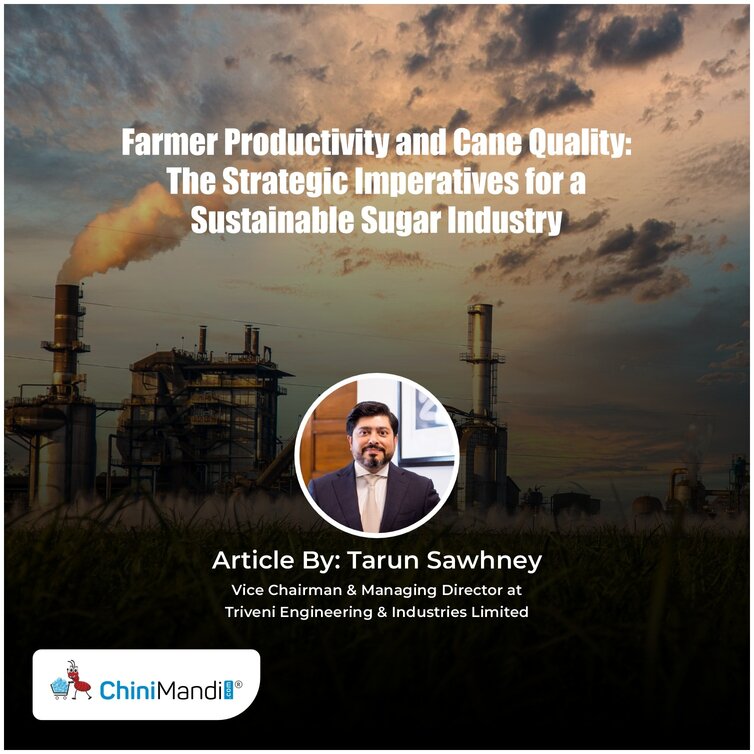
Mr. Tarun Sawhney is the Vice Chairman and Managing Director at Triveni Engineering & Industries Ltd.