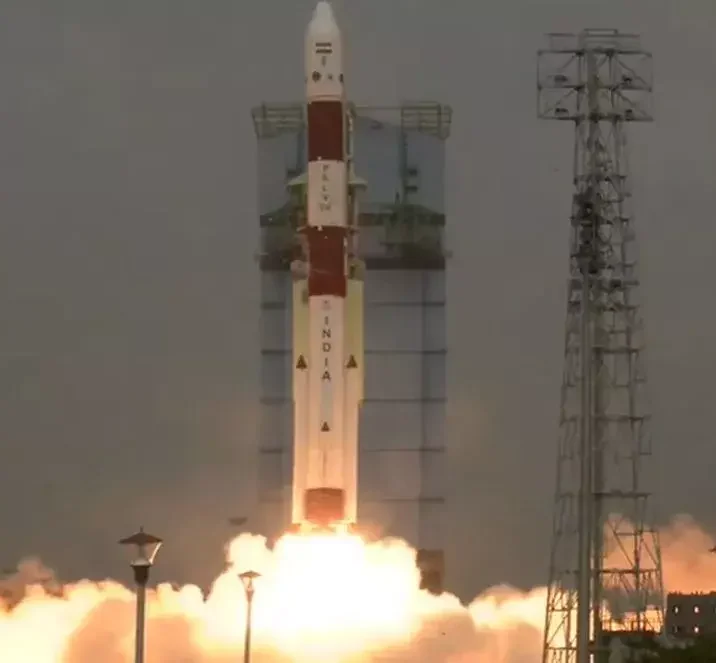
Sriharikota/Bengaluru: India’s first space mission of 2026 ended in failure on Monday after a technical problem affected the third stage of the Polar Satellite Launch Vehicle (PSLV), leading to the loss of 16 satellites and dealing a setback to a project with strategic, diplomatic and commercial importance, reports The Times of India.
The failure of the PSLV-C62 mission comes just nine months after a similar problem in the third stage of the PSLV-C61 mission, which prevented the EOS-09 satellite from reaching its intended orbit on May 18, 2025. This marks the first time the PSLV has suffered consecutive mission failures. The main payload on Monday’s flight was EOS-N1, also known as Anvesha, a Defence Research and Development Organisation (DRDO) satellite intended to strengthen India’s military observation capabilities through advanced imaging technology.

ISRO Chairman V. Narayanan said that a disturbance was noticed in the rocket’s movement towards the end of the third stage, followed by a deviation from the planned flight path. He said the data was being studied to understand what went wrong. ISRO has not yet released the failure analysis report of the earlier PSLV-C61 mission.
The 44.4-metre-tall PSLV lifted off from the first launch pad at the Satish Dhawan Space Centre at 10.18 am, about one and a half minutes later than scheduled. The launch initially proceeded as planned, but around eight minutes and forty seconds into the flight, a problem occurred between the shutdown of the third stage and the ignition of the fourth stage. Soon after, ISRO confirmed that the mission had failed.
Apart from EOS-N1, the mission carried Munal, a satellite for Nepal, and AyulSat, a technology demonstrator developed by start-up OrbitAID to test refuelling satellites in space. It also included 13 other payloads. AyulSat was meant to test fuel transfer within the satellite and later serve as a target for a second satellite planned by OrbitAID. This experiment was expected to move India closer to developing refuelling technology in space, which is currently possessed only by China.
OrbitAID founder and chief executive Sakthikumar R said the failure means the company will now have to launch both the target and chaser satellites together. He said the company hopes to attempt this later in the year.
The rocket also carried satellites from the United Kingdom, Brazil, Thailand and Spain, along with payloads developed by Indian start-ups. These were meant to demonstrate technologies such as processing data in space, communication systems, internet-based services, radiation measurement, agricultural data collection and a capsule designed to return to Earth after the rocket’s final stage was restarted and brought down.
This marks the third launch setback for ISRO since January 2025. Earlier, the GSLV-F15 mission failed to place the NVS-02 navigation satellite into its planned orbit due to a problem in its propulsion system.