The European Commission’s decision to safeguard sensitive agricultural sectors such as ethanol and sugar against additional tariff removal in the EU-India trade deal sends a clear signal about the strategic importance of domestic renewable ethanol production, according to the European renewable ethanol association (ePURE).
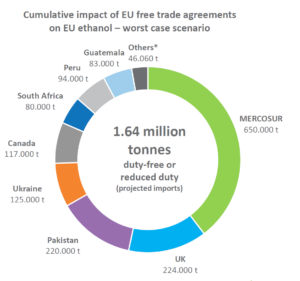
In a press release, the ethanol body stated that this important message should also have been sent in the recently agreed EU-Mercosur deal, which instead will allow a total volume of 650,000 tonnes of ethanol to be imported into the EU at a reduced duty (200,000 tonnes all uses) and completely duty-free (450,000 tonnes chemical uses).
“Let’s hope the EU-India deal is a sign that in future free-trade agreements the EU will not continue to give up its markets on sensitive sectors like ethanol,” it added.
Recently, in an interview with ChiniMandi, Abinash Verma, Ethanol Expert, ex-bureaucrat, Former DG ISMA and Promoter Shareholder of Grain-based ethanol plant, said that ethanol should be included in the EU’s zero-duty import list. This would help absorb excess ethanol production and create a steady market for producers.
Prime Minister Narendra Modi, European Commission President Ursula von der Leyen and European Council President Antonio Costa, on Tuesday jointly announced the conclusion of the India-European Union Free Trade Agreement (India-EU FTA) at the 16th India-EU Summit, held during the visit of the European leaders to India. The documents on the FTA conclusion were exchanged between EU Trade Commissioner Maros Sefcovic and Union Commerce Minister Piyush Goyal. This announcement marks a historic milestone in India-EU economic relations and trade engagement with key global partners.