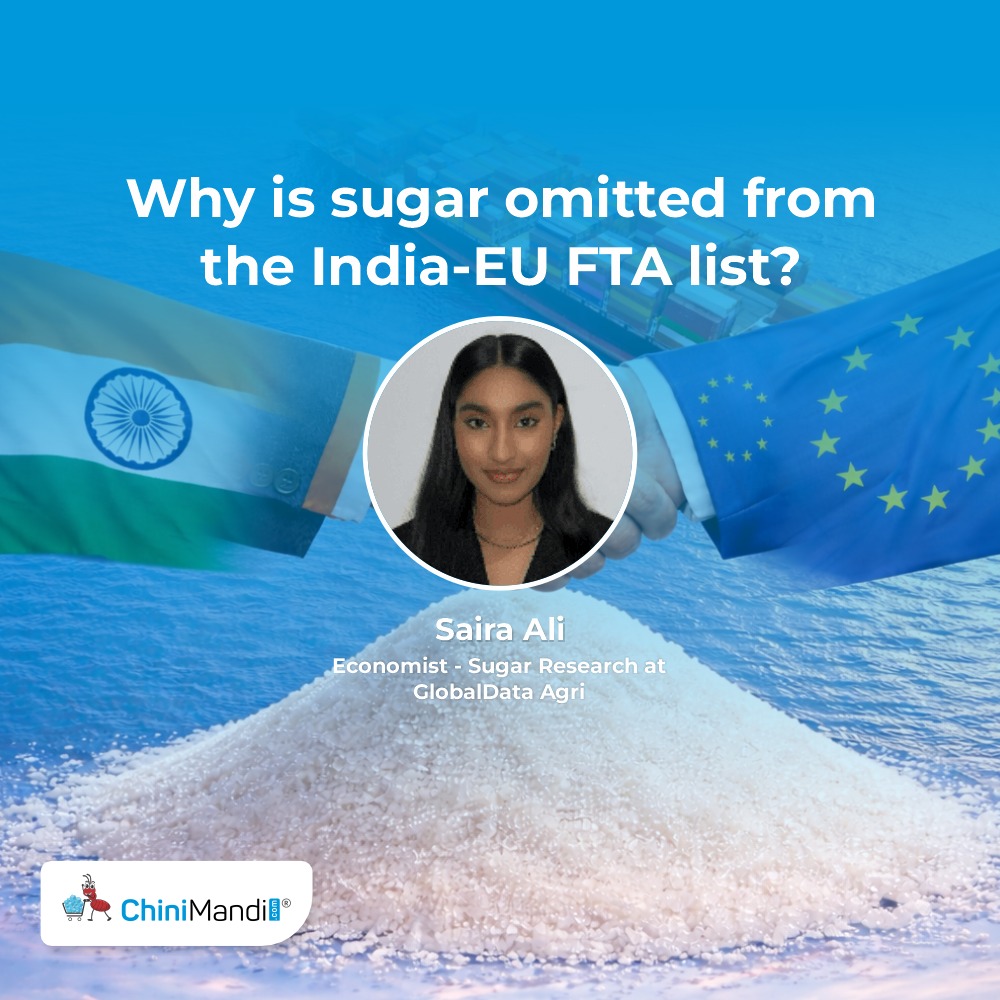
The India-EU FTA was signed last week. Saira Ali, an Economist within sugar research at GlobalData Agri, feels that, given the prevailing lower sugar prices in Europe, sugar will remain excluded from the list, as opening up the market for Indian sugar would be challenging for the EU market, as it would place additional pressure on domestic prices and producer margins.
How much sugar is Europe expected to import in 2026? And how will it change the dynamics of the global sugar trade?
We currently estimate a net import requirement of ~2.5 million tonnes for the EU+UK in 2026-27. This is driven by an expected 5-10% reduction in beet area, combined with flat consumption growth, minimum export assumptions of around 0.8 million tonnes, and a drawdown of stocks back towards historical averages.
At this level, EU+UK import demand is close to using up available duty-free supplies of around 2.4 million tonnes; therefore, CXL sugar (concessional sugar to the EU) may be required to balance the market, particularly if exports exceed minimum levels.
What is the price outlook in the major markets of Europe?
Domestic prices remain broadly unchanged from December, trading at around €400/ tonne, EXW beet belt. This places prices much closer to export parity, estimated at €335-340/ tonne, EXW beet belt, than to duty-free import parity, which is closer to €485/ tonne, EXW beet belt.
Despite many European processors announcing ambitious area reductions for 2026-27, the market has so far shown little upside response, suggesting that abundant global supplies in the near term are still driving price dynamics.
India vs Europe: How do the dynamics work in 2026?
India typically fully utilises its CXL quota of just under 6k tonnes of organic sugar into the EU+UK; beyond this quota, additional Indian sugar flows are unlikely under current trade agreements.
How does the EU- India FTA agreement alter the trading between the two blocs? Though food commodities are excluded from the list, do you think the development signals an easing of tariffs and trade in the future, vis-a-vis sugar and other soft commodities?
Soft commodities such as sugar remain highly sensitive within EU agricultural policy, particularly in the current market environment. European sugar prices have reached all-time lows, and processors have been pushing for significant beet area reductions for the 2026-27 season to help stabilise the market.
In this context, granting duty-free access to additional volumes of Indian sugar would be challenging for the EU market, as it would place additional pressure on domestic prices and producer margins.
The debate around agricultural concessions in other trade negotiations, such as EU–Mercosur, illustrates how cautious the sector remains. As a result, the EU–India FTA is more likely to deepen trade in areas where trade interests are more closely aligned than to signal near-term tariff liberalisation for sugar or other soft commodities.