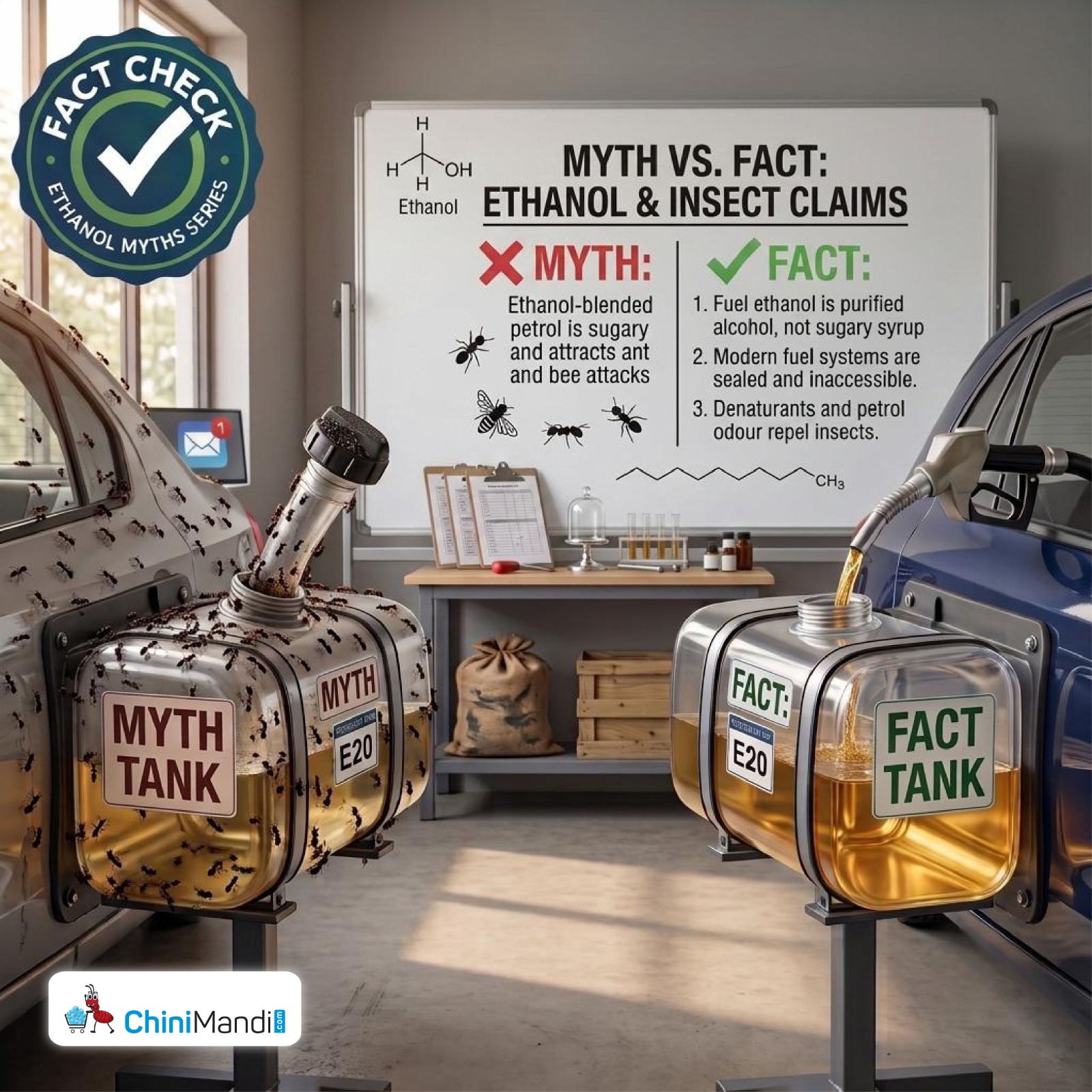
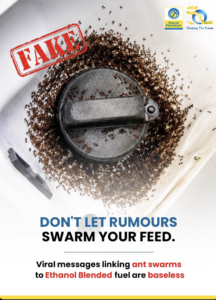
One of the most recent purported wrong claims going viral on social media is about bee and ant attacks on engines filled with ethanol-blended petrol. The erroneous social media handles are casting aspersions on the ‘sugar’ content of this green fuel, as it’s derived from molasses and grain-based feedstocks.
However, this is absolutely untrue and a manufactured lie intended to sow doubt among customers.

The idea that ants attack ethanol-powered or ethanol-fuelled vehicles is a common myth, but there is no scientific evidence that ethanol-blended petrol (such as E10, E20, or E85) attracts ants or causes ant infestations.
- Fuel ethanol is not sugar. The ethanol used in automotive fuel is highly purified alcohol, not sugary syrup. It contains no sucrose or glucose that would attract ants.
- Petrol dominates the fuel composition. In an E20 fuel, 80% is petrol and 20% is ethanol. Petrol has a strong hydrocarbon odour that is generally not attractive to insects.
- Fuel systems are sealed. Modern vehicles have closed fuel tanks, fuel lines, and injection systems. Ants cannot access the fuel under normal conditions.
- No evidence from large-scale use. Countries such as Brazil (using E27-E30 and even E100), the United States (E10, E15, E85), and India (E20) have millions of ethanol-compatible vehicles on the road. If ethanol attracted ants, it would be a widespread and well-documented engineering issue, which it is not.
Reacting to a viral social media post of an ant colony surrounding an automobile tank, the Government-owned oil company, Bharat Petroleum Corporation Limited, said that the fuel-grade ethanol used for petrol blending is produced through fermentation and distillation processes that eliminate residual sugars from the final product.
Further, fuel ethanol contains denaturants, which are repellent to insects. Upon blending, the characteristic hydrocarbon odour of petrol remains dominant over any inherent ethanol odour.
In addition, ethanol-blended petrol exhibits lower fuel vapour formation compared to conventional petrol. As a result, there is no identifiable attractant associated with E20 fuel that would cause ants or other insects to congregate around vehicle fuel caps.
Therefore, claims suggesting a link between E20 fuel and ant attraction have no scientific basis.
The Government, in a PIB release recently, also debunked the myth categorically, quoting BPCL’s clarification.
The Ethanol Blending Programme is the future of this country, as it would safeguard energy production indigenously and replace the harmful and costly crude imports. It shouldn’t be made a victim of a few vested interests, and should be seen from the prism of the country’s welfare.