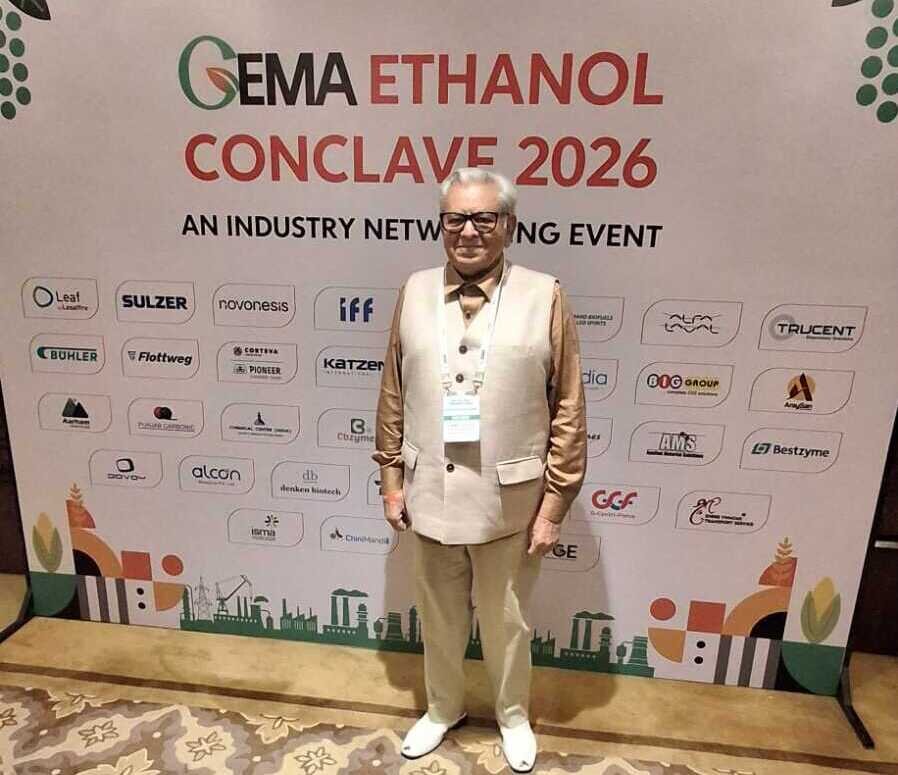
Dr C K Jain, President, Grain Ethanol Manufacturers Association (GEMA), said that there have been extensive tests done on vehicles which showed no damage. He said this is the biggest scientific validation in favour of the programme.
Q. How is GEMA countering the negative social media campaign against the Ethanol Blending Programme (EBP)?

As an industry association, we are making concerted efforts to counter the misinformation being spread through these social media posts that seek to malign the Ethanol Blending Programme (EBP).
Unfortunately, negative content spreads much faster than positive news. That is why we have to work twice as hard to ensure that facts reach the public. We are engaging with the media through interviews, writing articles, and actively using social media platforms to present scientifically validated facts and correct misconceptions.
It is difficult to understand what some influencers hope to achieve by spreading misinformation. False narratives may gain temporary attention, but facts ultimately prevail.
India does not have abundant crude oil reserves and remains heavily dependent on imports. Increasing ethanol blending is a national priority aimed at strengthening energy security and achieving Atmanirbhar Bharat. The programme has already helped save valuable foreign exchange while creating additional income opportunities for farmers.
As far as vehicle performance is concerned, modern vehicles are operating efficiently on ethanol-blended petrol. General maintenance issues or routine wear and tear cannot be attributed to ethanol fuel alone. Vehicle mileage depends on several factors, including driving habits, vehicle maintenance, road conditions, and traffic.
Q. Is India’s existing vehicle fleet compatible with E20 fuel?
Yes. The existing vehicle fleet is E20 compatible. Scientific validation of E20 compatibility began as early as 2014.
Extensive trials were conducted on BS-II and BS-III vehicles by leading institutions such as the Automotive Research Association of India (ARAI) and the Society of Indian Automobile Manufacturers (SIAM) between 2014 and 2018. These tests confirmed that E20 fuel can be safely used without any significant technical issues. There is no stronger validation than rigorous scientific testing conducted by the country’s premier automotive research institutions.
Q. There is a proposal to introduce retrofit Flex Fuel Vehicle (FFV) kits. Can you explain how this will work?
GEMA has submitted a proposal to ARAI regarding retrofit Flex Fuel Vehicle (FFV) kits. Similar technologies are already being used successfully in several countries.
The proposal is currently under evaluation. Once approved, these kits would enable existing petrol vehicles to operate as flex-fuel vehicles, allowing consumers to use different blends of petrol and ethanol depending on availability and price.
Such a policy would offer greater flexibility and economic benefits to consumers. However, it is important to recognise that policy formulation, testing, certification, and implementation take time. These processes cannot be completed overnight.
Q. What are the two most important measures needed to increase ethanol demand in India?
The Government has demonstrated a strong commitment to expanding ethanol use as part of its strategy to reduce crude oil imports and strengthen India’s energy security.
The Bureau of Indian Standards (BIS) has recently notified fuel specifications for higher ethanol blends, including E22, E25, E27 and E30 petrol. This signifies how the Government is serious about introducing higher blends. These guidelines lay the technical framework for E22, E25, E27, and E30 fuel blends, paving the way for the country’s next phase of biofuel expansion