
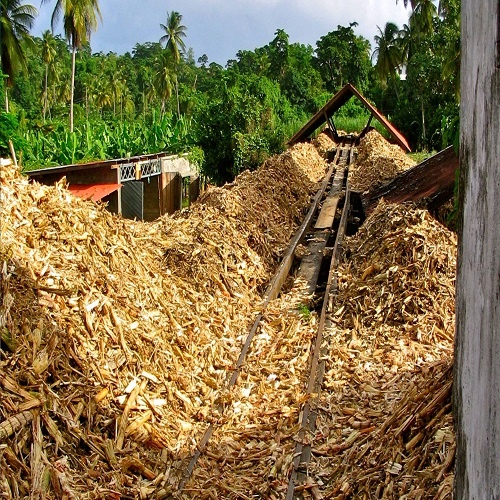
Sugarcane bagasse, a fibrous residue generated during sugar processing, could find another value-added application in the construction sector as its ash is being studied as a partial substitute for cement in concrete, The Economic Times reported.
Bagasse is commonly used as a fuel in sugar mills to generate heat and electricity. Burning the residue produces sugarcane bagasse ash (SCBA), which contains silica and other compounds that can contribute to cementitious reactions.

A 2021 review paper, Utilization of Sugarcane Bagasse Ash as Cement Replacement for the Production of Sustainable Concrete, examined two decades of research on SCBA. The researchers found that properly processed ash can contain significant quantities of reactive silica and can chemically interact with cement, potentially maintaining or improving the strength of concrete in some formulations.
The potential application is significant because cement production has a substantial environmental footprint. The International Energy Agency estimates that the cement sector accounts for about 7% of global CO₂ emissions, making the development of lower-carbon alternatives an important area of research.
Research points to optimum replacement levels
Studies, however, indicate that the performance of SCBA depends heavily on its processing and the concrete mix.
A 2022 study published in Scientific Reports found that a concrete mix containing 20% bagasse ash matched or exceeded the compressive strength of the conventional control mix under the conditions tested.
Another 2022 study, published in the Civil Engineering Journal, examined SCBA and silica-fume blends with cement replacement levels ranging from 10% to 40%. The researchers found that the 10% replacement mix delivered the highest mechanical strength among the tested formulations. Strength declined as the proportion of SCBA increased, while workability also became more difficult at higher replacement levels.
The findings suggest that there is no single universally applicable replacement percentage. Factors such as ash quality, particle size, processing method and concrete mix design can significantly influence performance.
Processing and supply remain challenges
Despite its potential, SCBA is not a ready-to-use cement replacement. The ash generally needs controlled processing and fine grinding to achieve consistent performance.
Supply-chain limitations are another challenge, particularly in the United States. Unlike established supplementary cementitious materials such as fly ash and slag, there is no comparable large-scale system for collecting and processing sugarcane bagasse ash.
Sugarcane production in the US is concentrated largely in Louisiana and Florida, with smaller production in Texas. Researchers, including teams at Louisiana State University, have examined SCBA for potential applications in transportation infrastructure.
For sugar mills, wider adoption could provide an additional outlet for a by-product that is already generated through bagasse combustion.
While SCBA is unlikely to eliminate concrete’s carbon footprint, research indicates that using processed sugarcane bagasse ash to replace a portion of cement could contribute to lower-carbon concrete while creating additional value from sugar industry residues.















