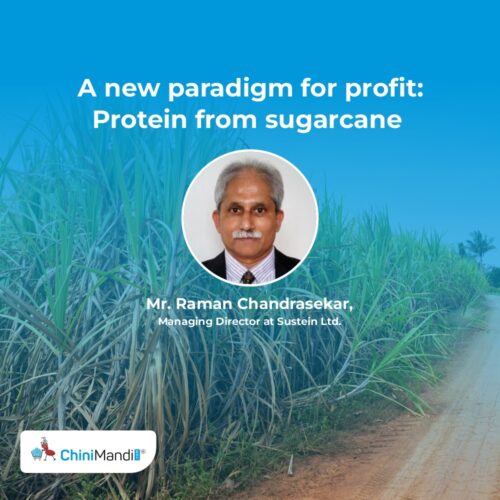
In a candid discussion with ChiniMandi, Raman Chandrasekar, Managing Director at Sustein Ltd., talked about how sugarcane-to-protein could be an important value addition for the sugar industry, resulting in much higher revenues compared to ethanol production.
He explained that well-proven commercial hyperscale biotechnology platforms for mycoprotein production would be viable and profitable pathways to greater independence for the industry and farmers. This would also become the foundation for a Bioeconomy fit for the 21st Century.

Q. How can we increase value addition in the sugar industry?
A. The greatest priority would be to maximise the value derived from sugar and its upstream stages. The Indian sugar industry has achieved great success in helping India’s first-generation biofuels mission. Our valuable feedstock could be even more profitably utilised by diversifying into higher value products, in addition to bioethanol.
The first higher value product from utilising sugar or sugarcane juice is Mycoprotein, a whole food. It is a whole biomass, high quality, complete protein. It is very versatile and suitable for nutritious meals, snacks, beverages, and even desserts. These minimally processed products appeal to vegans, vegetarians, and meat-lovers alike. Some formats can be shipped B2B without a cold chain, at ambient temperatures, even in India. Thus, the unmet protein-gap in India could be bridged at “India Scale, and India Price”.
Mycoprotein biomass is in itself a profitable product from the same feedstock, generating at least thrice the revenue compared to ethanol. Thus liberated from dependence on government, other biotechnology platforms are wide open, including all of Synthetic Biology.
Present policies tend to distort incentives that really matter for long-term sustainability. Burning bagasse for cogeneration works well because of energy price arbitrage, but this removes organic matter from the soil.
Collecting agri-residues such as paddy stubble is expensive, so burning happens, and it is in no way sustainable.
Q. Please explain the sugarcane-to-Protein concept? What are we aiming to achieve?
A. Sugarcane juice and sugar are very valuable resources. They are produced at great cost (water, fertiliser, labour, etc.) and even greater Opportunity Cost (not growing pulses).
First-Generation Ethanol (1G Ethanol, from subsidised food crops) is the default option in India only because of the mandate for blending in petrol. From the same feedstock (sugarcane juice), we ought to make mycoprotein for feeding India. Mycoprotein biotechnology platforms are proven at commercial hyperscale in the UK, USA, and now in Switzerland too.
Q. What policy bottlenecks are there in achieving sugarcane to protein?
A. We have the Ethanol Blending mandate, which is a priority for the Government, considering the benefits of reducing dependence on petrol, environmental benefits etc.
However, that’s proving to be a disincentive for the sugar-to-protein route and greater value addition. Sadly, the industry continues to depend on price support and subsidies, and tariff protections.
Q. How do you define commercially viable sustainability in agri and food value chains?
A. Any value chain that is not dependent on mandates, subsidies, and tariff protections will guarantee that it is commercially viable for the producers.
Q. What are the biggest misconceptions around sustainable agri-inputs and farmers and investors?
A. I feel that the biggest misconception is the fact that all such initiatives aimed at sustainability and moving up the value chain have to be supported by government policy!
Q. Can sustainability-led agri businesses scale in India without policy support?
A. Of course, that can happen. We need to liberate Indian agriculture from Government control and support. We could, over the next ten years, gradually phase down all subsidies, mandates, and tariff protections. This is the way to unleash the power of innovation at “India Scale, India Price”.
Q. Are India’s sustainability and climate policies aligned with on-ground agri realities, or are they still urban-centric?
A. Sadly, most policies are still urban-centric. Even the rural voices tend to adopt an urban accent. It should be decentralised.
Q. How can AI and other technologies speed up agri-sustainability?
A. Several innovations are happening already, but on a limited scale and are at an early stage. We need real-time, data-driven precision technologies (weather, pests, markets) to manage the entire value chain. If we gradually eliminate the perverse, price-distorting policies (even the well-intentioned ones), we will see forward-looking cultivation rather than merely tracking MSP, etc.