

In an editorial written by Atul Mulay, President and Global SBU Head – Bio Energy at Praj Industries Limited, and Member & Chairman of the Bio-Economy Committee at the Indian Federation of Green Energy (IFGE), titled “Fueling a new future: How biofuels can revitalise rural India and ease urban strain” on The Hindu Business Line, he said that the migration of people from rural to urban cities in search of jobs and livelihood has presented itself as the most persistent development challenge in the country. The key to unlocking the phenomenon is strategically vital for achieving balanced national growth, wherein both rural and urban centres register equal growth.
“For generations, a familiar story has played out: young people leave their villages for cities, driven by the hope of better livelihoods. This migration is primarily triggered by unstable agricultural incomes and limited local employment, reinforcing the belief that opportunity exists only in urban centres,” Mulay stated.

He argues that ‘Bioenergy proliferation’ offers a powerful opportunity to rewrite this narrative.
“By enabling a decentralised rural economy, a robust biofuels sector can directly address the economic “push” driving migration. It provides a practical pathway to build prosperity within villages. This is equally critical for cities, where unchecked migration has pushed infrastructure and resources to breaking point, creating consequences that demand urgent solutions,” Mulay talked about this much needed reform in the Editorial.
The real cost of overcrowded cities
Mulay said that a report by Primus Globus Beyond Urban Missions, India Needs a New Generation of Cities highlights the scale of the problem:
Productivity losses: Metropolitan regions lose over $6 billion annually due to traffic congestion.
Public health crisis: In Delhi, air pollution causes more than 11,000 premature deaths each year.
Housing strain: 42% of Mumbai’s population lives in slums and informal settlements.
Unsustainable growth: India’s urban population is growing at 30 people per minute, placing enormous pressure on a handful of major cities.
Mulay said that this model of concentrated urban growth is unsustainable. The data points to a clear vulnerability, one that cannot be solved by urban expansion alone. Addressing the root causes of migration by creating opportunities in rural India is essential.
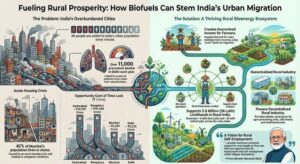
Biofuels: A guaranteed income for rural economy
Income volatility remains the strongest driver of rural distress. Stabilising farm incomes is therefore central to rural revitalisation. Mulay said that India’s biofuel policy, especially the Ethanol Blending Programme (EBP), has emerged as a critical de-risking mechanism for agriculture by creating a large, assured market for farm produce.
“The EBP links rural producers directly to national energy demand, providing farmers cultivating crops such as sugarcane and maize with assured offtake and predictable income. This shifts farming from a high-risk activity to a diversified enterprise integrated with energy production. By offering income stability, the programme directly reduces the economic pressure to migrate. This stability also sets the foundation for broader employment creation across rural communities,” he said.
A new wave of jobs In India’s heartland
Mulay said that the bioenergy sector’s impact extends far beyond farms, creating a local employment ecosystem that offers viable alternatives to migration. Jobs are generated across feedstock aggregation, logistics, plant operations, technology services, and co-product development, such as bio-fertilisers and bio-chemicals.
“Modern ethanol and Compressed Biogas (CBG) plants require skilled technicians, operators, and maintenance personnel. This demand is supported by vocational institutes and skill-based colleges that equip rural youth with industry-relevant capabilities, countering the notion that meaningful careers are available only in cities,” he said.
Mulay said that the scale is already significant. With a production capacity of 1,800 crore litres across approximately 500 plants, the bioethanol sector supports nearly 6 lakh direct and 30 lakh indirect jobs, impacting 36 lakh livelihoods across rural India. Decentralised energy further amplifies this impact by enabling local enterprises to grow.
Powering villages to fuel their own growth
Mulay said that the most transformative aspect of bioenergy lies in decentralised energy access. Locally produced biofuels now power two- and four-wheelers, tractors, trucks, generators, and static engines, helping overcome inconsistent electricity supply.
This energy security unlocks growth in agro-processing units, cold storage facilities, and small manufacturing enterprises, creating a self-sustaining cycle of local economic activity. Each enterprise strengthens village-level livelihoods, further reducing the need to migrate.
A global endorsement for a local solution
Mulay said that India’s bioenergy-led rural strategy aligns with global development priorities. The United Nations has consistently highlighted the importance of affordable, sustainable energy in strengthening rural economies and addressing drivers of migration. Yet over 666 million people globally still lack access to electricity, most of them in rural areas.
“The UN advocates decentralised renewable energy solutions for transport, cooking, and power—precisely the approach India’s bioenergy policy embodies. By enabling rural communities to generate energy, create income, and build resilience, bioenergy directly tackles the economic causes of migration while advancing climate goals,” he opines.
Fueling prosperity and vision for Viksit Bharat 2047
India’s bioenergy initiative is far more than an energy or environmental programme. It is a powerful socio-economic strategy capable of rebalancing national growth, reducing urban strain, while building prosperity in villages.
Mulay said that by addressing migration at its source, biofuels support a more distributed, resilient, and inclusive economy. As India moves toward the vision of Viksit Bharat 2047, bioenergy offers a pathway to align clean energy ambitions with rural development. In empowering villages to thrive, biofuels become more than fuel for engines—they become fuel for opportunity, stability, and a self-reliant India.
The editorial was first published in The Hindu BusinessLine