Government’s public policy think-tank, Niti Aayog, released a study report, ‘Scenarios Towards Viksit Bharat and Net Zero: An Overview’, highlighting India’s rapidly advancing clean mobility transition, driven by a national urgency to reduce reliance on oil imports, enhance energy security, and diversify the mix of transportation fuels.
The report said that central to this evolution is the expanding ecosystem surrounding ethanol, advanced biofuels, compressed biogas (CBG), and sustainable aviation fuel (SAF), all of which are positioned to play significant roles alongside electric mobility and green hydrogen.

The goal of achieving 20% ethanol blending (E20) by mid-2025, five years ahead of the initial target, highlights India’s capability to scale policy-driven supply chains and swiftly implement low-carbon fuels effectively.
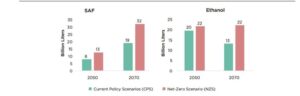
Biofuels Under Current Policies (CPS) vs. Net Zero Ambition (NZA)
The report stated that in the CPS framework, biofuels predominantly find their application in road transport. Ethanol demand is projected to peak at approximately 21 billion litres around the mid-2040s.
The uptake of SAF is gradual, mainly influenced by international aviation offset mandates. Meanwhile, CBG remains at a marginal level with limited applications in urban gas systems and specific transport uses.
Under the NZS trajectory, biofuels are expected to expand considerably; ethanol consumption is anticipated to reach around 22 billion litres by the middle of the century before stabilising. The Flex-fuel vehicles compatible with E20–E85/E100 are predicted to constitute 10% of car sales by 2050. SAF is expected to emerge as a primary growth driver, scaling up to 32 billion litres by 2070 and facilitating low-carbon aviation. CBG and other advanced biofuels will increasingly support freight logistics and municipal transport.
Collectively, these developments align with India’s objectives for energy security, industrial competitiveness, and substantial decarbonization within the transportation sector.
Biofuels in mobility system
While battery electric vehicles may dominate passenger fleets over time, flex-fuel hybrids, CBG-powered vehicles, and biofuel blends will continue to contribute to resilience and fuel diversification.
Key enablers include:
- The rapid deployment of E20 alongside expanding pathways for flex-fuel vehicles.
- A robust CBG ecosystem backed by SATAT initiatives and reforms in municipal waste management.
- Domestic research and development focused on second-generation (2G) biofuels.
- Production capacities for SAF that correspond with increasing demands in aviation.
The report mentioned that biofuels ensure that challenging sectors, particularly aviation, long-haul freight transport, and rural mobility, have access to clean alternatives that complement electrification efforts.
Role of Green Hydrogen in Mobility
Green hydrogen will be essential for sectors where batteries or biofuels do not provide optimal performance. Hydrogen fuel cell vehicles (HFCVs) are expected to enter the market after 2035, supplementing electric vehicles in heavy-duty transport. Hydrogen consumption for mobility could reach about 2 million tons by 2050 and approximately 5 million tons by 2070. Buses and heavy trucks powered by hydrogen might represent up to 20% of new vehicle sales.
In maritime applications, hydrogen derivatives like green ammonia and e-methanol could achieve production levels of 2.4 Mtoe and 7.1 Mtoe, respectively.
Niti Aayog emphasises that decarbonising India’s transportation system will depend on an integrated “Avoid–Shift–Improve” strategy:
- Avoid: Minimise private vehicle usage demand.
- Shift: Enhance public transit systems such as railways while promoting non-motorised forms of mobility.
- Improve: Utilise cleaner fuels alongside advanced drivetrains while enforcing strict efficiency standards.
Feedstock availability
The report reiterates that the swift growth of ethanol production in India has heavily relied on first-generation feedstocks:
- Maize (~50%)
- Sugarcane (~30%)
- Damaged food grains, along with various other sources
For sustainable long-term growth, there must be a managed shift towards utilising second-generation residues together with waste-based methods to alleviate pressures related to land use, water resources, or food security concerns.
NITI Aayog estimates that over 40 million tonnes of surplus food grains will be available by fiscal year 2047–48, which is enough for generating more than 16 billion litres of ethanol annually.
The report underscores the importance of Biofuels in energy self-reliance. Ethanol, CBG, other advanced options, along with SAF, are set to remain integral components within India’s clean mobility landscape over the upcoming decades when supplemented through electrification initiatives, combined green hydrogen applications/modal shifts, plus ongoing enhancements towards overall efficiencies achieved collectively.