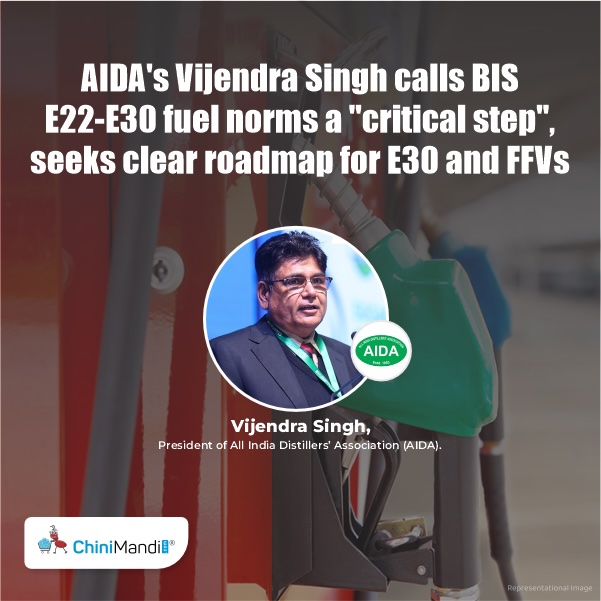
The All India Distillers’ Association President, Vijendra Singh, has unequivocally appreciated the BIS norms for E22 to E30 fuel blends, and called it a critical ‘higher blend standardisation’ step.
However, every big transformation needs a conducive Government policy to herald the change. Singh said that a clear roadmap is required for the successful adoption of E30 fuel, which will entail phased blending targets, timelines, mandates beyond E20, tax benefits on FFVs, etc.

What is the significance of BIS notifying standards for E22 to E30 fuel blends at this stage of India’s ethanol blending journey?
The notification of IS 19850:2026 (effective May 15, 2026) provides technical specifications for E22, E25, E27, and E30 blends, covering anhydrous ethanol admixture with motor gasoline, octane levels, sulphur content, vapour pressure, impurities, testing methods, and safety norms.
India achieved E20 ahead of schedule (the target was advanced to 2025 from 2030), with blending rising from ~1.5% in 2014 to 20%+. The BIS norms create a regulatory foundation for the next phase (phased move toward higher blends), enabling oil marketing companies (OMCs), automakers, and regulators to prepare.
It supports energy security, reduces crude imports, lowers emissions, and strengthens agricultural linkages amid global geopolitical uncertainties. This is not an immediate nationwide rollout of E30 but a critical higher blend standardisation step.
How will the new BIS standard IS 19850:2026 accelerate India’s transition beyond E20 blending?
The standard provides a clear technical language and quality framework for higher blends, which were previously missing.
This allows:
- Phased implementation — from E22/E25 pilots to broader E27/E30 adoption.
- Industry readiness: Automakers can calibrate/test vehicles, OMCs can plan blending infrastructure, and labs can certify fuel.
- Policy momentum: It aligns with ambitions for E25–E30 by ~2030 and supports
flex-fuel vehicles (FFVs).
- Faster scaling of domestic ethanol production (already expanded significantly) and infrastructure.
- It reduces uncertainty and builds confidence for investment in higher blends.
How prepared are Indian automobile manufacturers for higher ethanol blends such as E30?
Newer vehicles (BS-VI and later) are largely E20-compliant. Many can handle higher blends with minor calibrations (ECU tuning, materials resistant to ethanol’s hygroscopic/corrosive nature).
The prototypes for E85/FFVs have been demonstrated; SIAM and OEMs are in continuous consultation with the government on rolling out the Vehicle economically.
However, the challenges remain for older vehicles (pre-E20), which may need some for retrofits for running E-30.
Overall, the industry is moderately prepared for gradual increases but needs clear timelines and policy support for mass E30/FFV adoption.
What impact could higher ethanol blends have on vehicle mileage, engine durability and maintenance costs?
Ethanol has high octane numbers, which enhance the combustion of fuel, but it has lower energy than petrol.
The vehicles produced after 2022 are mostly suitable for a high blend of ethanol, but older vehicles may need some modification to run on higher blended petrol.
We believe that OEM will find an effective solution for the same.
The loss of mileage with a higher blend of ethanol can be offset by differential fuel pricing, which will encourage the customer to use the high blend of ethanol.
Could E22 to E30 fuel blends help India reduce crude oil imports meaningfully amid global geopolitical uncertainties?
Yes, very much possible. Each incremental % blending displaces crude-derived petrol. Moving beyond E20 could save additional substantial forex (E20 already saving a lot as OMCs are having under recovery of Rs 30 per ltr.
It reduces import dependence (India imports ~85% of crude), enhancing resilience against price spikes/geopolitical shocks (e.g., West Asia tensions).
Supports energy security and balance of payments while cutting GHG emissions.
Is India likely to face feedstock shortages if ethanol blending moves beyond E20?
I see a low risk there, which can be managed with feedstock diversification and better agriculture profits.
- Current capacity has grown rapidly (sugarcane, maize, surplus rice/grains, 2G from agri-residues).
- Maize has risen sharply as a feedstock; surplus rice allocations and 2G tech (e.g., stubble) are being pushed.
- Government policy (multi-feedstock, incentives, 2G projects) aims to avoid shortages. Experts note potential surplus capacity if blending doesn’t rise.37
No nationwide shortage is expected with proper planning.
How can higher ethanol blending support farmer incomes and rural economies?
There is a higher demand for sugarcane, maize, rice, and residues, which boosts procurement and prices for farmers (already ~₹ 70 k crore+ injected via ethanol every year.
The distilleries and supply chains create employment, giving a big boost to rural income. The blending programme turns surplus crops/residues into value (e.g., “Annadata to Urjadata”), reduces waste (stubble burning), and supports crop pattern shifts toward sustainable options like maize. This strengthens rural economies and links agriculture with energy.
What policy support will be required from the government to ensure the successful adoption of E30 fuels?
The following policies are required:
- Clear Roadmap: Phased blending targets, timelines, and mandates beyond E20.
- Incentives: Continued pricing support, interest subventions, GST benefits, and FFV purchase incentives.
- Infrastructure: Blending, storage, and distribution upgrades.
- Auto Industry: Mandates/standards for E30-compatible vehicles and FFVs.
- R&D & for diesel blending
- Consumer Awareness & Pricing: Mechanisms to mitigate mileage concerns and ensure affordability.
AIDA and industry stakeholders have been advocating for higher blending (e.g., 25%+) and FFVs to utilise capacity fully.