
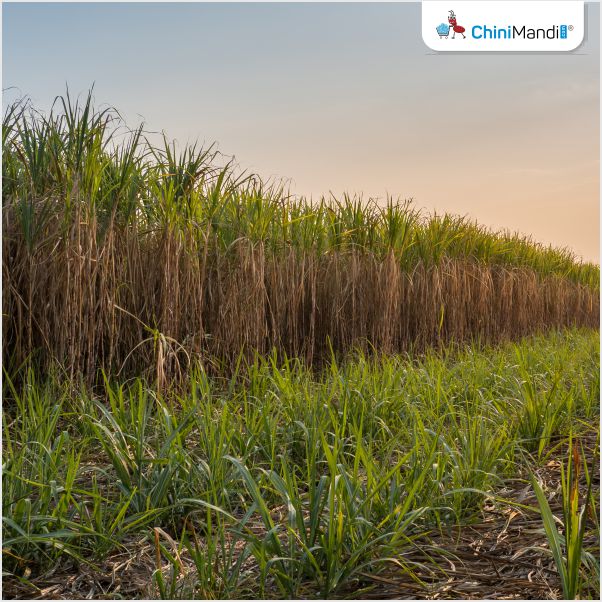
A quiet shift is taking place in the sugarcane fields of western Uttar Pradesh, where farmers are discovering new ways to improve incomes, soil health and water efficiency without reducing their main crop production.
In a sugarcane field in Meerut, a farmer carefully inspects his groundnut crop growing between rows of tall sugarcane. Just a few years ago, he had never imagined cultivating groundnut alongside sugarcane. Groundnut was traditionally associated with other parts of the state. Today, however, the crop has become an additional source of income, reflecting a broader change underway in the region, Global Agriculture reported.

The transformation has been driven by additive intercropping, a practice that allows farmers to grow a short-duration crop between the rows of a main crop without affecting its yield. The approach is being promoted through work carried out by CIMMYT-BISA and the Indian Council of Agricultural Research–Indian Institute of Farming Systems Research (ICAR-IIFSR).
Sugarcane has long dominated farming systems in western Uttar Pradesh because it is a high-income and relatively low-labour crop. It is typically grown in a cycle of plant crop, ratoon and wheat. While profitable, this system has gradually depleted soil nutrients and increased farmers’ exposure to climate-related risks.
Additive intercropping offers an alternative without requiring farmers to give up sugarcane cultivation. Since sugarcane is planted in wide rows, there is sufficient space during the early stages of crop growth to cultivate a secondary crop. Groundnut has emerged as a suitable option because it grows close to the ground, suppresses weeds, conserves soil moisture through natural mulching and adds nitrogen to the soil. The crop is harvested before the sugarcane canopy closes.
On-farm trials conducted in western Uttar Pradesh have shown that farmers can achieve up to 10 per cent higher sugarcane yields due to improved soil conditions and nitrogen enrichment from the intercrop.
Research station experiments have also demonstrated that growing wide-row crops in paired rows creates more space for field operations and fertilizer application. When combined with surface and sub-surface irrigation systems, water-use efficiency can improve by 75 to 80 per cent.
When the practice was first introduced, many farmers were uncertain. Questions centred on how to cultivate, harvest, store and market groundnut. Three years later, those concerns have largely been replaced by confidence and experience.
Farmers report noticeable improvements in soil and crop health. Many have also observed better sugarcane juice quality, which they attribute to the benefits of green manuring and mulching provided by the intercrop. As more farmers witness the results, adoption has spread rapidly across communities.
Groundnut has brought additional benefits beyond crop income. The oil extracted from the crop is of high quality, while the oil cake left after processing serves as a nutritious livestock feed, adding further value to farm households.
The impact has been particularly significant for tenant farmers. Income from groundnut can help offset land lease expenses and cultivation costs, allowing earnings from sugarcane or maize to translate more directly into profit. This has reduced financial risks for farmers cultivating rented land.
The practice is also beginning to attract younger people back to agriculture. Field experts note that the combination of dual income sources and lower production risk is making farming more appealing. Greater opportunities for innovation and improved returns are encouraging some young farmers to remain connected to agriculture rather than moving to urban areas.
The benefits extend beyond individual farms. India currently imports around 60 per cent of its edible oil requirements, making domestic oilseed production a national priority. During a recent visit to project fields in western Uttar Pradesh, Dr. M.L. Jat, Secretary of DARE and Director General of ICAR, stressed the importance of increasing oilseed cultivation through science-based and sustainable approaches to achieve self-sufficiency in edible oils.
The opportunity is considerable. Uttar Pradesh alone has nearly three million hectares under sugarcane cultivation. Even converting a portion of this area to additive intercropping with oilseeds could make a meaningful contribution to reducing import dependence.
The initiative has also received policy support. Earlier this year, the Uttar Pradesh Chief Minister described sugarcane-based additive intercropping as the future model for agriculture in the state and directed its implementation in mission mode from 2026-27 to 2030-31. Dr. Jat has set a target of bringing one million hectares of sugarcane under groundnut intercropping within a year, a goal that CIMMYT-BISA is supporting alongside ICAR.
The project aligns with the priorities of the Australian Centre for International Agricultural Research (ACIAR), which supports efforts to create more productive and sustainable agricultural systems. In India, ACIAR’s focus areas include sustainable intensification, crop diversification and groundwater management.
Researchers emphasise that achieving large-scale adoption will require strong collaboration among institutions. Farmers need access to suitable groundnut varieties, practical training on cultivation and storage, and reliable market linkages. CIMMYT-BISA and ICAR are currently working to provide these support systems.
For many farmers, the benefits are already evident in their fields. One veteran sugarcane grower summed up the change by saying that he once believed growing more crops would create more complications. Now, he sees it differently. More crops, he said, have brought more life to the soil.
That observation reflects a broader reality emerging across the region. Additive intercropping is improving soil health, strengthening farm incomes, enhancing water efficiency and creating a more resilient farming system. While it is not a complete solution to every agricultural challenge, it offers a practical way for farmers to produce more from the same land while protecting resources for future generations.
In the sugarcane fields of Meerut, that future is already taking shape.















