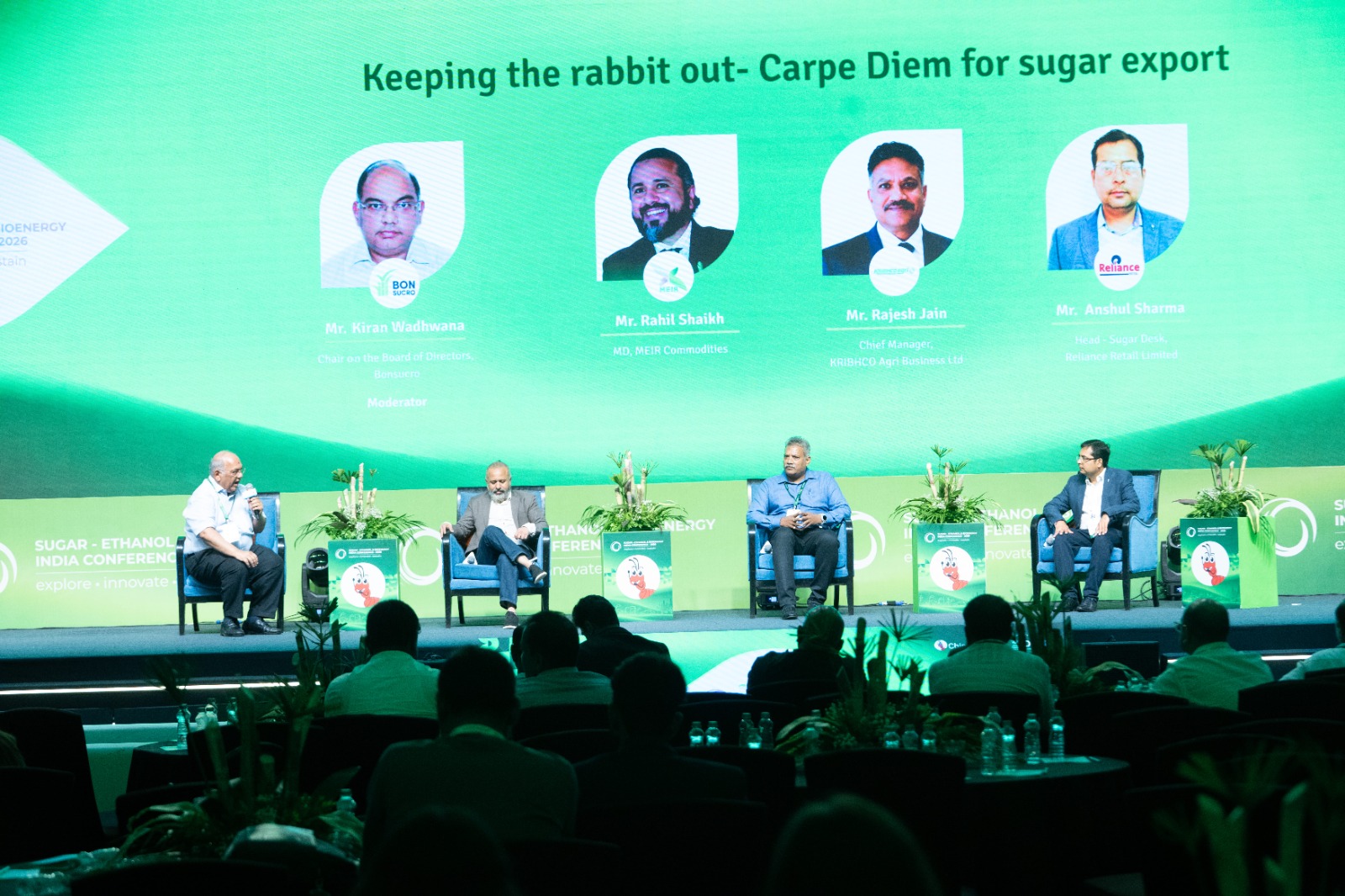
Mumbai: Greater policy predictability, flexible export decisions and stronger engagement between policymakers and trade stakeholders will be essential to maintaining India’s position in global sugar markets, industry representatives said during a panel discussion titled “Keeping the Rabbit Out – Carpe Diem for Sugar Export” at the Sugar Ethanol Bioenergy India Conference (SEIC) 2026.
The discussion focused on key issues affecting sugar exports, including the government’s priority of maintaining adequate domestic stocks, the need for policy flexibility based on production estimates, challenges arising from the cyclical nature of the sugar sector, international price parity and the possibility of allowing exports under the Open General Licence (OGL) framework.

The session was moderated by Kiran Wadhwana, Owner, COMDEX India Ltd.
Speaking during the discussion, Rahil Shaikh, MD, MEIR Commodities stressed the importance of consistency and predictability in export decisions and said abrupt policy changes create uncertainty across the value chain.
According to Shaikh, once export quotas are announced, the market should receive adequate certainty to plan business operations.
“Government should not give shock to the market. Once the export quota is allocated, then the government should not cancel it suddenly,” he said.
Sharing a global trade perspective, Rajesh Jain, Chief Manager, KRIBHCO Agri Business Ltd said sudden restrictions on exports can have longer-term consequences for India’s position in international markets.
According to Jain, importing countries often respond to supply disruptions by investing in domestic production capabilities.
“Once the government bans exports, the importing country focuses on becoming self-sufficient,” he said.
He added that the industry expects closer coordination and support from policymakers.
“The government should understand us and support us,” Jain said.
Addressing the policy framework for exports, Anshul Sharma, Head – Sugar Desk, Reliance Retail Limited said careful and measured decision-making is essential for maintaining exporter confidence.
According to Sharma, export policies should be developed with long-term market stability in mind rather than short-term reactions.
“Policymakers should not be in a hurry while designing export policy. This would bring confidence among exporters,” he said.
Participants also emphasised that structured dialogue between the government and market participants could reduce uncertainty and support smoother implementation of export decisions.
The panel observed that greater engagement with traders and exporters would help minimise disruptions and improve policy outcomes for the sector.
The discussion reflected industry sentiment that while safeguarding domestic sugar availability remains important, stable and predictable export policies will be equally critical to sustaining India’s competitiveness in global sugar trade.
To watch full discussion click here