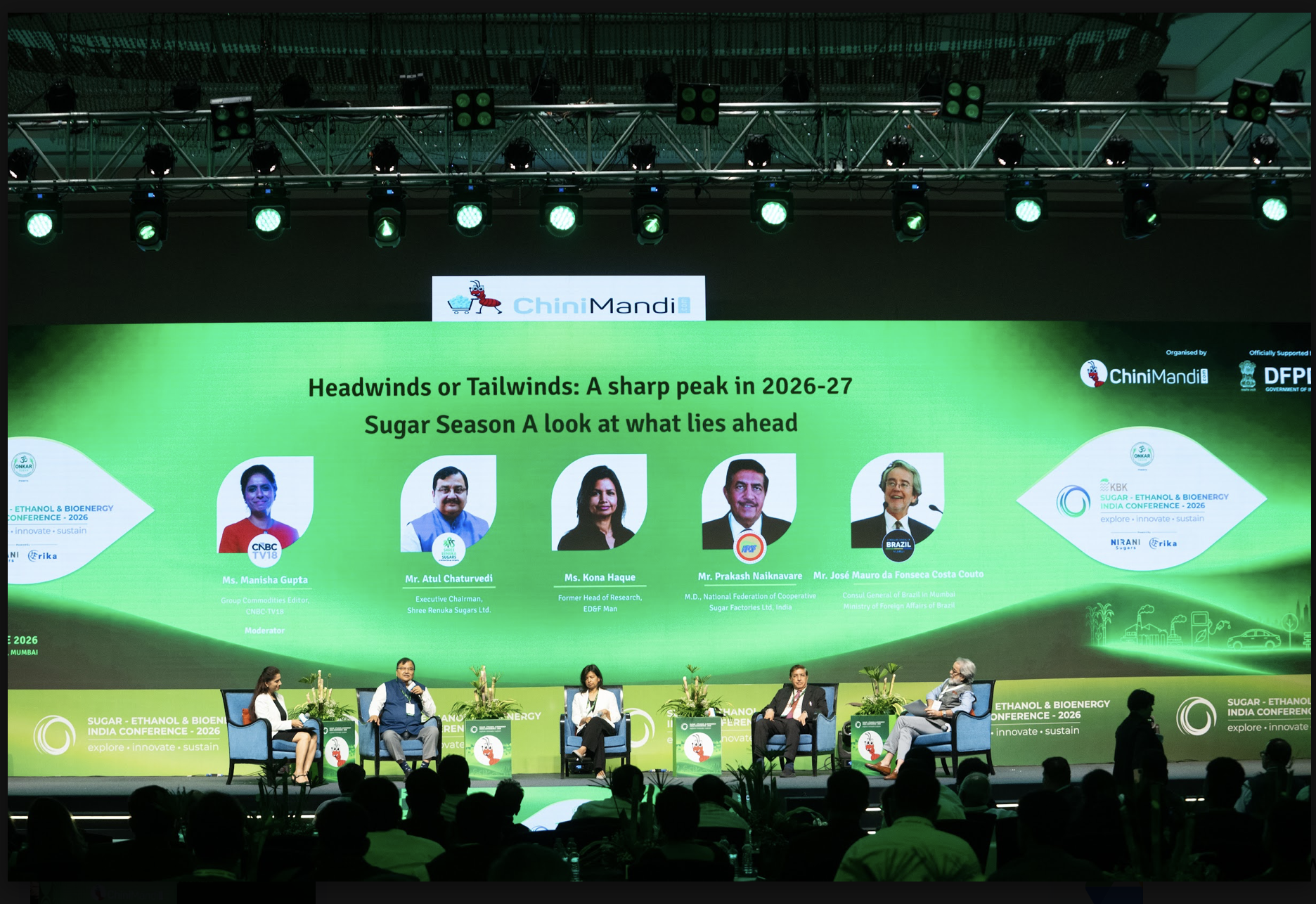
Speaking during a panel discussion titled “Headwinds or Tailwinds – Sugar Outlook 2026-27, at SEIC 2026, organised by ChiniMandi on 12th and 13th June 2026 at the Westin Hotel, Powai, Mumbai, Atul Chaturvedi, Director, Shree Renuka Sugars, cautioned that while India is actively working to build ethanol demand, the availability of sugarcane-based feedstock could emerge as a major challenge in the coming year.
“We may end up producing more sugar because ethanol production from sugarcane juice is unlikely to increase significantly,” Chaturvedi said. “With El Niño looming over us, sugar prices are expected to remain elevated. In such a scenario, it is difficult to imagine mills diverting large quantities of cane juice towards ethanol.”

He noted that molasses-based ethanol alone would contribute only marginally to overall supplies. According to him, policymakers need to reconsider the economics of sugarcane juice ethanol if they wish to sustain growth in the ethanol blending programme.
“Maize is clearly gaining traction as a feedstock. At the same time, policymakers remain concerned about sugar prices. If sugar production does not rise sharply, ethanol supplies from the sugar sector could become a question mark,” he said.
Chaturvedi also questioned the need for further expansion of ethanol capacity when demand growth remains uncertain. “Feedstock availability is the key issue. Distilleries operate only for five to six months in a year, and securing adequate feedstock will remain a challenge for the sugar sector.”
Looking ahead, he said industry stakeholders would closely monitor the progress of El Niño and the government’s policy response. “If geopolitical tensions in West Asia ease and crude oil prices soften, it remains to be seen whether the government will continue with the same level of ethanol push. Overall, it is shaping up to be a challenging year.”
Ethanol outlook remains positive
Offering a more optimistic perspective, Prakash Naiknavare, Managing Director of the National Federation of Cooperative Sugar Factories (NFCSF), described the ongoing geopolitical turmoil as a catalyst for accelerating India’s energy transition.
“The current conflict is, in a way, a blessing in disguise because it has once again highlighted the importance of energy security. Ethanol is receiving greater policy attention, and I remain optimistic about its future,” he said.
Naiknavare, however, pointed out several structural issues that need attention. Ethanol procurement prices have remained unchanged for some time, while feedstock allocations continue to be uneven despite the rapid expansion of ethanol production capacity.
“Flex-fuel vehicles are already on Indian roads, and ethanol dispensing stations have started operating in cities like Delhi. The ecosystem is gradually taking shape,” he noted.
He also highlighted discussions around a dual sugar pricing mechanism. According to him, around 60-65% of India’s sugar is consumed by industrial and bulk buyers who benefit from lower ex-mill prices, whereas household consumers pay significantly higher retail prices.
“A dual pricing mechanism, supported through the GST framework, could help reduce the burden on household consumers while maintaining industry viability,” he said.
Referring to a meeting chaired by Union Home Minister Amit Shah on May 27, Naiknavare revealed that the proposal had received encouraging attention.
“He appreciated the concept and expressed interest in exploring ways to make sugar more affordable for household consumers. The matter has been referred for further examination,” he said.
At the same time, he warned that sugar production in Uttar Pradesh could decline in the 2026-27 season, making El Niño a critical factor to watch.
Brazil’s biofuel success
Representing the Brazilian perspective, the Brazilian Consul General, José Mauro da Fonseca Costa Couto, highlighted the country’s decades-long experience in developing a successful biofuel ecosystem.
“Brazil today has nearly 40 million flex-fuel passenger vehicles, and consumers can access ethanol at virtually every fuel station,” he said.
He pointed to Brazil’s latest biofuel incentive programme, which encourages higher blending levels of ethanol and other renewable fuels as part of the country’s broader energy transition strategy.
“Our objective is to make Brazil increasingly self-reliant in green energy. Biodiesel blends can already reach very high levels. The most important lesson is that governments must create a stable policy framework. Once investors commit capital, they need confidence that the policy environment will remain supportive.”
Sugar market: Heightened volatility
Global commodities expert Kona Haque said the sugar market is entering a period of increased uncertainty driven by weather risks and energy market developments.
“We started the year with a small global sugar deficit. In my view, the market may be underestimating the size of Brazil’s crop,” she observed.
According to Haque, despite higher crude oil prices resulting from tensions in West Asia, Brazilian mills have not aggressively shifted towards ethanol production because domestic ethanol demand remains relatively subdued and gasoline prices continue to receive policy support.
“As a result, mills are still favouring sugar production, which could eventually push the market towards surplus,” she said.
She added that refined white sugar markets currently appear stronger than raw sugar markets, while the biggest weather risks remain concentrated in India and Thailand due to the potential impact of El Niño.
“The 2026-27 season is shaping up to be a very important one. Volatility is returning to commodity markets. Equity markets appear relatively insulated for now, but crude oil inventories are gradually tightening. If we eventually experience an oil price shock, it could reignite global interest in renewable fuels.”
On sugar prices, Haque remained constructive. “Given the weather risks and broader macroeconomic backdrop, the sugar market retains a bullish undertone.”
The Moderator of the session was Manisha Gupta, Group Commodities Editor, CNBC-TV18
To watch full discussion click here