
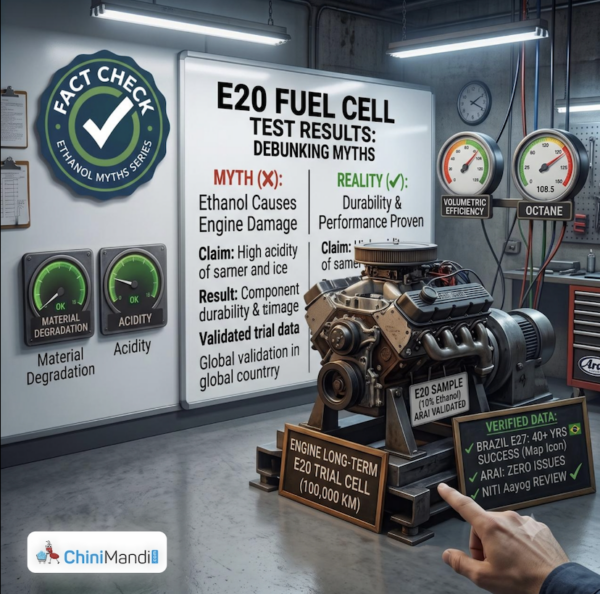
Social media handles are rife with miscommunications and deliberately spreading misconceptions about the Ethanol Blending with Petrol Programme (EBP). One of the most common and harmful pieces of information being spread callously and irresponsibly by a few influencers on social media platforms is the claim that ‘Ethanol Causing Engine Damage’.
As a dedicated national forum and a platform to safeguard the interests of farmers and the sugar, ethanol, and bioenergy industries, ChiniMandi is looking at all the arbitrary claims regarding this national Ethanol Blending mission and dispel deliberate attempts by some influencers to derail it. Provide science based facts that will break the fabricated myths.

Ethanol is safe: Period
There is no scientific basis to say that vehicle engines are eroding or their performance is reducing due to the usage of ethanol fuel.
The Ministry of Petroleum and Natural Gas has rebutted the false claims more than once. India’s E20 programme was not introduced without testing.
In a PIB release in 2025, MoPNG said that “Before the nationwide rollout, the Government commissioned multiple studies through the Automotive Research Association of India (ARAI), Indian Oil Corporation Limited (IOCL), Society of Indian Automobile Manufacturers, Bharat Petroleum Corporation Limited and Hindustan Petroleum Corporation Limited to evaluate engine durability, material compatibility, emissions, fuel economy and vehicle performance. These studies formed the basis of the Government’s decision to advance E20 implementation”.
Concerns related to performance and mileage being raised now were anticipated as early as 2020 by the Government, and an Inter-Ministerial Committee (IMC) of the NITI Aayog examined them at length. This was also backed by research studies carried out by IOCL, ARAI and SIAM.
The use of E-20 gives better acceleration, better ride quality and most importantly, lowered carbon emissions by approximately 30% as compared to E10 fuel.
Ethanol’s higher-octane number (~108.5 compared to petrol’s 84.4) makes Ethanol-blended fuels a valuable alternative for higher-octane requirements that is crucial for modern high-compression engines. Vehicles tuned for E20 deliver better acceleration which is a very important factor in city driving conditions.
Additionally, Ethanol’s higher heat of vaporisation reduces intake manifold temperatures, increasing air-fuel mixture density and boosting volumetric efficiency.
The proof is in the pudding: the successful example of Brazil running on E27 for years with zero issues totally kills any misnomer regarding ethanol fuel.
Dr. Reji Mathai, Director of Automobile Research Association of India (ARAI), speaking exclusively to ChiniMandi, had categorically denied any structural damage caused by E20 to vehicle engines.
He said that E-20 fuel does not cause structural damage to the engine or vehicle. “A few rubber/plastic parts have shown inferior performance during standard testing. However, the field trials spanning more than 1 lakh kms (cumulative) have not shown any adverse impact on components”, he highlighted.
Union Minister for Petroleum and Natural Gas Shri Hardeep Singh Puri, during the launch of the E85 dispensing stations on 5th June 2026, said that since E20 became the standard fuel across the country, there has not been a single reported case of engine failure or vehicle breakdown attributable to ethanol blending.
“E20-compatible vehicles deliver improved acceleration and better ride quality, particularly under city driving conditions”, Puri stated.















