
Several irresponsible and inaccurate social media influencers are trying to set an anti-tone regarding the Ethanol Blending Programme.
They are trying to negate the scientific validation of the programme and ignoring the many benefits it brings.

One of the viral claims made by them is that E85 can be used in any petrol car. This is completely false. Flex Fuel Vehicles (FFVs), which are manufactured to use any blend of ethanol with petrol beyond E20, can only run on E85. Using E85 in regular vehicles can damage the car. Hence, it is beyond doubt that E85 blended fuel can only run on FFVs, and not on BS-VI vehicles.
Some social media handles are also claiming that every car needs a new engine to use E20. This is equally erroneous and totally baseless. Car companies have on record said that most new vehicles sold in India are already E20-compatible.
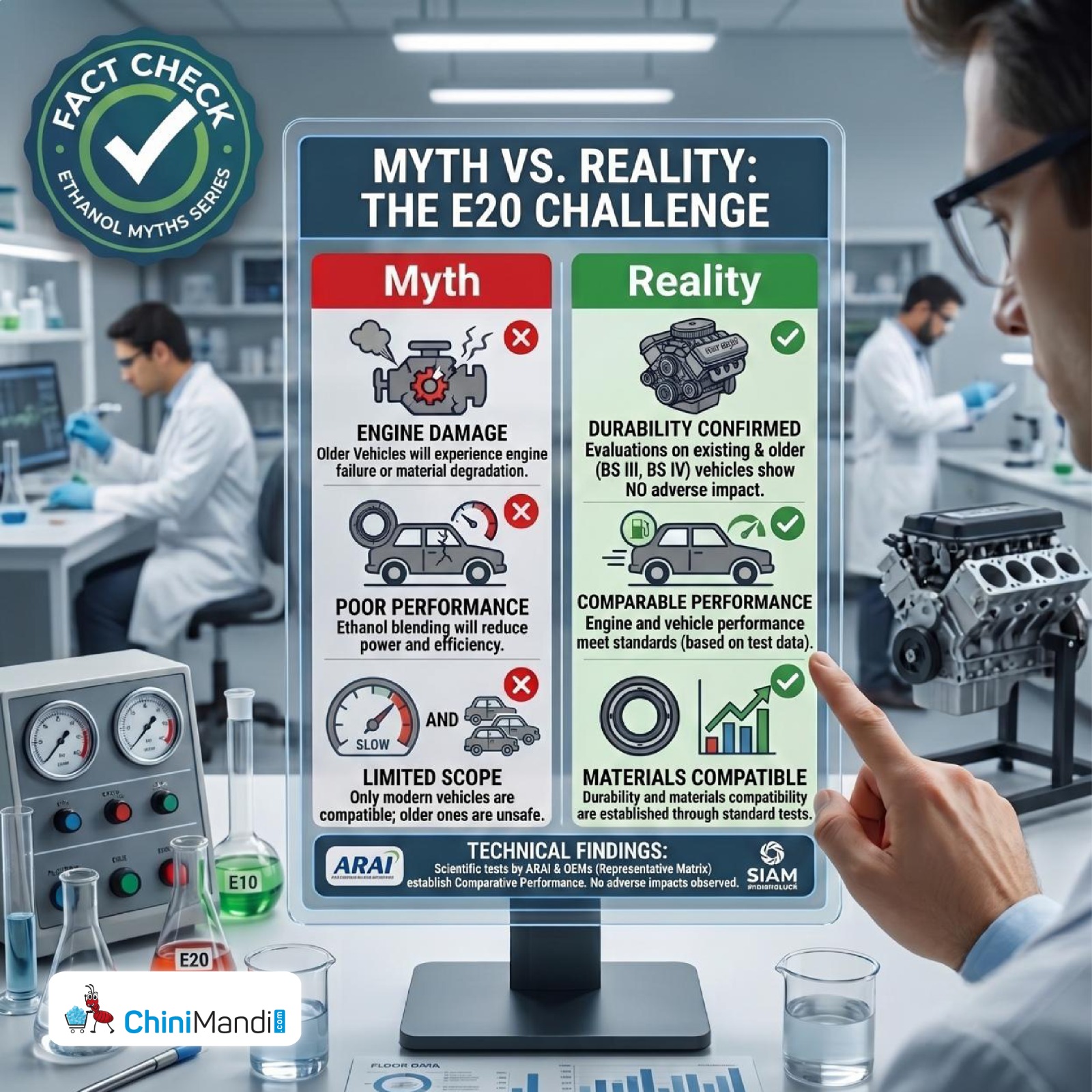
Reji Mathai, Director of Automotive Research Association of India (ARAI), said that the compatibility of existing vehicles when a new fuel like E20 is introduced can only be done after due evaluations wherein the OEMs are a key stakeholder because the fuel was non-existent when the vehicle was launched. Adding to this, Mathai said that the introduction of E20 was carried out only after comprehensive technical evaluations like vehicle/engine performance, durability, material compatibility, etc on a representative vehicle matrix of existing and old vehicles.
“The vehicle selection (which represents the existing vehicle parc) for such evaluations was done after extensive consultations with OEMs. These evaluations comprise standard and customised tests to establish the comparative performance of identified vehicles/engines with the proposed fuel, which in this case is E20,” he emphasised.
Quoting studies done (by ARAI & OEMs) in the last few years on 2- and 4-wheeler vehicles that covered BS III & BS IV vehicles, Mathai said that the test results were duly deliberated and it was observed that there is no adverse impact of E20 fuels on the representative vehicles on which testing was carried out.
“In the past also, when the ethanol blending was increased from E5 to E10, similar studies were conducted. As the results of varied tests using E20 fuel did not show any adverse impact on vehicles/ engines, the implementation of E20 fuel was carried out,” he stated.















