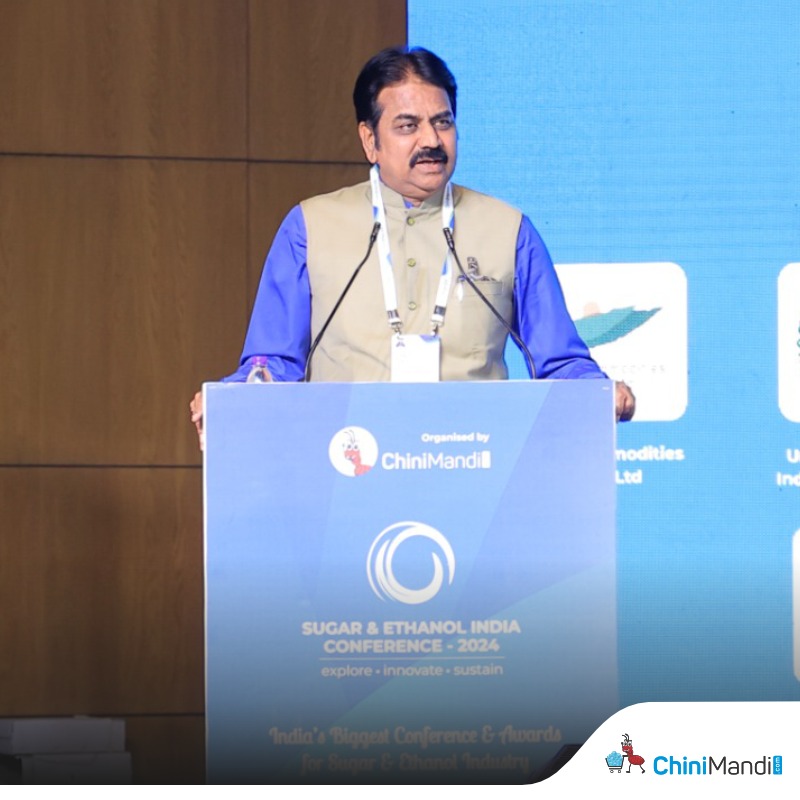
Pune: Maharashtra’s sugar production during the upcoming crushing season could remain significantly below the state government’s projection, with mills unlikely to operate for more than around 80 days and total sugar output potentially not exceeding 85 lakh tonnes, National Federation of Cooperative Sugar Factories Ltd (NFCSF) President Harshvardhan Patil said, Free Press Journal reported.
Speaking to the press in Pune, Patil said the NFCSF had apprised the state government of the ground situation amid concerns over cane availability and sugar recovery.

The state government has projected sugar production of around 112 lakh tonnes, based on an estimated cane yield of 81 tonnes per hectare and sugar recovery of 11.25%. However, industry representatives have questioned the projection, citing lower cane yields and recovery.
Maharashtra’s sugar mills operated for around 104 days last season and produced approximately 104 lakh tonnes of sugar after accounting for diversion of sugar towards ethanol, Patil said.
Alongside concerns over production, Patil highlighted the financial pressure on sugar mills and reiterated the industry’s demand to raise the minimum selling price (MSP) of sugar to Rs 45–50 per kg. He said the MSP had remained unchanged for eight years despite rising input and production costs.
The NFCSF has also sought a soft-loan package to help sugar mills meet expenses related to harvesting and transportation, salaries and maintenance. Patil said Chief Minister Devendra Fadnavis had assured the industry that a proposal would be placed before the state Cabinet and that the government would explore providing guarantees for such loans.
Patil also called for action against illegal jaggery-making units, saying they divert sugarcane away from sugar mills and distort the cane market.
The NFCSF has been seeking a stronger linkage between sugar prices and the Fair and Remunerative Price (FRP) of sugarcane to improve the financial viability of mills and ensure timely payments to farmers. It has also advocated continuation of the reserved cane-area system, retention of the 25-km minimum distance criterion between sugar mills and greater long-term policy stability.
The comments come days after the sugar industry maintained that there was no shortage of sugar despite a sharp increase in retail prices. The NFCSF said ex-mill sugar prices, which briefly approached Rs 50 per kg, subsequently declined by nearly 30%. It said mills gained little from the temporary price increase as only around 1–1.5 lakh tonnes were sold at the higher rates, while the industry has estimated its average production cost at Rs 42–43 per kg.
Patil also emphasised the need to transform cooperative sugar factories into integrated bioenergy centres, identifying compressed biogas (CBG) as a major diversification opportunity. Sugar mills have access to press mud, spent wash, bagasse and agricultural biomass, which he said should be treated not merely as waste or by-products but as energy resources and additional revenue streams.
The NFCSF is also promoting precision agriculture, artificial intelligence, modern sugarcane management, automation and energy-efficient processing as part of efforts to modernise the sector.
It has proposed a Rs 90-crore Global Centre of Excellence for Accelerated Sugarcane Breeding at the ICAR-Sugarcane Breeding Institute in Coimbatore. The proposed centre would focus on developing high-yielding, climate-resilient and disease- and pest-tolerant sugarcane varieties using genomics, molecular breeding and other technologies.
Patil said the future of India’s cooperative sugar sector would depend on combining farmer-focused sugarcane development, financially sustainable sugar pricing, ethanol and CBG diversification, technological adoption and modernisation rather than relying solely on conventional sugar production.