
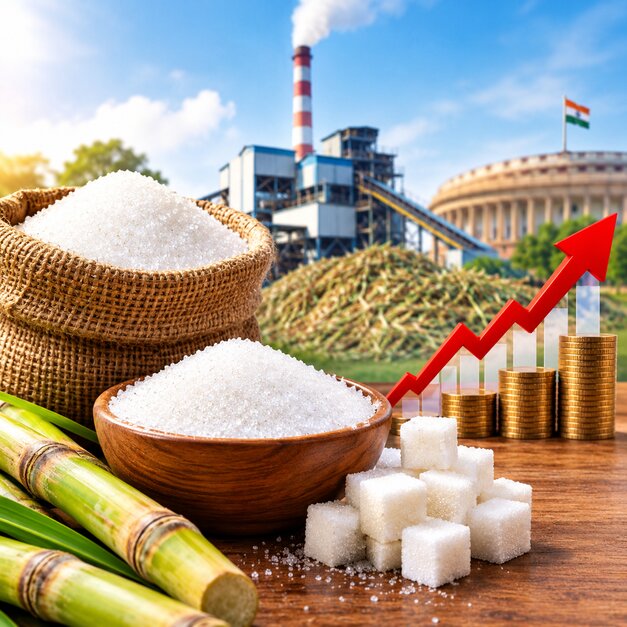
Kolhapur: Ex-mill sugar prices in India have risen by around Rs 600 per quintal in a week, as limited supplies from sugar mills and a tight opening balance for the 2026-27 sugar season put upward pressure on the market. Prices have moved towards Rs 5000 in Maharashtra & Rs 5000 to 5100 per qntl. in Uttar Pradesh, although rates vary across producing regions depending on availability, demand and the quality of sugar.
The increase comes as the industry moves from the 2025-26 season into the new crushing season. India entered October with an estimated opening sugar balance of around 35 to 37 lakh tonnes (LMT), roughly six to seven weeks of domestic consumption. While these stocks are expected to support consumption during the transition, the pace at which mills release and dispatch sugar has become an important factor for market sentiment, with mills set to start crushing operations from October 15.

Industry sources attribute the recent price rise partly to a shortage of readily available supplies from mills rather than an overall shortage of sugar in the country. The distinction is significant: sugar may be available in mill inventories, but delayed sales, dispatches or release of stocks can restrict immediate availability for consumers.
The government has also flagged discrepancies between the sale particulars and GST details submitted by some sugar mills. It has decided to intensify physical verification at mills from October 9 so that reported sales, inventories and actual market supplies are properly accounted for. Mills under scrutiny have been asked to submit details of their sales for August 20 to August 31 by October 10. The move comes amid concerns about tight availability ahead of the festive season.
Speaking to ChiniMandi on the condition of anonymity, a senior government official said that mills should continue supplying sugar to the market at reasonable prices. The official indicated that the government is closely tracking mills’ sales and dispatches and will monitor their compliance with the prescribed supply requirements.
The Centre has already introduced measures to improve the movement of sugar through the supply chain. These include a fortnightly quota system, directions to dispatch sold sugar within seven days and closer monitoring of stocks. For October, every mill must sell and lift at least 45 per cent of its fortnightly quota between October 1 and October 8, and the balance by October 15. Any shortfall will be treated as a violation of the Essential Commodities Act, 1955, and the Sugar (Control) Order, 2025. The government has also revised dealer stockholding norms for October 15 to November 30, limiting stocks to 1000 quintals and the holding period to 15 days. A higher limit of 2000 quintals applies to Kolkata, its extended metropolitan areas and Assam.
Early crushing expected to improve availability
The commencement of the 2026-27 crushing season is expected to bring additional supplies into the market. Maharashtra has issued crushing licences to 210 sugar mills (104 cooperative and 106 private), which are set to begin operations from October 15. The decision is intended to improve sugar availability during the festive period, although mills are not being compelled to start early.
Some factories have already begun crushing in Maharashtra. The early start is expected to contribute to the initial flow of new-season sugar. Elsewhere the season is yet to gather pace: crushing has not started in Karnataka, and mills in Uttar Pradesh are preparing to begin around October 20.
The early start, however, comes with concerns about cane maturity and sugar recovery. Farmer organisations in Maharashtra and Karnataka have opposed advancing crushing operations, arguing that immature cane could reduce recovery and cane weight, affecting both farmers and mills. They have sought compensation for potential losses and higher prices for sugar and ethanol. Union Food Minister Pralhad Joshi has called a meeting on October 12 to discuss these demands. Maharashtra Sugar Commissioner Sanjay Kolte and Cooperation Minister Babasaheb Patil will meet a farmers’ delegation on October 14.
No shortage of sugar, says the broader supply picture
Despite the recent increase in ex-mill prices, the government has maintained that India has adequate sugar stocks to meet domestic requirements. Its earlier stock-verification exercise found sufficient physical stocks, while officials identified instances in which mills were holding more sugar than declared or selling less than their allocated quotas. The government has said there is no justification for panic buying or excessive stockholding.
Additional supply is also in the pipeline. The Centre has allowed duty-free import of 10 lakh tonnes of raw sugar up to October 31 and has permitted mills to sell sugar produced in October without restriction.
The market is therefore facing the challenge of ensuring that available sugar reaches buyers in a timely manner, rather than an outright nationwide shortage. The balance for the full season is tighter. The USDA’s New Delhi office has projected India’s 2026-27 sugar production at 29.5 million tonnes, well below its earlier official estimate of 33.6 million tonnes, which makes the smooth flow of existing stocks all the more important.
With the festive season underway and the new crushing season beginning, the government is expected to maintain close oversight of mill inventories and sales. If dispatches improve and new-season production enters the market as anticipated, the additional availability could ease the immediate pressure on prices.
Trade sees further upside without intervention
The trade, however, is less sanguine about the near term. According to trade sources, mills in Uttar Pradesh are selling sugar to their agents at around Rs 4500 per quintal, while their agents are offering it in the market at Rs 5000 to 5200 per quintal. Taking their cue from these market rates, mills in Maharashtra, Karnataka and Gujarat have firmed up their own prices to nearly the same levels.
Market participants say that because mills are not releasing adequate quantities, prices can rise by a further 10 per cent if the government does not intervene, which would take ex-mill rates beyond Rs 5200-5400 per quintal. To bring prices under control, the government may allow an additional sale quota. For now, the market will be watching whether mills increase supplies at reasonable rates and whether early crushing translates into a faster flow of sugar to buyers.














