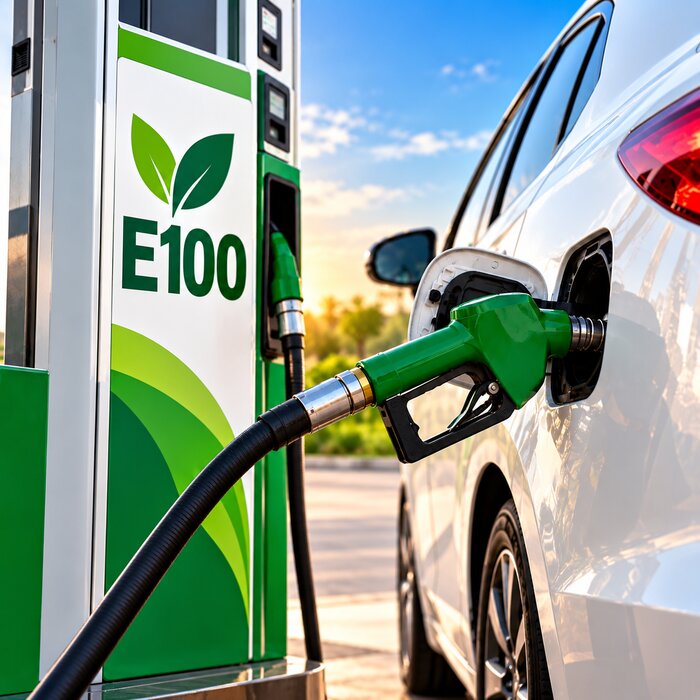
The Indian Sugar & Bio-Energy Manufacturers Association (ISMA) welcomes the notification of the Central Motor Vehicles (Amendment) Rules, 2026, vide G.S.R. 911(E) dated 23 October 2026, by the Ministry of Road Transport and Highways (MoRTH). The Amendment to the Central Motor Vehicles Rules, 1989, expressly recognises E100 alongside E85 within the applicable emission-certification framework for flex-fuel vehicles (FFVs), requiring vehicles designed to operate on these fuels to comply with the relevant emission standards, testing requirements and vehicle-safety norms prescribed for their respective categories.
This regulatory milestone provides an important foundation for the development, testing and certification of vehicles designed to operate on higher ethanol blends. The recognition of E100 is expected to facilitate the wider adoption of higher ethanol blends, build on the existing E85 flex fuels in the Indian market, and unlock additional domestic ethanol demand while strengthening synergies between India’s biofuel and automotive industries.

Flex-Fuel Vehicles: Engineered for Higher Ethanol Blends
As per the MoRTH’s definition of flex-fuel vehicle, “a vehicle designed to run on fuel between E20 to E85/E100.” Such vehicles will not have material compatibility issues. According to the US Department of Energy, these vehicles use a single fuel system with minor ethanolcompatible modifications to the engine control module (ECM), fuel pump, fuel heater and injection system, and fuel lines and seals to accommodate ethanol’s higher oxygen content.
Ethanol Mobility: Environmental and Energy-Security Benefits
Ethanol offers significant advantages as an indigenous transport fuel. Its wider use can
reduce dependence on imported crude oil, conserve foreign exchange and strengthen national energy security. As a renewable fuel produced from biomass, ethanol can also contribute to lower lifecycle greenhouse gas emissions. The carbon dioxide released during combustion is 100% biogenic in origin, having been absorbed during biomass growth.
Higher ethanol blends can also offer air-quality benefits. Ethanol’s higher oxygen content
promotes more complete fuel combustion, with approximately 9 kg of air required per
kilogram of ethanol, compared with 14.6 kg for petrol. FFVs operating on ethanol blends can reduce certain tailpipe pollutants, including carbon monoxide (CO) and hydrocarbons (HC). Notably, E100 can reduce particle number (PN) emissions by 84% compared with E20, while particulate matter (PM) emissions can be among the lowest compared with conventional fossil-fuel vehicles. Wider adoption of E85/E100-compatible FFVs can therefore complement India’s existing ethanol blending programme and advance the transition towards a more diversified and sustainable mobility ecosystem.
Strengthening Farmer Prosperity and Domestic Ethanol Demand
India’s achievement of 20% ethanol blending has delivered significant benefits for the country, including substantial foreign exchange savings and enhanced farmer incomes. Expanding ethanol mobility towards E100 has the potential to multiply these gains. If 50% of new car sales comprise E100-compatible flex-fuel vehicles from 2027 onwards, with new car sales growing at a 5% CAGR, ethanol consumption could reach a total of approximately 1,471 crore litres by 2030, generating foreign exchange savings of Rs 71,448.8 crore and farmer income of Rs 58,489.9 crore. This transition could further strengthen the link between agricultural prosperity, domestic manufacturing and India’s energy security.
The expansion of ethanol mobility can also catalyse investment and employment across the
value chain, including ethanol-compatible automotive components, domestic ethanol production capacity, fuel storage and distribution infrastructure, and associated manufacturing and services. It can strengthen the linkage between farmers, ethanol producers, fuel retailers and automobile manufacturers while supporting the development of a domestic bioenergy ecosystem.
Enabling the Next Phase of India’s Ethanol Journey
The recognition of E100 alongside E85 lays the foundation for the next phase of India’s
ethanol journey, expanding the role of domestically produced ethanol in the transport sector. Accelerating this transition will require wider availability of E85/E100-compatible FFVs, accessible fuel infrastructure and a supportive, predictable policy framework. ISMA remains committed to advancing ethanol mobility as a catalyst for farmer prosperity, domestic manufacturing and energy security, contributing to the vision of Atmanirbhar Bharat and Viksit Bharat.
Deepak Ballani, Director General, ISMA, said, “India’s regulatory framework is steadily
evolving to enable ethanol-based mobility. The recognition of E100 alongside E85 under the
CMVR framework is a significant step towards accelerating the adoption of flex-fuel vehicles. Such progressive and enabling policy measures will be instrumental in unlocking domestic ethanol demand, strengthening energy security and advancing India’s journey towards Atmanirbhar Bharat.”