
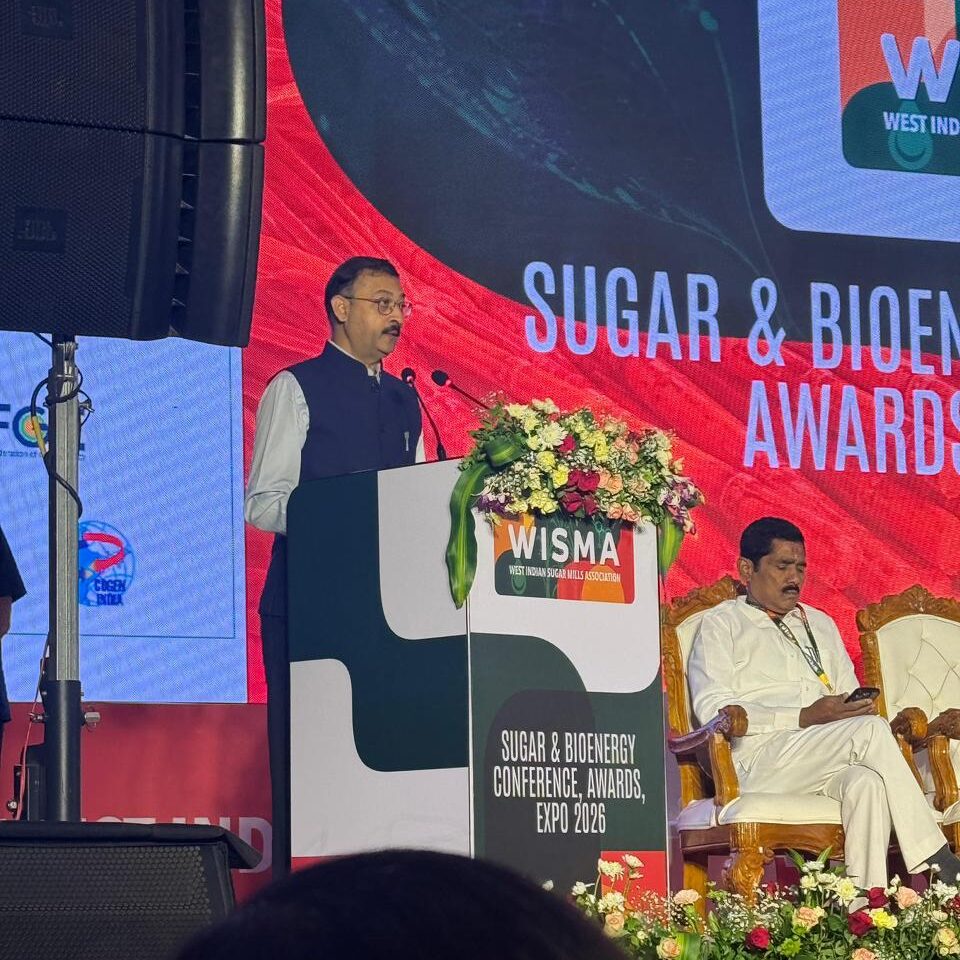
Pune: Maharashtra’s sugar industry recorded higher sugarcane crushing, sugar production and cane cultivation area during the 2025-26 crushing season, while the sector continued to strengthen its position as a major producer of ethanol and renewable energy, Maharashtra Sugar Commissioner Dr. Kolte said at the WISMA Sugar and Bio-Energy Conference.
Addressing industry leaders, sugar mill representatives and policymakers, Dr. Kolte said Maharashtra cultivated sugarcane on 1.653 million hectares during the season, producing over 130 million metric tonnes of cane. A total of 104.5 million metric tonnes of cane were crushed by 210 sugar factories across the state.

Of the participating mills, 102 were cooperative sugar factories and 108 were private mills, reflecting the significant contribution of both sectors to Maharashtra’s sugar economy.
“The state has achieved marginal growth over the previous season in terms of sugarcane area, cane crushing and sugar production,” Dr. Kolte said.
Maharashtra produced 13.2 million metric tonnes of sugar during the 2025-26 season, with an average sugar recovery of around 9.5 percent and an estimated recovery of nearly 11 percent after accounting for ethanol diversion.
The Sugar Commissioner stressed that the industry can no longer rely solely on sugar production and must diversify into bio-energy and value-added products to ensure long-term sustainability and support higher payments to sugarcane farmers.
“If sugar factories are to remain financially strong and continue supporting farmers’ rising income expectations, diversification into bio-energy and other by-products has become essential,” he said.
Dr. Kolte highlighted Maharashtra’s growing ethanol sector, noting that 156 ethanol production units are currently operational in the state, including 84 cooperative and 72 private-sector units. Together, these units have an annual production capacity of 2.97 billion litres.
During the previous year, Maharashtra’s sugar industry supplied 1.04 billion litres of ethanol to oil marketing companies, generating revenue exceeding ₹7,000 crore.
He also pointed to the success of bagasse-based co-generation projects. Maharashtra currently has 129 co-generation units, including 60 cooperative and 69 private-sector facilities, with a combined electricity generation capacity of 2,710 MW.
These units are capable of generating nearly 5.5 billion units of electricity annually and contributed approximately ₹1,900 crore in revenue during the previous year.
The Commissioner said the state government is actively promoting compressed biogas (CBG) production under its recently announced bio-CNG and CBG policy. The policy encourages sugar mills to utilise press mud and other biological waste for renewable gas production.
Under the new framework, smaller sugar factories can develop cluster-based CBG projects, while private investors are allowed to establish facilities under public-private partnership (PPP) models. The government has also announced incentives and financial support, including provisions of up to ₹500 crore for the sector.
To promote awareness, the Sugar Commissioner’s office recently organised a workshop involving sugar mill executives and private-sector technology providers to explain opportunities available under the new policy and encourage greater participation in CBG projects.
Dr. Kolte further revealed that the Sugar Commissioner’s office has submitted a comprehensive bio-energy and bio-fuel policy proposal to the state government. The proposal includes equity support for cooperative sugar factories, capital subsidies, interest concessions and tax incentives such as GST and stamp duty benefits for bio-energy projects.
The proposal is currently under consideration by the government.
Looking ahead, Dr. Kolte said Maharashtra’s sugar factories should evolve into integrated bio-energy hubs aligned with India’s sustainability and net-zero goals.
“All products and by-products generated by sugar factories are environmentally sustainable. The sugar industry has the potential to play a major role in achieving climate and sustainability objectives while creating additional revenue streams for farmers and mills,” he said.
He praised industry bodies such as WISMA and other sugar sector organisations for helping mills adopt new technologies and renewable energy initiatives, expressing confidence that collaborative efforts would accelerate the transformation of Maharashtra’s sugar industry into a leading bio-energy sector.















