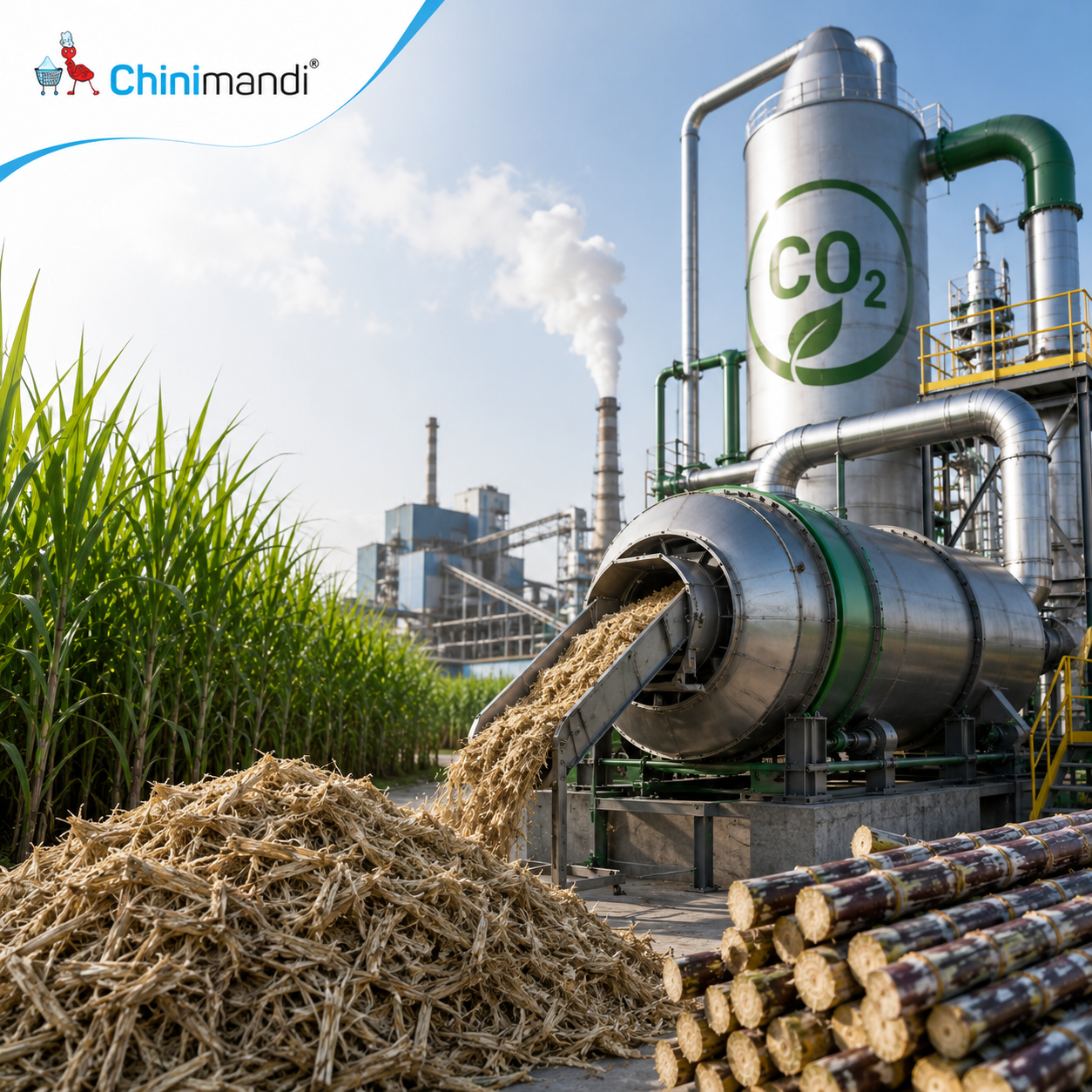
Researchers at the Faculty of Chemical Engineering (FEQ) of the State University of Campinas (Unicamp) have developed a carbon dioxide (CO₂)-based technology to dry sugarcane bagasse, a process that could significantly improve energy generation and operational efficiency at sugar and ethanol mills.
The technology, licensed to Unicamp spin-off company Quimergia Inovação, uses carbon dioxide generated within sugar mills as the drying medium instead of conventional hot combustion gases, Journal Da Unicamp reported.

Sugar mills typically burn bagasse-the fibrous residue left after crushing sugarcane—to produce steam and electricity. However, the high moisture content of bagasse reduces combustion efficiency, limiting power generation and increasing operating costs.
According to the research team, existing drying methods expose bagasse directly to hot combustion gases containing oxygen, soot, ash and acidic compounds. Besides lowering equipment life, the presence of oxygen increases the risk of oxidation and spontaneous combustion.
The newly developed process replaces oxygen-rich air with carbon dioxide, an inert gas that reduces the surface tension of water in wet bagasse, enabling faster and safer drying. Since CO₂ does not support combustion, it also lowers the risk of fires during the drying process.
The research was carried out by a team of five chemical engineers led by Jean-Christophe Bonhivers, along with professors Rubens Maciel Filho and Adriano Pinto Mariano, and researchers Carlos Eduardo Vaz Rossell and Riann de Queiroz Nóbrega. The group later established Quimergia Inovação to commercialise the technology, with support from Inova Unicamp.
The system is designed for sugar, ethanol and bioenergy plants that use bagasse as boiler fuel. Researchers said the technology can improve thermal efficiency, reduce equipment wear, lower maintenance costs and minimise the risk of spontaneous ignition.
According to the team, the process could increase the dry matter content of bagasse from around 50% to 80%, resulting in nearly 30% higher high-pressure steam generation and up to 50% more surplus electricity available for sale.
Researchers also said the additional renewable electricity could be used for applications such as green hydrogen production through water electrolysis, creating new revenue opportunities for mills while supporting the energy transition.
The technology requires modifications to existing boiler systems, bagasse storage facilities and heat recovery equipment to integrate the CO₂ drying process.
The proof of concept has already been validated under laboratory conditions with support from the São Paulo Research Foundation (FAPESP) through its Innovative Research in Small Businesses (PIPE) programme. The research team is now seeking industrial partners in São Paulo to establish a pilot plant before commercial deployment.
With around 400 sugar and ethanol mills operating in Brazil, the researchers see a large domestic market for the technology. They also believe it could be adapted for use in countries such as India, the United States, Australia, China and Thailand, as well as for corn-based ethanol distilleries in the future.