
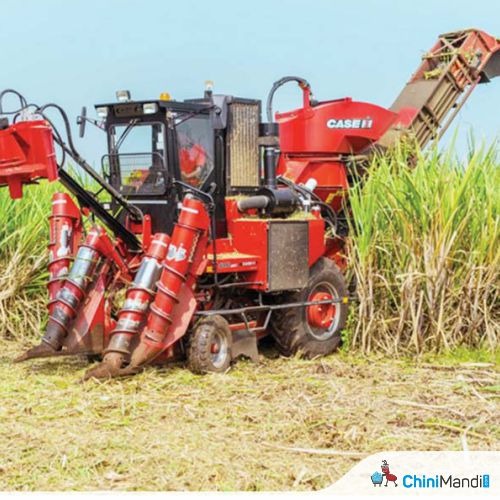
Kathmandu: China’s domestically developed sugarcane harvesters are gaining ground against imported equipment and establishing a growing presence in international markets, as rising labour costs and the push for mechanisation drive demand for specialised machinery.
Luoyang Chenhan Agricultural Equipment Technology, based in Henan province, now holds about half of China’s sugarcane harvester market and exports its machines to Southeast Asia and Latin America, the company said, according to Ratopati.

The company was founded by Zhang Changxian, a former engineer who began work on a domestic sugarcane harvester in 2008. It took eight years of development before the machine reached the market. Zhang and his team conducted extensive field testing in Guangxi in southern China, refining the equipment to cope with muddy fields, storm-damaged cane and sloping terrain.
The push for mechanisation has gained importance as China seeks to lower sugar production costs and improve the competitiveness of its domestic industry. China produced about 11.2 million tonnes of sugar in the 2024/25 marketing year, while consumption stood at around 15.7 million tonnes, according to the Chinese Agricultural Outlook Committee under the Ministry of Agriculture and Rural Affairs. The resulting supply gap was partly met through imports of about 4.6 million tonnes.
Rising labour costs have further strengthened the case for mechanisation. Zhang said a worker in 2008 could harvest about one tonne of sugarcane a day for 25-30 yuan, while the cost has now risen to 180-250 yuan for the same amount. The company’s harvesters can handle more than 100 tonnes a day, equivalent to the work of roughly 100 workers.
China initially relied heavily on imported harvesters, but machines designed for the large, flat sugarcane fields of countries such as Brazil and Australia were poorly suited to China’s smaller and often sloping farms. Chenhan therefore developed a ‘cut and break’ harvesting system designed specifically for local field conditions.
The development process also placed considerable financial pressure on Zhang, who invested money originally set aside for his daughter’s education to keep the project going.
Chenhan completed its first harvester in 2015 and launched the machine commercially in 2016. It sold more than 30 units in its first year, with annual sales rising above 150 machines the following year.
The company began exporting in 2019, supplying markets including Vietnam, Thailand, Indonesia, Costa Rica and Venezuela. Exports now account for about one-fifth of its total revenue.
The ability to customise harvesters to meet specific customer requirements has helped the company expand internationally. Chenhan is also developing smart control systems, hybrid-power technology and machines designed to consume less fuel as it seeks to strengthen its position in the global agricultural machinery market.















