
The U.S. Environmental Protection Agency (EPA) has unveiled a significant proposal aimed at enhancing American energy security and supporting domestic agriculture. The agency is proposing Renewable Fuel Standard (RFS) volume targets for 2026 and 2027, marking a pivotal step forward for the program, which celebrates its 20th anniversary this year.
Under the leadership of President Trump, the EPA’s “Set 2” proposal seeks to uphold the original intent of the RFS program, expanding the use of American-made biofuels, bolstering domestic energy production, and aiding rural economies.

“This new approach supports U.S. farmers while helping to stabilize fuel prices and preserve the role of liquid fuels,” said EPA Administrator Lee Zeldin. “We must stop relying on foreign competitors at the expense of American consumers and producers.”
Secretary of Agriculture Brooke Rollins emphasized the impact on agricultural producers, stating, “President Trump understands the vital role the RFS plays for corn and soybean growers. Administrator Zeldin’s proposal is the most ambitious to date, providing much-needed market certainty for producers and reducing costs for consumers at the pump. The USDA and EPA are now more aligned than ever in promoting American-grown biofuels.”
Rollins also highlighted recent trade successes, including a deal with the U.K. that secured tariff-free access for over $700 million in ethanol exports. “This is part of our strategy to expand American energy leadership globally,” she said.
If finalized, the proposed rule would set the highest Renewable Volume Obligations (RVOs) in the program’s history, reinforcing the Trump Administration’s commitment to energy independence and rural development.
Key elements of the proposal include:
-
Ambitious growth targets for core renewable fuels.
-
A revised valuation system that favors domestically produced biofuels and feedstocks over foreign imports.
-
The elimination of electricity (eRIN) as a qualifying renewable fuel under the RFS, aligning with the President’s goal to roll back electric vehicle mandates.
Traditionally, the RFS operated as a single-variable system, adjusting only fuel volumes. The new proposal introduces a second factor—adjusting the value of Renewable Identification Numbers (RINs) based on the fuel’s origin. Under this system, foreign biofuels and feedstocks would receive only half the RIN value compared to domestic equivalents.
The proposed rule is expected to cut U.S. dependence on foreign oil by about 150,000 barrels per day during 2026 and 2027. In 2024, nearly 45 percent of biomass-based diesel (BBD) feedstocks and fuels were imported. By reducing the RIN value for these imports, the EPA aims to stimulate domestic production and further enhance national energy security.
The Set 2 Rule proposes the biofuel volume requirements and associated percentage standards for cellulosic biofuel, biomass-based diesel (BBD), advanced biofuel, and total renewable fuel for 2026 and 2027. The volume targets are as follows:
Table 1: Volume Requirements 2023 – 2027 (billion RINs)a
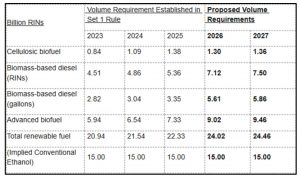
One RIN is equivalent to one ethanol-equivalent gallon of renewable fuel.
This proposal is a central piece of President Trump’s broader strategy to reinforce American energy independence, expand agricultural markets, and push back against unfair international trade practices. Finalizing these requirements would secure investments made by U.S. farmers, processors, and fuel producers—industries critical to the nation’s energy stability and the vitality of rural communities.