
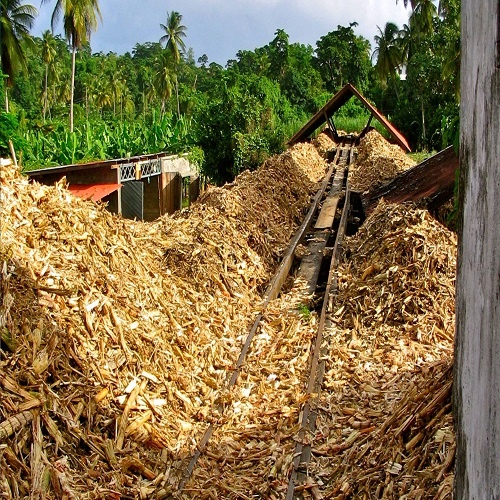
Researchers from the State University of Maringá in Brazil’s Paraná state have evaluated sugarcane bagasse ash as a partial substitute for mineral filler in asphalt mixtures, with laboratory and field results indicating improved mechanical performance under traffic load conditions, CPG Click Oil and Gas reported, citing a study published in the scientific journal Scientific Reports.
The ash, a residue produced when sugarcane bagasse is burned for energy generation at sugar and ethanol mills, was tested as a replacement for 5 per cent of the total mineral aggregates in an asphalt-rubber mixture — a type of pavement used on roads carrying heavy traffic. The researchers found that the ash had smaller particles, a more irregular surface texture, and lower density than conventional mineral filler, though these characteristics influenced mixture parameters without compromising the void content required for adequate technical performance.

The study was part of master’s research conducted by civil engineer Vinícius Milhan Hipólito of the State University of Maringá. After laboratory testing, the modified mixture was applied to an experimental section of highway BR-158, between the cities of Campo Mourão and Maringá in Paraná. In remarks cited by the Estradas portal, Hipólito said the experiment demonstrated positive results in mechanical performance while also reducing reliance on mineral aggregate and the cost of the asphalt mixture.
Laboratory tests showed a 40 per cent increase in Marshall stability and a 22 per cent improvement in the indirect tensile test. Field sample data indicated an 18 per cent increase in resilient modulus, a 73 per cent increase in Flow Number, and a 28 per cent reduction in the permanent deformation rate over 10,000 cycles in the dynamic creep test. A separate Hamburg Wheel Tracking Device test showed an 11 per cent reduction in permanent deformation over 20,000 cycles. These indicators are used to measure how pavement mixtures respond to repeated traffic pressure, particularly in relation to the formation of wheel ruts and surface depressions.
The study’s environmental rationale rests on the scale of sugarcane production in Brazil. The National Supply Company (Conab) estimated Brazil’s 2025-26 sugarcane harvest at 673.2 million tonnes, generating substantial volumes of bagasse ash as a byproduct of energy generation at sugar-energy mills. The researchers noted that using ash as a partial filler substitute could reduce the demand for quarry-extracted materials such as stone dust, though the environmental benefit would depend on the proportion used, transport distances, waste quality control, and project-specific technical requirements.
The publication noted that any broader application of the technology would require the ash to meet granulometric standardisation requirements, have a known composition, and demonstrate behaviour compatible with road construction norms. It also emphasised that the study demonstrated technical feasibility under controlled conditions for a specific mixture type and did not represent a recommendation for generalised commercial adoption on Brazilian roads. Long-term monitoring of pavement behaviour under varied climate, load, and maintenance conditions would be necessary before large-scale use could be considered.















