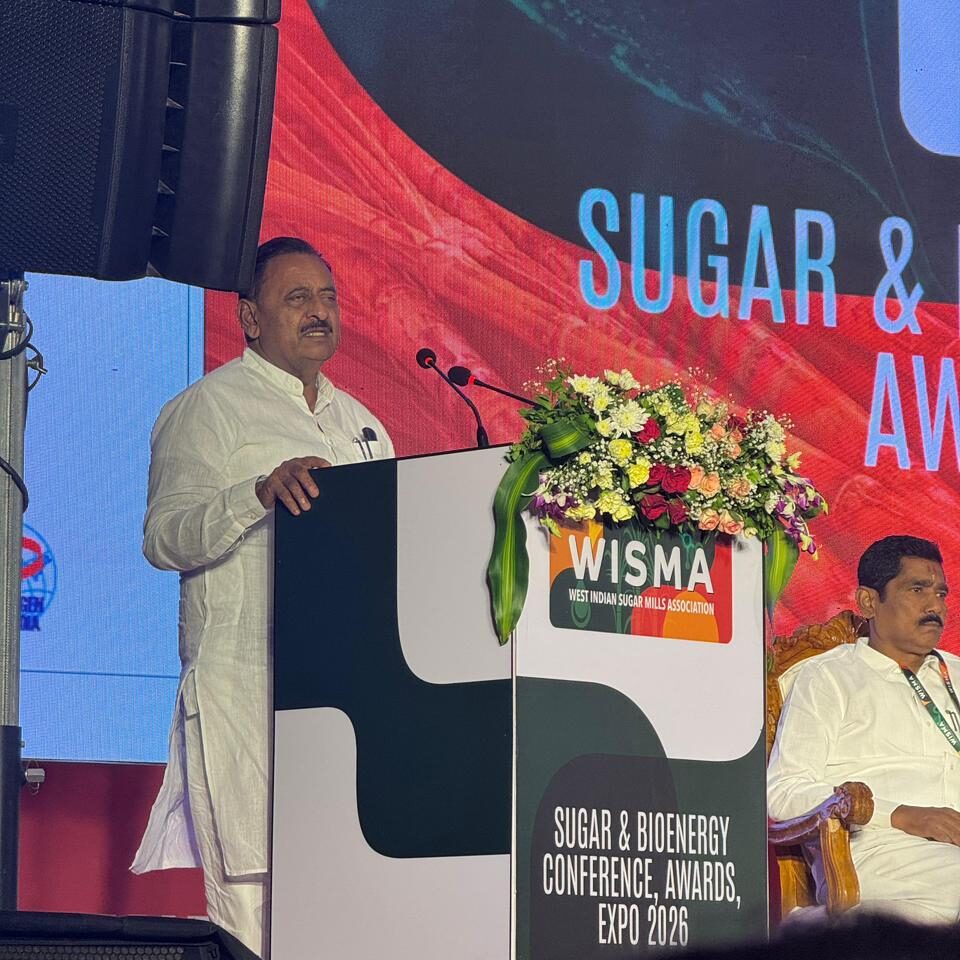
Pune: Maharashtra’s sugar industry must rapidly adopt new technologies, artificial intelligence (AI), water-efficient farming practices and bio-energy projects to overcome current challenges and remain globally competitive, Maharashtra Cooperation Minister Babasaheb Patil said while addressing the WISMA Sugar & Bio-Energy Conference, Awards Distribution Ceremony and Exhibition.
Speaking at the conference Patil acknowledged that the sugar sector is facing significant difficulties. However, he emphasized that Maharashtra’s identity and rural economy have been built on the foundations of the cooperative sugar movement.

“The state’s economy and rural prosperity are closely linked with sugar factories and agriculture. Despite present challenges, the government stands firmly behind the industry,” he said.
Patil noted that excessive expansion of crushing capacities by some factories without proper planning had contributed to the sector’s current stress. As Cooperation Minister, he said the government has exercised caution in approving new capacities, while permitting smaller factories to expand only to economically viable levels.
Highlighting the importance of technological intervention, Patil called for greater use of AI-driven agriculture, drip irrigation and sprinkler systems to improve sugarcane productivity and water-use efficiency. He cited successful AI-based sugarcane cultivation projects undertaken by the Vasantdada Sugar Institute (VSI), supported by state government funding.
“Future growth will depend on increasing cane yield per acre through technology rather than merely expanding cultivation area,” he said.
The minister also stressed the need for mechanisation in sugarcane harvesting, noting that labour shortages and rising harvesting costs have made harvesters increasingly important. He cited examples of factories that have successfully adopted 100 per cent mechanised harvesting and said the technology helps reduce costs while improving operational efficiency.
Patil said the future viability of sugar factories would increasingly depend on value-added by-products rather than sugar alone. He urged factories to invest in compressed biogas (CBG), ethanol, green energy and waste-to-wealth projects.
Referring to his visit to Japan, Patil described a large-scale waste-processing facility that converts waste into metal products, electricity and compost, demonstrating how waste management can become a profitable business model. Similar opportunities exist for Maharashtra’s sugar industry, he said.
The minister also highlighted the growing role of ethanol in India’s energy security. He welcomed efforts to increase ethanol blending in petrol and noted that new ethanol-powered vehicle technologies are being introduced in the country. Increasing ethanol blending levels and expanding biofuel production would help reduce dependence on imported crude oil, he added.
Patil further called for stronger regulation of unlicensed and loosely regulated sweetener-producing units, including khandsari and jaggery operations, to ensure a level playing field for the organised sugar sector.
Addressing farmers, he urged wider adoption of water conservation measures such as farm ponds, recharge pits, desilting of reservoirs and improved irrigation practices. He cited examples where simple water-management interventions had significantly improved crop productivity and soil quality.
“The challenges before the sugar industry are real, but they are not insurmountable. With technology, innovation and collective efforts from government, farmers and industry stakeholders, we can build a stronger and more sustainable future for Maharashtra’s sugar sector,” Patil said.
He also assured sugar factories and farmers that the state government would continue supporting the sector and work closely with industry representatives to address emerging challenges.