
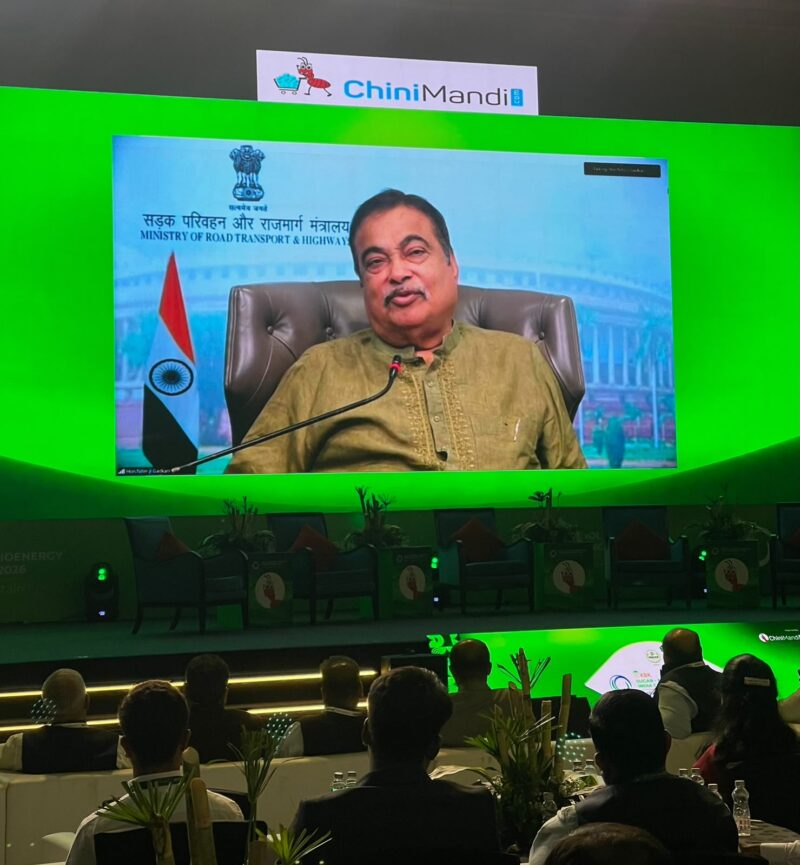
Mumbai: Stressing that the future growth of India’s sugar and bioenergy sectors must be supported by the sustainable use of natural resources, Nitin Gadkari, Union Minister for Road Transport and Highways, called for greater focus on irrigation efficiency and water conservation in sugarcane cultivation while addressing the Sugar Ethanol Bioenergy India Conference 2026 in Mumbai.
Highlighting the challenge of balancing agricultural growth with environmental sustainability, Gadkari said the expansion of ethanol production and bioenergy initiatives must go hand in hand with responsible water management practices.

Describing sugarcane as a water-intensive crop, the minister said improving irrigation efficiency and treating water as a valuable national resource would be critical to ensuring the long-term sustainability of the sugar and ethanol industries.
Advocating a new approach to water use, Gadkari suggested that India should explore the concept of a water grid, similar to other infrastructure systems, to optimise distribution and reduce wastage.
“Water should be used like deposits in a bank,” he said, adding that governments, NGOs and social organisations should work together to strengthen water conservation efforts across the country.
Moving from water management to India’s broader energy transition, Gadkari outlined a long-term roadmap centred on ethanol, biomass, green fuels and rural industrialisation.
He said India is steadily moving towards higher ethanol usage in transportation and reiterated the government’s intention to promote flex-fuel technology across vehicle categories.
“Flex engine is our aim and we are achieving it,” Gadkari said.
He added that the country is working towards enabling vehicles capable of operating on significantly higher ethanol blends and expressed confidence in the future of ethanol-led mobility. The government has authorised the use of E100 fuel and is in process of legally authorising the use of 100 percent ethanol, he said.
The minister noted that nearly 96 per cent of India’s vehicle fleet — around 38 crore vehicles — continues to run on fossil fuels, contributing to rising carbon emissions.
Gadkari said approximately 330 million metric tonnes of carbon emissions are being released into the atmosphere and warned that emissions could rise sharply if alternative energy solutions are not adopted at scale.
Positioning farmers at the centre of India’s energy transition, Gadkari said agriculture must evolve beyond food production to become a source of fuel, industrial raw materials and clean energy.
“Our aim is to make farmers self-reliant and bioenergy is important for this,” he said.
The minister highlighted ongoing research across multiple areas of alternative fuels and said work is progressing on converting ethanol into isobutanol, which could emerge as an alternative to diesel.
He said isobutanol could find applications across the agriculture, construction and automobile sectors, creating new industrial opportunities.
Gadkari also said efforts are underway to develop technologies for converting carbon dioxide into ethanol, underlining that innovation and research should remain national priorities.
Expanding on opportunities for the sugar and bioenergy sectors, he said agricultural residues and industrial by-products could become important feedstock sources.
According to the minister, around 4,000 plants based on agricultural waste are expected to be established across India, while materials such as spent wash and press mud can be effectively utilised for energy generation.
Turning to aviation and global fuel markets, Gadkari said India has strong potential in bio-aviation fuel and Sustainable Aviation Fuel (SAF) produced from ethanol.
“The world market will be open for us,” he said, adding that India should prepare to emerge as a major supplier of sustainable fuels.
The minister also highlighted opportunities to reduce import dependence through innovation in infrastructure materials.
India currently requires around 120 lakh tonnes of bitumen annually, of which domestic production meets only about 25 per cent of demand, he said.
Gadkari suggested that bio-bitumen produced from biomass and sugarcane molasses could reduce imports while creating additional revenue streams for the agricultural sector.
He added that trials involving biomass-based bitumen in road construction had delivered encouraging results.
Calling hydrogen the fuel of the future, Gadkari said India is also working on expanding biogas and compressed biogas (CBG) plants across villages to create stronger rural economies and more stable income opportunities.
Concluding his address, Gadkari said India’s transition towards ethanol, biofuels, hydrogen and sustainable technologies is aimed not only at reducing emissions but also at creating a more resilient agricultural economy.
“All these attempts will help us to make India self-reliant,” he said, adding that bioenergy-led diversification has the potential to accelerate agricultural growth and strengthen rural development.
To watch full discussion click here
















no sense in this statement. Corruption and crony capitalism is destroying India scarce water resources.