
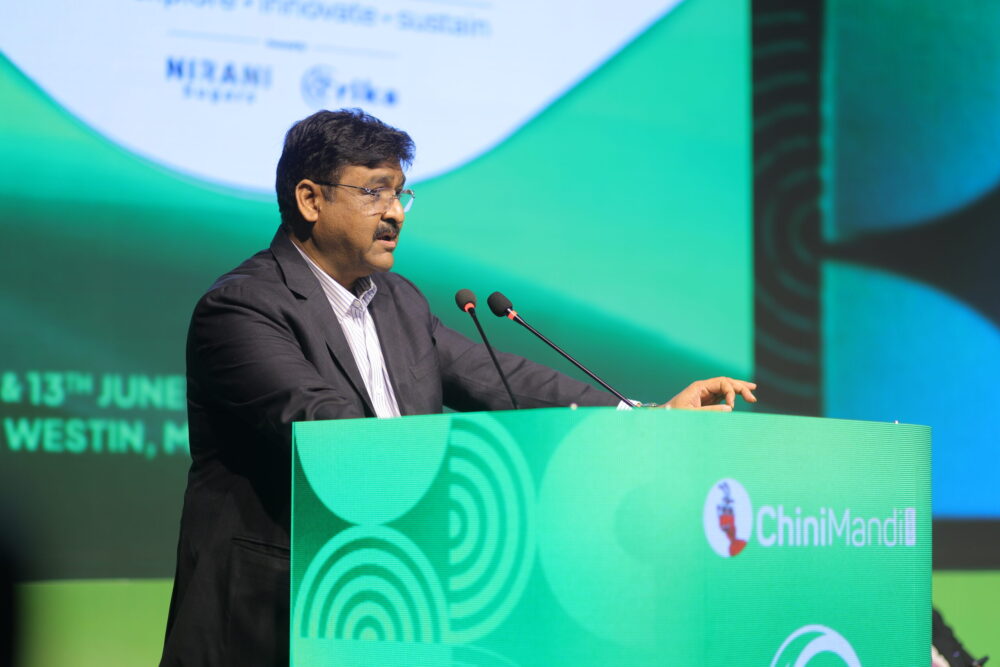
Mumbai: Positioning the Indian sugar industry at the centre of the country’s clean energy transition, Ravi Gupta, Director, Shri Renuka Sugars in his keynote address at the inauguration of Sugar Ethanol Bioenergy India Conference 2026 in Mumbai (SEIC) 2026, said India’s ethanol success story has evolved beyond fuel blending and is now driving rural prosperity, energy security and environmental sustainability.
Addressing policymakers, sugar industry leaders, oil marketing companies and automobile manufacturers, Gupta said few industries globally enjoy the unique position of simultaneously contributing to food security, energy security and economic development.

Reflecting on India’s biofuel journey, he said that two decades ago, achieving nearly 20 percent ethanol blending appeared highly ambitious, but collaborative efforts transformed it into reality.
“Thanks to visionary leadership and the support of the Government, oil marketing companies, automobile manufacturers and the industry, India has created one of the most successful biofuel programmes in the world,” he said.
According to Gupta, the ethanol programme has gone far beyond reducing crude oil imports and has delivered meaningful economic outcomes in rural India.
“It has created prosperity in villages. It has improved liquidity in sugar mills. It has enabled timely payments to farmers. It has generated economic activity in rural India. Money which earlier went out of the country to oil-producing nations is today circulating within Indian villages,” he said.
Describing ethanol as more than an energy product, Gupta remarked, “Ethanol is not merely a fuel. Ethanol is rural development in liquid form.”
Gupta credited Union Minister Nitin Gadkari for consistently advocating the concept of farmers becoming energy producers.
“He often says, ‘I do not want India to import fuel, I want India to import prosperity to farmers.’ Today we are witnessing that vision becoming reality,” Gupta said.
He noted that recent developments—including the launch of flex-fuel vehicles and wider availability of higher ethanol blends—signal the emergence of a stronger ecosystem for alternative fuels.
“The launch of the flex-fuel Wagon R by Maruti Suzuki marks a new chapter in India’s mobility story. Hero MotoCorp has introduced flex-fuel motorcycles. And our Oil Marketing Companies have started retailing E85 fuel at prices almost twenty rupees cheaper than petrol,” he said.
Gupta said the current transition extends beyond industrial growth and represents a structural transformation in rural India.
“For decades, Indian farmers have been our ‘Anna Daata’—the providers of food security. But I believe the coming decades will witness another historic transformation. Our farmers will increasingly become ‘Urja Daata’—providers of energy security,” he said.
Calling the shift a “silent revolution,” Gupta argued that the sugar industry is emerging as a sector capable of delivering food security, energy security and environmental sustainability simultaneously.
Looking at the broader energy landscape, Gupta said India should adopt a multi-technology approach instead of relying on a single solution.
“Electric mobility will have its place. Hydrogen will have its place. Bio-CNG will have its place. And ethanol will certainly have its place. The future belongs not to one technology, but to many technologies working together,” he said.
He also identified Sustainable Aviation Fuel (SAF) as the next major opportunity for India.
“The world aviation industry is looking for low-carbon alternatives. And I believe India is uniquely positioned to emerge as a major player in Sustainable Aviation Fuel. We have feedstock. We have technology. We have entrepreneurial spirit. And above all, we have farmers,” Gupta said.
Highlighting the role of compressed biogas and integrated bio-energy complexes, Gupta said agricultural residue can become a source of economic value and sustainability.
“Every sugar mill can evolve into an integrated bio-energy complex producing sugar, ethanol, biogas, power and bio-fertilizers,” he said.
Gupta also stressed that the green energy transition requires financially healthy businesses capable of sustained investment.
“Green energy cannot come from a weak industry. It requires investment. Investment requires confidence. And confidence comes from profitability,” he said.
He argued that sugar pricing should be viewed in the context of enabling future investments in ethanol, SAF and compressed biogas.
“Sugar provides the foundation upon which investments in green energy are built. Therefore, allowing sugar prices to move in line with market realities should not be viewed merely through the prism of sugar,” he said.
Gupta added that India should expand its ambitions beyond sugar exports.
“We should aspire to export energy. We should export ethanol technologies. We should export engineering expertise. We should export Sustainable Aviation Fuel. We should export green molecules and green solutions to the world,” he said.
Projecting his vision for India by 2047, Gupta said he sees villages becoming centres of energy production, thousands of compressed biogas plants emerging, aircraft flying on Sustainable Aviation Fuel and flex-fuel vehicles becoming common across Indian roads.
Concluding his address with a quote from Swami Vivekananda—“Arise, awake, and stop not till the goal is reached”—Gupta said India’s path forward is clear.
“From Anna Daata to Urja Daata. From sugar to sustainability. From villages to value creation. And from India being an energy importer to India becoming an energy leader.”
“The journey has begun. The future is bright. And the best days of the Indian sugar industry are not behind us. The best days are yet to come,” he concluded.















