
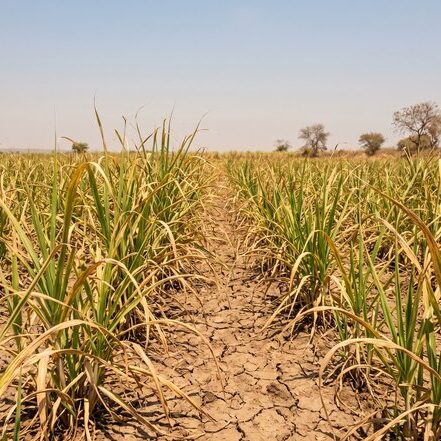
Kolhapur: Sugarcane cultivation across parts of Maharashtra is facing growing uncertainty as delayed monsoon conditions, shrinking reservoir levels and fresh restrictions on agricultural water use tighten pressure on farmers dependent on irrigation.
With weather forecasts indicating delayed rainfall and the possibility of below-normal monsoon conditions, the state government has moved to protect drinking water reserves by restricting the use of stored water in dams and irrigation systems.

In a circular issued on Saturday, Principal Secretary of the Irrigation Department Eknath Dawale directed that water earmarked for drinking purposes must not be used for any other purpose except during emergencies. The order referred to forecasts from the India Meteorological Department (IMD) indicating possible El Niño conditions and lower rainfall across the country, making conservation of available water essential.
According to the Water Resources Department, Maharashtra’s reservoirs currently hold only 24.41 per cent of their total storage capacity, lower than the corresponding period last year when storage stood at around 31.10 per cent. Pune division remains the most affected with storage at 14.54 per cent, while Amaravati and Nagpur divisions hold 37.77 per cent and 36.53 per cent respectively. Storage levels in Konkan stand at 29.77 per cent, followed by Chhatrapati Sambhajinagar at 26.72 per cent and Nashik at 25.07 per cent.
The water restrictions have had an immediate impact on sugarcane-growing regions where irrigation-dependent crops are entering a critical stage.
In Nashik and neighbouring areas, the suspension of irrigation releases from reservoirs has placed sugarcane and orchard farming under severe stress. Although all reservoirs in Nashik district and the Jayakwadi dam had reached full capacity during the previous monsoon, farmers dependent on the Godavari canal system are once again facing water shortages after irrigation releases were stopped earlier than expected due to delayed rainfall.
The disruption has placed nearly one million tonnes of standing sugarcane at risk across parts of Rahata, Kopargaon, Sinnar and Vaijapur talukas. Farmers say rainfall has now become the only immediate source of relief for protecting standing crops.
Many growers had expected scheduled irrigation support because water availability had remained comfortable after the monsoon. According to farmers, two irrigation rounds for the rabi season were expected before the end of February, followed by additional summer releases in March and May. Instead, only three irrigation cycles were completed, leaving groundwater levels under pressure and perennial crops exposed to moisture stress.
Concerns are also growing that fodder shortages may force early harvesting of standing cane, affecting yields and returns. Farmers argue that more effective water planning could have reduced the current crisis.
Adding to concerns in western Maharashtra, the Office of the Executive Engineer, Kolhapur Irrigation Department (North), has imposed a ban on the use of agricultural water pumps along major rivers in the district.
Executive Engineer Jyoti Devkar announced that agricultural water lifting has been prohibited on both banks of the Panchganga, Bhogawati, Dudhganga, Warna, Tulshi, Kasari, Kadvi, Kumbhi, Dhamani and Jambhali rivers. The order came into effect on June 15, 2026, and will remain in force until further instructions are issued.
Under the order, any unauthorised water extraction during the restriction period will lead to seizure of the pump and suspension of the water lifting licence for one year. The Irrigation Department has stated that it will not be responsible for losses resulting from violations.
The move has increased concern among irrigation-dependent farmers, especially in sugarcane-growing belts where river pumping has traditionally supported standing crops during dry periods.
Meanwhile, weather forecasts suggest that monsoon activity may strengthen after the twentieth of the month. Farmers across the Godavari basin and other sugarcane-producing regions say timely rainfall is now essential to protect crops and avoid further losses.















