
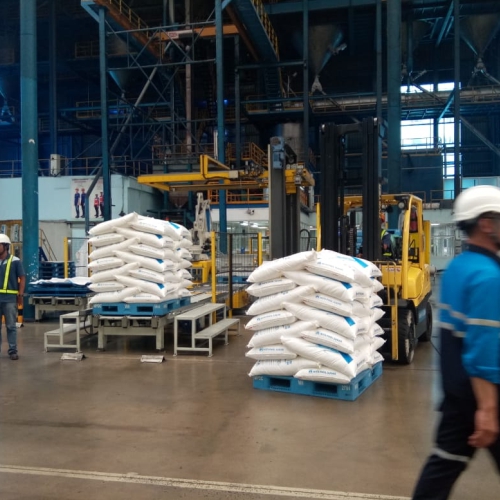
South Africa’s sugar industry is renewing calls for stronger protection against imported sugar following the agreement between the Industrial Development Corporation (IDC) and Vision Sugar Group that secured the future of Tongaat Hulett Limited (THL) and helped safeguard thousands of jobs across the sector.
Industry groups and labour organisations say that while the rescue package has stabilised one of the country’s largest sugar producers, urgent action is now needed to shield the sector from rising volumes of low-cost sugar imports, Mail & Guardian reported.

For several years, stakeholders across the sugar value chain have argued that cheaper imports, primarily from India, Guatemala, Brazil and Thailand, have intensified pressure on the domestic industry. Sector representatives also point to the impact of South Africa’s Health Promotion Levy, introduced in 2018, as an additional challenge for producers.
Industry proposals seeking safeguards against low-priced deep-sea sugar imports are currently under review by the International Trade Administration Commission (ITAC), which is also assessing possible changes to the dollar-based reference price used for sugar tariff calculations.
The SA Canegrowers Association warned that the continued rise in imports is placing the local industry under increasing strain.
According to the association, nearly 200,000 tonnes of imported refined sugar entered South Africa during 2025, driven by lower global sugar prices, exchange rate movements and what it described as insufficient tariff protection.
The association added that early indicators from 2026 suggest imports continue to increase despite recent tariff adjustments.
Data from the South African Revenue Service showed that the country imported 24,600 tonnes of deep-sea sugar in January 2026 alone, exceeding total import volumes recorded during the full years of 2020, 2021 and 2022 combined.
SA Canegrowers Chairperson Higgins Mdluli said importers were benefiting from lower international prices while selling sugar domestically at prices comparable to locally produced sugar.
According to Mdluli, the result has been reduced market space for locally produced sugar and growing concern over employment across the sector. Industry estimates suggest cheap sugar imports have contributed to losses of approximately R1.5 billion.
Labour federation Cosatu in KwaZulu-Natal also expressed concern over the effect of imported sugar on employment and rural livelihoods.
Cosatu KZN Secretary Edwin Mkhize said protecting jobs remained the organisation’s priority during the Tongaat Hulett process and stressed that local sugar production must receive stronger protection to preserve employment and support small-scale growers.
The federation also called for accountability over actions that contributed to Tongaat Hulett’s financial difficulties.
South Africa’s sugar industry remains a major contributor to rural economies, particularly in KwaZulu-Natal and the Mpumalanga lowveld region, generating more than R25 billion annually. KwaZulu-Natal contributes R18.8 billion, while Mpumalanga contributes around R6 billion.
Chairperson of the parliamentary portfolio committee on trade and industry, Mzwandile Masina, said recent improvements in sugar sales were encouraging but insufficient to secure long-term industry stability.
He pointed to the Sugar Value Chain Master Plan as an important mechanism to support industry recovery but noted that challenges remain, including import pressure, funding requirements and finalisation of pricing and trade protection measures.
During the first phase of the master plan, local sugar sales increased from 1.25 million tonnes to 1.55 million tonnes, while local sourcing by downstream users rose to 98 per cent of sugar sold.
According to the Department of Trade, Industry and Competition, engagement with industry stakeholders is continuing as part of an ongoing review of the master plan, with several proposals under consideration, including additional trade remedies aimed at supporting the sector.















