
Varietal development in sugarcane is a cornerstone of policy advancements pinned to the sugar sector. There have been several concerns- weather issues, pest damages etc. that is hampering good sugarcane production lately.
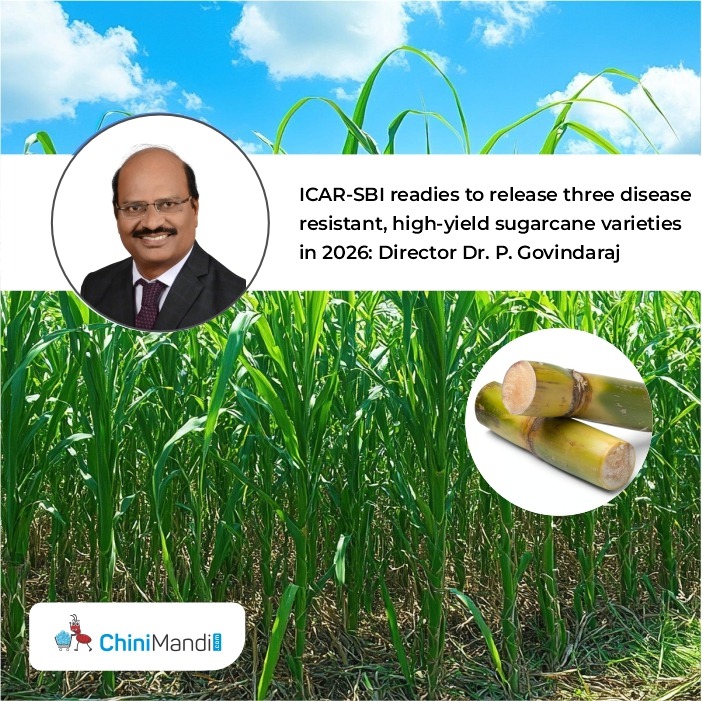
The Director of ICAR-Sugarcane Breeding Institute, Coimbatore, Dr. P. Govindaraj, said that the institute has identified three sugarcane varieties which are showing higher yielding prospects. These three varieties are in the final stage of Release.

He said that higher sugarcane yielding varieties combined with high sugar content promise to give higher ethanol yield as well, hence the focus of the institute is to develop disease resistant, high cane yield and high sugar recovery varieties.
Which new sugarcane varieties are closest to commercial release?
There are three promising varieties that have been identified for release in 2026:
- Co 20016 (Karan 20): An early-maturing, high-yielding variety identified in July 2026 for commercial release in the North West Zone (Haryana, Punjab, Rajasthan, Uttarakhand, and parts of Uttar Pradesh). It combines high cane yield with improved adaptability and red rot resistance.
- Co 18003: A mid-late maturing variety identified and ready to be released for the Peninsular Zone consisting of Tamil Nadu, Kerala, Karnataka, Andhra Pradesh, Gujarat, Maharashtra and Madhya Pradesh. It offers superior yield than Co 86032 and with better juice quality attributes and is resistant to Red rot.
- Co 09004: An early maturing variety identified and ready to be released for the East Coast Zone consisting of Coastal regions of Tamil Nadu, Andhra Pradesh and Orissa. It recorded higher cane yield, better juice quality and resistant to Red rot and smut diseases.
These varieties are in the final stage of Release through Central Variety Release Committee and Gazette Notification
How many varieties are currently in the breeding pipeline, from early-stage research to multi-location trials?
The ICAR-SBI follows robust, well-defined multi-tier breeding procedures.
Around 1850 clones are in the early-stage evaluation, 350 clones in the advanced station trials and 70 clones are in the muti-location trials including AICRP(S), SISMA and ISMA trials. These improved clones in different stages of testing will ensure a steady flow of superior varieties suitable for different agro-climatic zones in the country, with emphasis on yield, quality, and resilience.
Which traits are now receiving the highest priority: higher sugar recovery, yield, climate resilience, disease resistance, or water-use efficiency?
All listed traits are important in modern sugarcane improvement to meet the requirements of both farmers and sugar industries. However, disease resistant particularly evolving varieties resistant to red rot disease (caused by Colletotrichum falcatum) combined with high cane yield and sugar recovery have been accorded top priority since the beginning of sugarcane genetic improvement in India.
With respect to the red rot breeding programme, new pathotypes (variants) of Colletotrichum falcatum are emerging frequently (e.g. pathotype Cf13 affecting popular variety Co 0238). So, efforts are made to evolve resistant varieties against the new pathotype. In the recent breeding programmes of the ICAR-SBI, climate resilience traits, especially drought tolerance are being actively stacked into new lines. Although there is no targeted breeding programme especially for tolerance to drought, advanced stage selection clones at Initial Varietal Trial of AICRP(S) are tested for drought tolerance.
Micro Irrigation is advocated wherever water shortage is experienced. Emphasis is given for balanced improvement for yield, quality, and biotic and abiotic stress tolerance as it ensures varietal requirement of both farmer and sugar industry.
Are varieties being developed specifically for higher ethanol production?
Not yet. Extensive studies carried out at the institute indicated that all the high sugar varieties are suitable for higher ethanol production. Hence, high sugar varieties combining high cane yield is expected to give high ethanol yield as well. So, the high sugar varieties already developed are generally well-suited for the ethanol industry.
Has the breeding strategy changed in response to climate change and evolving industry requirements?
Yes. While the objectives such as high cane yield and high sucrose content in juice remains the basic requirement of any sugarcane improvement programme, other breeding objectives set at the ICAR-SBI Coimbatore are dynamic, responsive and target to the emerging abiotic and biotic stresses, industry or end user need. For example, when the new pathotypes of Colletotrichum falcatum emerged in East Coast Zone (ECZ) and North Western Zone (NWZ), the ICAR-SBI has evolved Moderately Resistant varieties against the newly evolved pathotypes prevailed in the respective zone (Co 09004 for ECZ and Co 20016 for NWZ).
Flowering is a negative trait in sugarcane farming, serious in the peninsular zone of India and is influenced by climate change. Non-flowering varieties such as Co 09004 and Co 18009 were evolved to address the issue. Drought is a cosmopolitan abiotic factor affecting sugarcane yield. The ICAR-SBI has recently released a drought tolerant sugarcane variety, Co 18009 for cultivation in Tamil Nadu. There was growing demand from the gur/jaggery industry in Northern Karnataka and Maharashtra to evolve sugarcane varieties that give golden colour jaggery. Co 92005 was developed to cater their needs. Biomass and paper industries demanded sugarcane with high energy/biomass for boiler, paper or particle board making.
The ICAR-SBI has identified a few high biomass generating Type I and Type II energy canes. Spiny sugarcane varieties (with spiny hairs on leaf sheath) cause itching to the harvesting labours hence not preferred. Recently evolved varieties do not have or with less spines.
When combine harvester was introduced in Tamil Nadu or South India, the industry was demanding erect, growing, self-detrashing varieties with compact stubble. Co 86032, Co 0212 and Co 18009 were evolved to suit mechanical harvesting. The breeding objectives at ICAR-SBI are reviewed regularly to align with climate change, industry demands, and farmer feedback.
Can future sugarcane varieties significantly reduce irrigation requirements?
Sugarcane is one among the few crops that produce higher biomass and it is the one of the largely harvested biomass on the earth. In south India, few progressive farmers are harvesting 100 tonnes of cane per acre (120 tonnes biomass including tops and trashes). To produce 120 tonnes biomass per acre, the crop inherently requires substantial water. Efforts are made to develop Water Use Efficient (WUE) sugarcane varieties which require less water per unit of biomass production. Further using high WUE and drought tolerant varieties as well as adapting micro irrigation techniques such as surface drip and sub-surface drip irrigation the total water requirement of sugarcane crop can be significantly reduced in future.
Which diseases currently pose the greatest threat to Indian sugarcane production?
- Red rot (new pathotype Cf13) in Sub-tropical region of India
- Pokkah boeng-crown mealy bug complex in Tamil Nadu and parts of South India
Co 0238 was a blockbuster variety; however it succumbed to pests. Was this an inherent trait of the variety or were there usage concerns? What lessons can we learn from this?
Resistance or susceptibility in sugarcane variety to the red rot infection is genetically controlled. In the last few decades, red rot in India was largely controlled through evolving resistant variety rather than through chemical control. At time when Co 0238 was released in 2009 for the North West Zone of India comprising the states of Haryana, Punjab, Rajasthan, Uttarakhand and Western and Central Uttar Pradesh it showed MR (moderately resistant) reaction to the then prevailing pathotypes (cf7 and cf8).
Large scale spread of this wonder variety beyond the recommended zone, poor replacement of seed canes in certain zones, monoculture with single variety (occupied 82% of the sugarcane grown area in Uttar Pradesh in 2021-22), poor care under water-logged conditions in Eastern U.P. etc. exerted pressure on red rot pathogen and as a result, a new pathotype (Cf13) of Colletotrichum falcatum has emerged in the Uttar Pradesh which infected the moderately resistant Co 0238.
Emergence of virulent strains of red rot vis-à-vis the susceptibility of Co 0238 to red rot outbreaks in recent years in North India, the U.P. in particular has led to significant losses, particularly in the Terai belt and western UP.
Key Lessons learned from this episode are:
- Varietal Diversification: Sometimes a cane variety may be extraordinary in performance and very much preferred by all end-users. However, extensive monoculture of such variety beyond 60% of the total cropped area will result in increased susceptibility to pests and disease and ultimately leads to losses to cane growers and sugar industry. Therefore, varietal diversification with 5-6 major varieties must be maintained in each factory or zone or in the State. Adopting a balanced combination of early, mid-late, water logging and disease-resistant varieties is always beneficial in many ways.
- Seed Health and periodical varietal replacement programmes are required with newly developed resistant varieties. Enforcing the production and planting of disease free, vigorous planting materials (seed canes) either through tissue culture derived seed canes by following stringent three-tier seed production program the field life of the dominant varieties may be prolonged. The problem of red rot in Co 0238 in the U.P. state could have been delayed for a few years, if strong seed health programmes as narrated above combined with seed treatment have been followed.
- Integrated management: Solely relying on varietal resistance would mislead and may lead to sudden breakdown of resistance. Therefore, prophylactic plant protection measures such as sett treatment with appropriate fungicides and with appropriate sett treatment devices may be adopted especially if a variety spreading in larger acreage and sporadic incidence of known pests/diseases are noticed. Also, emphasis must be given on soil health management by applying organic manures, composts, green manures, biofertilizers and trash incorporation practices. Soil carbon and beneficial microbes in the soil should be improved.
- Pest and disease surveillance and Advisory: Periodical survey / monitoring of emerging pests/disease combined with advisories to manage the problem at critical times and organizing awareness campaigns along with sugar factories and state administration will pay much dividend.
- Continuous Breeding: The research organization should continually work on the further improvement of a popular variety and keep ready a second line of varieties as an alternate / replacement variety.















