
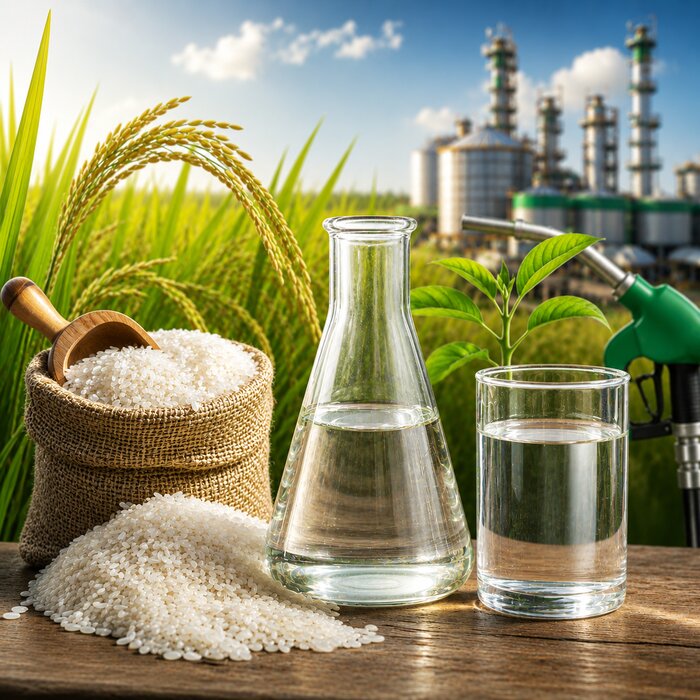
An expert committee constituted by the Ministry of Agriculture and Farmers Welfare in 2024 has found that water requirement is highest for rice among ethanol feedstock crops, followed by maize and sugarcane, the government told the Lok Sabha on Thursday.
In a written reply to an unstarred question, Minister of State for Petroleum and Natural Gas Suresh Gopi said the government had adopted a balanced approach to the Ethanol Blended Petrol (EBP) Programme to ensure water sustainability, food security and farmers’ interests remained paramount. The Minister was responding to a question from Shri Thiru D M Kathir Anand on the water footprint of ethanol production and its implications for groundwater resources, irrigation demand and agricultural sustainability, with specific reference to Tamil Nadu.

According to the reply, the government follows a diversified feedstock strategy under the National Policy on Biofuels, drawing ethanol from multiple approved sources including sugarcane-based feedstocks, maize, damaged foodgrains, broken rice, foodgrains unfit for human consumption, and surplus foodgrains approved by the National Biofuel Coordination Committee (NBCC). The Minister said the government was also promoting Second Generation (2G) ethanol from agricultural residues under the Pradhan Mantri JI-VAN Yojana to progressively increase the use of non-food feedstocks.
The reply said the diversion of foodgrains for ethanol production was carefully calibrated in consultation with the Department of Food and Public Distribution, with food security requirements under the Public Distribution System (PDS), the National Food Security Act (NFSA), Other Welfare Schemes (OWS) and prescribed buffer stocks accorded the highest priority. Only surplus foodgrains, after meeting these requirements, were permitted for ethanol production, the Minister said, adding that the government was encouraging crop diversification towards comparatively less water-intensive feedstocks such as maize.
On water-use efficiency, the Minister said measures such as micro-irrigation and drip irrigation were being promoted under the Per Drop More Crop component of the Pradhan Mantri Krishi Sinchayee Yojana, with many sugar mills also encouraging farmers to adopt water-efficient cultivation practices. Molasses-based distilleries with incineration boilers and grain-based distilleries are required to operate as Zero Liquid Discharge (ZLD) units, enabling recycling and reuse of process water, according to the reply, which noted that modern ethanol plants typically consume about three to five litres of processed water to produce one litre of ethanol.
On funding, the Minister said approved budgetary allocations for the bio-ethanol (2G) project under the PM JI-VAN Yojana stood at Rs 189.38 crore in 2021-22, Rs 83.34 crore in 2022-23, Rs 151.99 crore in 2023-24, Rs 30 crore in 2024-25 and Rs 37.875 crore in 2025-26, against which Rs 150 crore, Rs 37.5 crore, Rs 75 crore, Rs 7.5 crore and Rs 37.5 crore respectively were disbursed to project developers in the corresponding years. The Minister added that financial assistance had been approved in June 2026 for two commercial-scale and one demonstration-scale 2G ethanol project.















