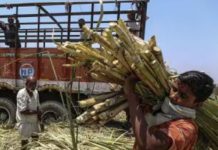
Pune: With Maharashtra’s sugarcane crushing season set to begin soon, the Sugar Commissionerate has directed sugar mills to take preventive measures to protect cane-cutting workers and their families from leopard attacks.
The Commissionerate has advised mills to avoid setting up temporary settlements for cane-cutting workers inside sugarcane fields and instead provide accommodation at safer locations. The directions come amid concerns over increasing human-wildlife conflict in sugarcane-growing areas, Agrowon reported.

The Junnar forest division in Pune district has the highest leopard population in Maharashtra. According to the Forest Department, extensive sugarcane cultivation in the region has created favourable conditions for leopards to take shelter in fields. With successive generations of leopards being raised in sugarcane areas, many of them are now less familiar with forest habitats.
Sugarcane fields are not the natural habitat of leopards. However, the expansion of irrigation and availability of water have encouraged sugarcane cultivation even in traditionally dry areas. Limited human activity in fields after planting, along with the availability of water and prey, has made sugarcane fields suitable shelter for leopards.
The dense crop provides hiding places, while the availability of prey such as rabbits and wild boars has contributed to the increasing presence of leopards.
The risk becomes particularly significant during harvesting. When sugarcane is cut, young leopard cubs can be exposed in open fields, increasing the possibility of encounters between workers and wildlife.
Safety measures for cane workers
The Sugar Commissionerate has asked sugar mills to implement several measures to minimise the risk of leopard attacks. These include providing worker accommodation at safe locations, installing temporary fencing if settlements are located near fields, and arranging solar fencing or adequate lighting around worker settlements.
Mill management has also been asked to coordinate with the Forest Department and educate workers about leopard behaviour and safety precautions.
Special arrangements should be made for the supervision, care and education of children living in cane-worker settlements. Mills have also been advised to provide enclosed toilets and discourage open defecation around the settlements.
The measures are aimed at reducing human-wildlife encounters and ensuring the safety of thousands of cane-cutting workers and their families during the upcoming crushing season.