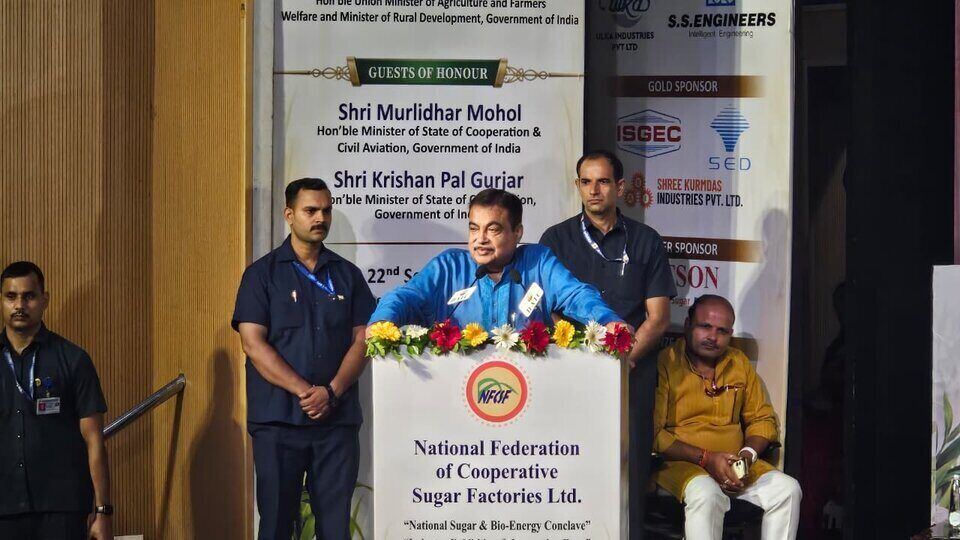
New Delhi: Union Minister Nitin Gadkari has urged sugar mills to move beyond dependence on sugar production and develop a wider portfolio of ethanol, compressed biogas (CBG) and other value-added products to improve their economic viability and strengthen farmers’ incomes.
Addressing the National Federation of Cooperative Sugar Factories Ltd (NFCSF) efficiency awards ceremony, Gadkari said sugar mills could not remain dependent solely on sugar as the commodity operates within a global market where production surpluses in major producing countries can sharply influence prices.

He said diversification into energy and power was essential for making agriculture economically viable. “Diversification of agriculture towards energy and power sector” was an approach he had advocated since 2004, he said, adding that the conversion of knowledge and technology into wealth would be critical for the future of agriculture.
Gadkari said sugar mills needed to focus on the economic value of by-products and waste generated across the agricultural value chain. He described this approach as “waste to wealth”, arguing that agricultural residues such as bagasse, paddy straw, bamboo and Napier grass could be converted into fuels and other products.
Referring to the global sugar market, Gadkari said Brazil’s large-scale mechanised sugarcane farming and its production costs could influence international sugar prices when the country has a surplus. According to him, Indian sugar mills therefore cannot depend only on sugar revenues and need to develop additional revenue streams through by-products.
He highlighted ethanol as one of the key opportunities for the sugar industry. Sugarcane juice and other feedstocks can be converted into ethanol, while distilleries and integrated sugar complexes can create additional value from products generated during processing.
Gadkari also pointed to the potential of CBG as another major avenue for sugar mills and farmers. He said technology was now available to produce CBG from paddy straw, bamboo, bagasse and Napier grass. He cited government data showing that 1,908 CBG plants had been registered in the country, of which 132 were operational.
According to Gadkari, around 22 million tonnes of paddy straw are burnt annually in Punjab and Haryana, representing a significant potential feedstock for bioenergy production. He said converting agricultural residue into fuel could simultaneously address waste management, reduce fossil-fuel imports and create an additional source of income for farmers.
He also highlighted developments in sustainable aviation fuel (SAF) and advanced biofuels. Indian Oil has established a plant in Panipat to produce SAF from agricultural residue, while bamboo is being used for ethanol production at Numaligarh in Assam, he said.
Gadkari said value addition could also extend to products derived from sugarcane processing. Press mud and wax generated by sugar mills could be used for higher-value applications. He cited the example of sugar mills in Satara, where wax obtained from sugarcane processing could fetch Rs 300-350 per kg and is used by the cosmetics industry.
He also referred to developments in flex-fuel vehicles, saying Toyota was scheduled to launch a 100% flex-fuel Innova in October that can operate on ethanol. He said greater use of electric vehicles for transporting sugarcane from farms to mills could also reduce diesel consumption and operating costs.
Gadkari stressed that technology could play a major role in reducing agriculture costs and increasing productivity. He cited artificial intelligence, nano urea, nano DAP and drone-based spraying among the technologies that could help farmers reduce input costs while improving yields.
He also highlighted the potential of converting carbon dioxide into value-added products. According to him, carbon dioxide can be processed through electrolyser-based technologies to produce products such as hydrogen, methanol and urea, creating additional opportunities for industrial and agricultural value addition.
The minister cited the growth in maize prices following the decision to permit maize-based ethanol production. He said maize prices in Bihar and Uttar Pradesh had increased from around Rs 1,800 to Rs 2,600 per quintal, putting an additional Rs 45,000 crore into farmers’ hands.
Gadkari said ethanol production from damaged grain and broken rice was also creating new demand for agricultural produce. Such diversification, he said, could help farmers become energy producers rather than remaining solely dependent on conventional agricultural commodities.
He argued that the fundamental challenge facing Indian agriculture was its lack of economic viability. Farmers would be able to build sustainable incomes only when agriculture generated greater value from its primary produce and by-products, he said.
“Knowledge to wealth” and “waste to wealth” should therefore become central to the development of agriculture and rural economies, Gadkari said, stressing that innovation, entrepreneurship, science, technology, research and skill development would be critical to achieving this transition.
He said stronger agricultural incomes would translate into stronger rural economies, with the development of bioenergy and value-added industries creating employment and reducing dependence on imported fossil fuels.