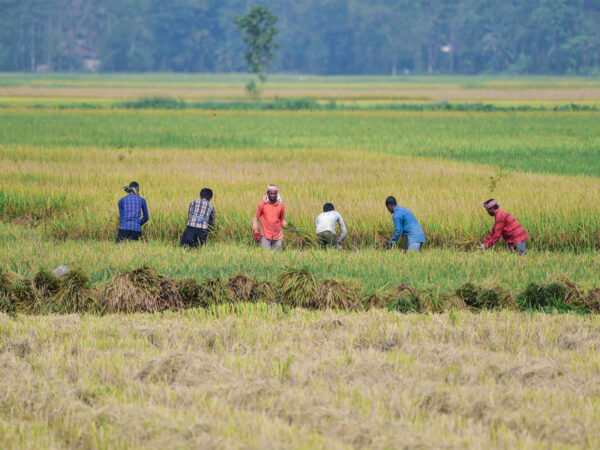
Sugarcane acreage in India stood at 5.84 million hectares as of September 18, marginally lower than the 5.88 million hectares recorded a year earlier, even as overall kharif sowing has nearly caught up with last year’s level, according to agriculture ministry data, reported Mint.
The sugarcane acreage was down by around 40,000 hectares year-on-year, while farmers had covered 110.39 million hectares under kharif crops by September 18. Overall kharif acreage was 1.3% below the 111.89 million hectares recorded during the same period last year, but remained broadly in line with the ministry’s normal benchmark of 110.4 million hectares.

The marginal decline in sugarcane acreage comes alongside lower coverage of several other major crops, including rice, maize and cotton.
Rice acreage fell 3.7% year-on-year to 42.9 million hectares, while maize acreage declined to 9.27 million hectares from 9.48 million hectares a year earlier. Cotton acreage also fell to 10.9 million hectares from 11 million hectares.
In contrast, pulses acreage increased 1.4% to 11.9 million hectares, with higher sowing reported in Uttar Pradesh, Jharkhand, Telangana, Rajasthan, Madhya Pradesh and Andhra Pradesh.
The area under Shri Anna and coarse cereals rose marginally to 18.5 million hectares from 18.4 million hectares last year, supported by higher acreage in Rajasthan, Chhattisgarh, Odisha, Madhya Pradesh, Uttar Pradesh, Bihar, Jharkhand and Uttarakhand.
The overall crop picture remains uneven amid a 15% rainfall deficit and dry spells in parts of the country.
Agricultural experts have stressed the need to improve farm productivity and ensure more efficient and sustainable use of cultivated land to strengthen India’s agricultural resilience.
Uday Raj Anand, chief executive officer, domestic business, Parijat Industries, said agricultural resilience would increasingly depend on how productively and sustainably each hectare is managed rather than simply on expanding the area under cultivation.
Oilseed acreage edged up to 19.4 million hectares, although lower soybean and groundnut acreage offset gains in sesame and sunflower.
Meanwhile, the India Meteorological Department has forecast favourable conditions for the withdrawal of the southwest monsoon from the remaining parts of Punjab, Haryana-Chandigarh and Delhi, some more areas of Rajasthan, as well as parts of Saurashtra and Kutch, Jammu & Kashmir, Himachal Pradesh, Uttarakhand and west Uttar Pradesh over the next two to three days.
The southwest monsoon generally begins withdrawing from western Rajasthan in September before progressing towards other parts of northwest and central India and subsequently towards the southern peninsula and eastern regions.
The withdrawal marks the transition to the post-monsoon season, although its pace will depend on prevailing rainfall and atmospheric conditions.