
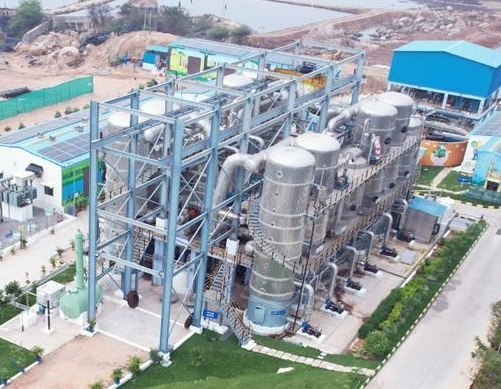
Varanasi: Balrampur Sugar Mills is developing what is being described as India’s first plant to manufacture plastic from sugar and sugar-industry waste, with the facility coming up under the company’s Kumbhi PLA (Polylactic Acid) division in Lakhimpur Kheri.
The plant is expected to use sugar and its byproducts as raw materials to manufacture PLA resin, which can subsequently be processed into a range of plastic products. A significant portion of the output is expected to be used in the production of gypsum boards, which are widely used in residential, office and commercial construction.

According to the team involved in transporting the plant machinery, sugar will first be processed into an acid, which will subsequently undergo further processing to produce lactide and ultimately PLA granules. The PLA resin can then be used to manufacture different products.
The project is being developed at an investment of more than ₹3,000 crore and has received support from international companies.
Machinery for the facility is being transported from Belgium to India by shipping and logistics company JM Baxi. The heavy equipment was scheduled to leave the Dafi Toll Plaza on Tuesday as it continued its journey towards the project site.
One of the most unusual aspects of the project has been the long-distance transportation of the machinery. A 308-wheel truck carrying the equipment reached Varanasi on Monday after a journey lasting nearly five months.
The workers accompanying the equipment have effectively been living on the road throughout the journey, with the truck serving as both their workplace and temporary home.
Sajeeb, one of the employees travelling with the machinery, said the journey had entered its fifth month, although the equipment had yet to reach its final destination. He said the workers prepare their meals on the truck and spend nights in temporary shelters made from tarpaulins whenever the convoy stops.
The workers have also carried basic household items with them. A cot is used for sleeping, while ropes tied between parts of the machinery are used to hang clothes for drying. Cooking equipment, food and water are also kept with the travelling crew.
The project represents an effort to move sugarcane beyond conventional products such as sugar and ethanol by converting sugar and its derivatives into a bio-based material that can be used in industrial applications.















