New Delhi: The Indian Sugar & Bio-energy Manufacturers Association (ISMA) welcomes the Government of India’s final notification of the Corporate Average Fuel Economy (CAFE III) norms for M1 category vehicles, issued by the Ministry of Power on September 29, 2026, according to a press release.
The final framework, applicable from April 1, 2027 to March 31, 2032, sets annual average fuel consumption standards for passenger vehicles and provides a technology-neutral pathway towards improving vehicle efficiency and reducing carbon emissions.

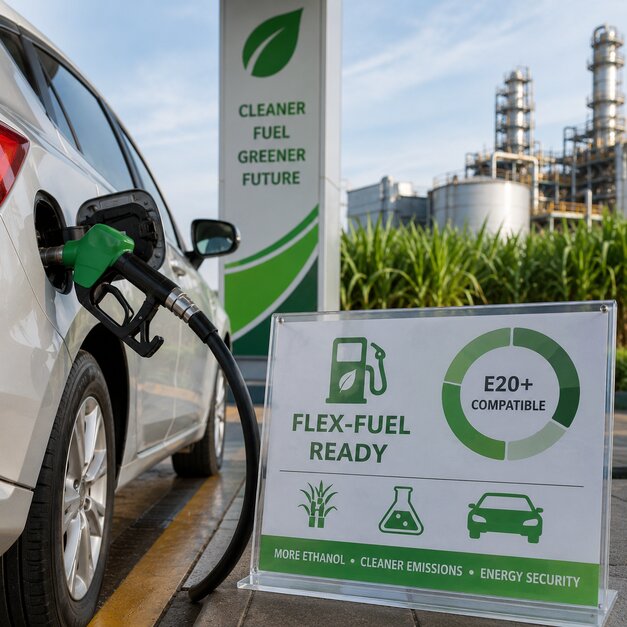
Importantly, the final notification retains key provisions recognising the contribution of ethanol-blended fuels and flex-fuel technologies to India’s decarbonisation journey. It provides a Carbon Neutrality Factor (CNF) of 8% for vehicles operating on E20 or higher ethanol blends, including Strong Hybrid Electric Vehicles (SHEVs) and Plug-in Hybrid Electric Vehicles (PHEVs), and 22.3% for Flex Fuel Ethanol Vehicles (FFVs).
The norms also retain Volume Derogation Factors (VDF)/super credits for cleaner vehicle technologies. Flex Fuel Ethanol Vehicles receive a factor of 1.1, while Flex Fuel Strong Hybrid Electric Vehicles receive 2.5. The framework additionally provides factors of 3.0 for Battery Electric Vehicles and Range Extended Electric Vehicles, 2.5 for PHEVs, and 1.6 for Strong Hybrid Electric Vehicles.
Welcoming the notification, Deepak Ballani, Director General, ISMA, said: “ISMA welcomes the notification of the CAFE III norms by the Ministry of Power and BEE, which further strengthens the policy ecosystem for cleaner and more energy-secure mobility.
The recognition of ethanol-based mobility through an 8% Carbon Neutrality Factor (CNF) for E20–E30 vehicles and 22.3% CNF for Flex Fuel Ethanol Vehicles, along with Volume Derogation Factors of 1.1 for FFVs and 2.5 for FFV hybrids, is an important step towards encouraging greater fuel and technology choice in India.
With E20 successfully achieved, E85 infrastructure being rolled out and commercially available FFVs entering the market, CAFE III provides an important regulatory push for the next phase of India’s ethanol journey.
These measures can help create additional avenues for utilising India’s growing ethanol capacity while reducing fossil-fuel dependence, strengthening energy security and resilience, and advancing India’s journey towards a more self-reliant and low-carbon mobility sector.
ISMA appreciates the Government’s continued support for scaling up ethanol-based clean mobility in India.”
ISMA believes that recognising the carbon benefits of ethanol within vehicle efficiency regulations complements India’s broader push towards the development and deployment of FFVs and flex-fuel hybrid technologies.
The notification also defines a Flex Fuel Ethanol Vehicle as one capable of operating on blends of gasoline and ethanol containing up to 85% ethanol (E85) or 100% ethanol (E100).
The final CAFE III framework represents an important step towards bringing together vehicle efficiency, alternative fuels and multiple clean-mobility technologies within India’s transport decarbonisation strategy. For the sugar and bio-energy sector, the continued recognition of ethanol’s carbon benefits can support further investment across the ethanol value chain while strengthening India’s energy security and domestic biofuel ecosystem.