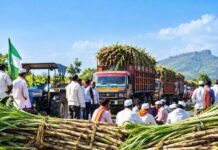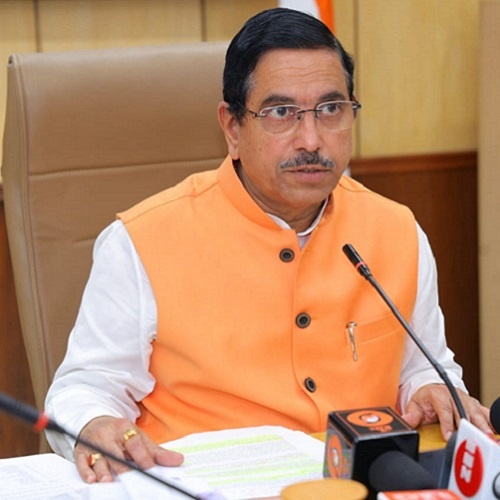
Bengaluru: The Central Government is positive about resolving the problems of sugarcane farmers. Various issues were discussed in detail at a four hour meeting held in Delhi, and the farmers’ problems will be resolved soon. Cane farmers should therefore not launch road blockade agitations, Union Minister Pralhad Joshi appealed.
Speaking to reporters in Delhi on Tuesday, Joshi said the Central Government led by Prime Minister Narendra Modi has always given priority to farmers’ interests. He said the Centre is committed to addressing the problems of sugarcane farmers and will seek the cooperation of all state governments for this.

Joshi said Union Agriculture Minister Shivraj Singh Chouhan and he himself have listened to the farmers’ problems. The issues of cane growers cannot be resolved in a day or two, or through any single ministry alone. This requires coordination between various ministries and state governments. He expressed confidence that the Central Government will soon bring news that gives farmers relief.
A joint committee has been formed to study the problems. A meeting lasting three to four hours was held in Delhi under the leadership of Union Agriculture Minister Shivraj Singh Chouhan to discuss the problems of sugarcane farmers. It was attended by senior Central Government officials, the concerned ministers of state governments and representatives of various farmer organisations.
The farmers’ problems were heard in detail at the meeting, and it was decided to form a joint committee to study these issues and suggest long term solutions. Joshi said the committee will include sugarcane farmers, agricultural scientists and representatives of the Central and state governments, and will study the farmers’ problems and recommend the necessary measures.
FRP, weight differences and wastage were among the issues discussed. The meeting discussed the fair and remunerative price (FRP) of sugarcane, the demand for a minimum support price, differences in cane weight and the alleged practice of sugar mills showing nine percent wastage, or weight loss, after cane is harvested.
The demand for fixing a separate price for sugar meant for commercial use was also deliberated. The demand for implementing a State Advised Price (SAP) in the interest of Karnataka’s sugarcane farmers was raised as well. Citing the implementation of SAP in Tamil Nadu, Haryana, Punjab and Uttar Pradesh, it was suggested that the Karnataka government also consider moving in this direction. The sugar content of cane, the nine percent wastage, weight differences and possible irregularities at sugar mills were also discussed. Joshi clarified that the state government has been advised to take strict action to stop such malpractices.
Pralhad Joshi rejected claims that the meeting with farm leaders from Maharashtra and Karnataka ended without any outcome. He said the meeting was positive and fruitful. Farm leader Raju Shetti has also agreed to the decision to form a joint committee. The suggestions and demands put forward by office bearers of various farmer organisations at the meeting will also be considered. Joshi appealed to farmers not to take the path of agitation and not to lose hope, assuring them that the Central Government will take positive steps to resolve their problems.
Meanwhile, Karnataka Chief Minister D. K. Shivakumar met Union Minister Pralhad Joshi in Delhi late on Monday night to discuss the problems of sugarcane farmers and the cane price for the 2026-27 sugar season.
Issues raised before Chief Minister Shivakumar included sugar mills recording lower cane weights, alleged tampering with weighing scales, cheating of farmers during transport after cane harvesting, and the fixing of a State Advised Price. Joshi requested that attention be paid to these matters.
Chief Minister Shivakumar also shared details of the meeting on social media. He said the discussion with the Union Minister was aimed at ensuring that Karnataka’s sugarcane farmers get a fair and remunerative price and that their problems are resolved. He also urged the Central Government to protect the interests of sugarcane farmers while taking the state’s position into account.