
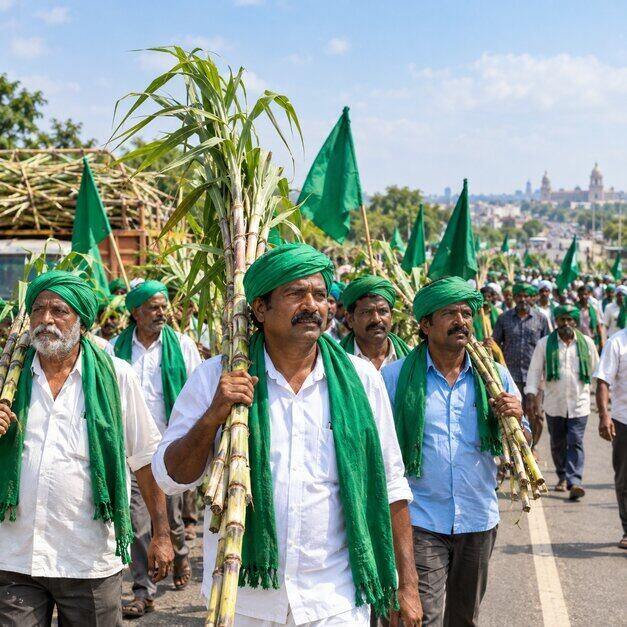
The ongoing protests by sugarcane growers across North Karnataka have brought back memories of the historic Nargund farmers’ rebellion of 1980, when an agitation over agricultural levies escalated into a major confrontation with the government and had far-reaching political consequences, The Times of India reported.
Farmers’ demonstrations, including highway blockades and road protests, have disrupted normal life in Dharwad, Belagavi, Bagalkot and Koppal districts as growers press for better sugarcane prices.

The 1980 Nargund uprising began with farmers opposing a betterment levy imposed by the state government. The movement spread across the region and turned violent after police opened fire on protesters. The incident claimed the lives of two farmers, Basappa Lakkundi and Irappa Kadlikoppa, and two police personnel.
However, farmer leaders believe the present agitation is different in its scale and underlying issues.
Shankar Ambali, state president of Karnataka Raitha Sene, said the earlier rebellion had a wider impact because it involved farmers growing different crops, whereas the current protests are largely confined to the sugar sector. He cautioned that sugarcane’s classification as an essential commodity could limit the duration and wider impact of the present agitation.
Ambali also stressed that farmers must ensure their demands are not diverted or exploited to serve the interests of sugar factory owners.
Siddu Teji, state president of Karnataka Kalasa Banduri Rait Horata Samiti, said the then government led by R Gundu Rao had failed to respond adequately to the Nargund farmers’ grievances, allowing the movement to escalate.
He noted that the current situation was different, with both the Union and state governments engaging with farmers. However, he cautioned that growers could also be influenced by vested interests.
Teji pointed out differences in the approach adopted by the two governments. While the Union Government convened a meeting on October 11 without adequate preparation, the Karnataka government had presented a detailed 10-page proposal during its October 9 meeting at Minister Laxman Savadi’s office, he said.
Recalling the circumstances behind the 1980 rebellion, Teji said incomplete irrigation and canal projects had deprived farmers of water even as severe drought conditions affected agricultural operations. The combination of inadequate irrigation infrastructure and government inaction fuelled widespread resentment among growers.
The Nargund incident occurred on July 21, 1980, when police fired on protesting farmers. The deaths of the two farmers and two police personnel became a defining moment in Karnataka’s agrarian movement.
The agitation strengthened the Karnataka Rajya Raitha Sangha and contributed to the Congress party’s defeat in the 1983 Assembly elections. The Janata Party subsequently formed Karnataka’s first non-Congress government.
The latest protests have once again placed sugarcane pricing and farmers’ economic concerns at the centre of Karnataka’s political and agricultural debate.















