
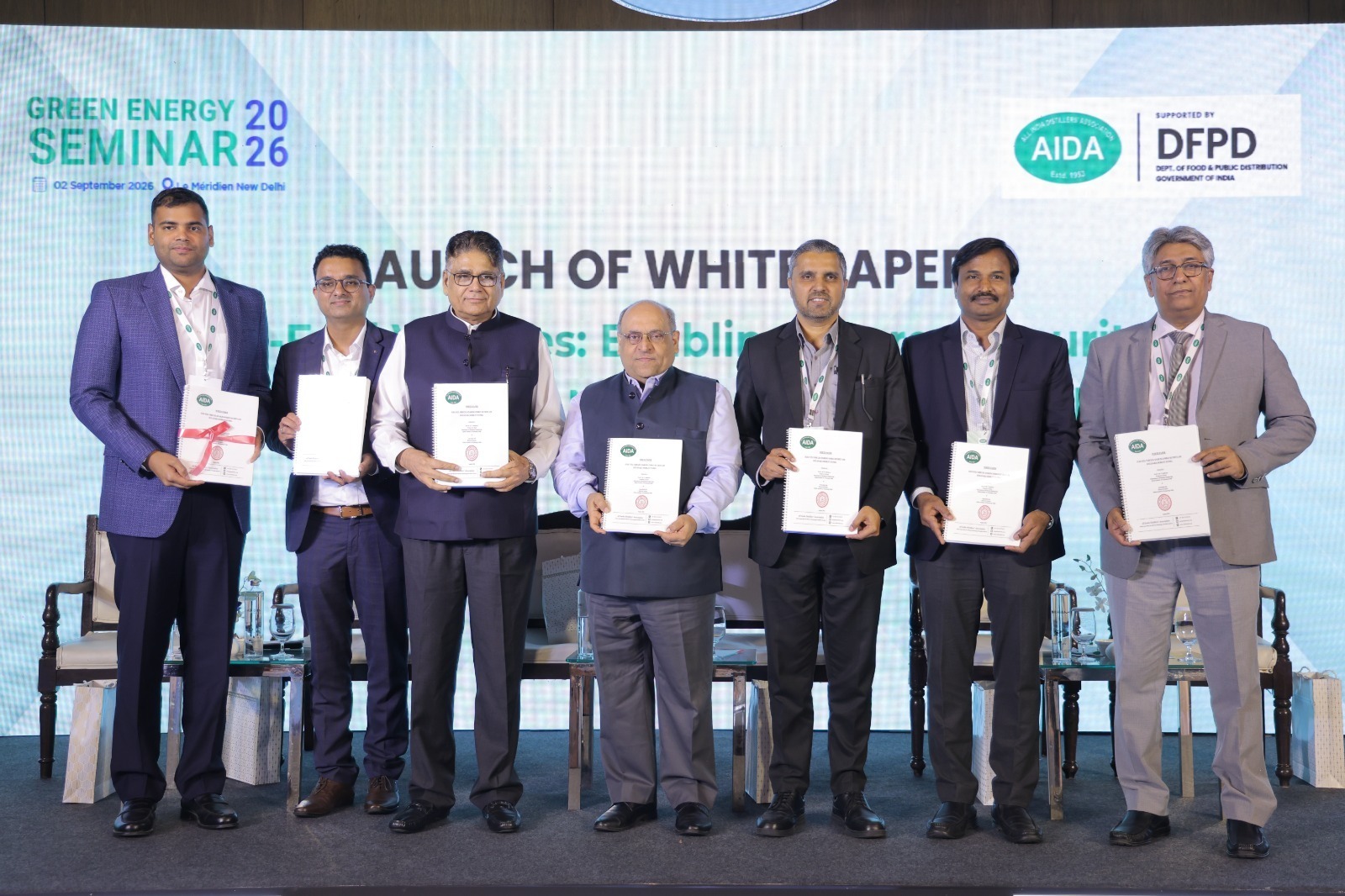
New Delhi: As India prepares for the next chapter of its ethanol and clean mobility journey beyond E20, the All India Distillers’ Association (AIDA) and IIT Delhi unveiled a landmark white paper presenting a practical roadmap for scaling Flex-Fuel Vehicles (FFVs) as a key pillar of the country’s energy security and sustainable mobility strategy, according to a press release.
The white paper, “Flex-Fuel Vehicles: Enabling Energy Security and Sustainable Mobility in India,” was launched at the AIDA Green Energy Seminar 2026, bringing together policymakers, automotive leaders, ethanol producers, fuel companies, researchers and technology experts to deliberate on India’s evolving multi-fuel mobility ecosystem.

At a time when India has successfully achieved E20 blending and is exploring higher ethanol blends, the IIT Delhi study shifts the national conversation from “Can India produce ethanol?” to “Can India build the vehicles and ecosystem capable of using it at scale?”
A roadmap for India’s flex-fuel future
Prepared by an expert team from IIT Delhi, the white paper examines every critical element required for successful FFV adoption including vehicle technology, fuel pricing, infrastructure readiness, sustainable feedstock, consumer acceptance, financing and market development.
Rather than merely identifying challenges, the study presents a prioritised ten-point policy roadmap that outlines immediate and long-term measures for building a commercially viable flex-fuel ecosystem in India.
The paper argues that Flex-Fuel Vehicles represent a pragmatic pathway for strengthening energy security, reducing crude oil dependence, expanding consumer fuel choice and supporting a cleaner mobility future while leveraging India’s growing domestic ethanol production capacity.
Designed as a reference document for government departments, automotive manufacturers, oil marketing companies, ethanol producers, investors and mobility stakeholders, the study offers one of the most comprehensive frameworks yet for advancing flex-fuel mobility in the Indian context. The paper goes beyond the debate on fuel and vehicle technology. It asks a larger question: What would it actually take to make flex-fuel mobility work at scale in India?
Drawing on technical and policy analysis, the IIT Delhi team examines the multiple pieces of the FFV ecosystem from vehicle technology and fuel pricing to infrastructure, sustainable feedstock, consumer acceptance, financing and market development.
CRID India white paper complements the post-E20 vision
Alongside the IIT Delhi publication, CRID India also launched its white paper titled “Towards a Sustainable Bioenergy Future for India: Feedstock Security, Land-Water Balance and The Path Beyond E20.”
The study examines how India can responsibly expand ethanol production while balancing food security, agricultural sustainability, land use and water resources. One of the most important contributions of the paper is its evidence-based examination of the often-simplified “food versus fuel” debate.
The study also distinguishes between total land under crops such as rice, sugarcane and maize and the incremental land actually attributable to ethanol production, taking into account alternative uses and co-products.
Its analysis estimates that ethanol-attributable land in 2023–24 was approximately 3.46 million hectares — only around 1.58% of India’s gross cropped area.
How should India optimise its limited land, water and biomass resources to deliver the greatest national benefit?
This makes the paper relevant not just to ethanol producers, but to policymakers, automotive companies, farmers, fuel companies, investors, technology providers and everyone shaping India’s future energy landscape.
Together, the two white papers present a holistic vision for India’s post-E20 future one addressing the supply side of sustainable ethanol production and the other defining the mobility pathway through Flex-Fuel Vehicles.
With India’s transport sector entering a decisive phase, the two publications offer timely policy and technical insights for organisations working across the bioenergy, automotive and clean energy value chain.
The IIT Delhi white paper, in particular, provides a compelling blueprint for how Flex-Fuel Vehicles can become a significant contributor to India’s ambition of building an energy-secure, self-reliant and low-carbon mobility ecosystem.














