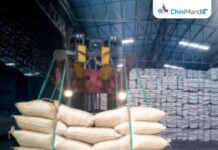
The Food Corporation of India (FCI) sold rice to ethanol distilleries at Rs 2,250-2,320 per quintal between June 2025 and June 2026, around 40% below its average procurement cost, according to a written reply in the Rajya Sabha on Tuesday.
Minister of State for Consumer Affairs, Food and Public Distribution Nimuben Jayantibhai Bambhaniya said FCI dispatched 6.35 million tonnes of rice worth Rs 14,596.78 crore from its warehouses to ethanol plants during the 12-month period, Hindustan Times reported.

Among the states receiving the highest quantities, Haryana topped the list with 844,141 tonnes, followed by Uttar Pradesh (838,645 tonnes), Punjab and Himachal Pradesh combined (658,952 tonnes), West Bengal (584,672 tonnes) and Madhya Pradesh (432,485 tonnes).
Under the Open Market Sale Scheme (Domestic), rice was supplied to ethanol distilleries at Rs 2,250 per quintal between June and October 2025 and at Rs 2,320 per quintal from November 2025 to October 2026. The government has fixed the price at Rs 2,390 per quintal for the November 2026 to June 2027 period.
FCI’s average acquisition cost was Rs 3,719.72 per quintal in 2024-25 and Rs 3,889.46 per quintal in 2025-26 (revised estimates). The acquisition cost covers procurement from farmers, while the economic cost also includes storage, transport and other carrying expenses.
The government said ethanol producers are not receiving any subsidy, maintaining that rice is sold at the notified OMSS price. However, the parliamentary reply did not explain why the sale price remains significantly below FCI’s acquisition cost.
The reply also disclosed that two cases of diversion of FCI rice allocated for ethanol production had been detected. State food departments have taken action against the distilleries involved, while FCI has stopped further rice allocations to them. The names of the distilleries were not disclosed.
Agriculture expert and independent director at a listed agriculture company G.K. Sood said selling rice below its economic cost effectively amounts to a subsidy.
“The government plans to allocate 7.2 million tonnes of FCI rice for ethanol production during the 2026-27 ethanol supply year at around Rs 23,900 per tonne, compared with an economic cost of about Rs 43,100 per tonne. Unless the difference is provided separately through the Union Budget, it will eventually be reflected in the food subsidy bill,” he said.
Sood said the policy raises broader questions because rice production is already supported through minimum support prices and other subsidies while also being highly water-intensive.
“The larger issue is why such large quantities of rice are procured only to be diverted to ethanol production at a substantial cost to the exchequer,” he added.
Madan Sabnavis, Chief Economist at Bank of Baroda, said the pricing appears to have been designed to fit the economics of ethanol procurement by oil marketing companies under the blending programme.
The parliamentary reply comes as the government expands the range of feedstocks used under the ethanol blending programme by increasing the use of surplus FCI rice. The government has allocated 7.2 million tonnes of rice for ethanol production in the 2026-27 ethanol supply year (November-October), up from 5.5 million tonnes in the current year, at a notified price of Rs 2,390 per quintal.
FCI procures rice from farmers at the minimum support price under an open-ended procurement system. With procurement consistently exceeding the requirements of the Public Distribution System and other welfare schemes, rice stocks have remained well above the prescribed buffer norms for several years, prompting the government to channel part of the surplus towards ethanol production.