

Misinformation spreads like wildfire in the digital age. A sensational video, a misleading image or an out-of-context claim can reach millions of screens before science and facts have time to respond.
The latest victim to fall prey to this is the Ethanol Blended Petrol (EBP) programme, where a string of unsubstantiated social media posts are casting doubts on a policy that has brought great economic, environmental and strategic benefits to the country.

The Ministry of Petroleum and Natural Gas’s recent rebuttal to the erroneous claims concerning ethanol-blended petrol is a reminder that every major national policy needs to be based on evidence rather than viral news.
The Ethanol Blending Programme is not an overnight experiment. Established in 2003, it evolved over roughly twenty years through scientific experimentation, stakeholder consultations and then through phased implementation.
But while this approach follows a standardised structure, social media has increasingly been flooded with clips declaring that ethanol attracts ants, destroys engines, has sugarcane juice straight mixed with petrol or invalidates vehicle insurance.
These stories have gained popular ground because sensationalism tends to pull more attention than factual information.
Fuel-grade ethanol is not similar to some of the agricultural feedstocks. Whether made from sugarcane juice, molasses, maize, or broken rice, ethanol is produced following stringent methods that eliminate every bit of sugar.
The viral “ant video” is an example of how misinformation can snowball. Bharat Petroleum Corporation Limited (BPCL) explicitly stated that there is no scientific basis connecting E20 fuel to ant attraction.
Likewise, concerns regarding E20 impacting vehicle insurance have been downplayed by the stakeholders concerned. More importantly, there is currently no evidence of widespread engine failures due to ethanol blending since the introduction of E20.
Unfortunately, misinformation hardly ever recognises scientific truth-finding.
This also raises an important question: why is misinformation around ethanol spreading so rapidly? While the source of every viral post cannot be conclusively established, there have been persistent claims that vested interests linked to the petroleum lobby are behind campaigns aimed at discrediting ethanol blending. In interviews and public addresses, Union Minister Nitin Gadkari has argued that misinformation about E20 damaging engines or being unsafe is being deliberately circulated because the programme reduces India’s dependence on imported fossil fuels and strengthens India’s domestic biofuel ecosystem.
Speaking at the SEIC 2026 conference, Gadkari narrated an incident in which a public personality told him that his jeep had broken down because of ethanol-blended fuel. Gadkari said he asked whether the vehicle ran on petrol or diesel, and when he was told it was a diesel vehicle, he replied, “We don’t even blend ethanol in diesel, so how did it break down?” He added that “many attempts were made to spread misinformation,” suggesting that targeted campaigns were being carried out against ethanol and alternative fuels.
India has invested in building one of the biggest biofuel programmes. By cutting crude oil imports, the country has already saved over ₹1.4 lakh crore in foreign exchange.
The recent West Asia conflict has showcased the importance of being self-reliant in energy production. For a country that imports a huge amount of its crude oil output, reliance on the global volatile energy market will, if not lead to increased use of international oil, it is not only imperative at an economic and strategic level.
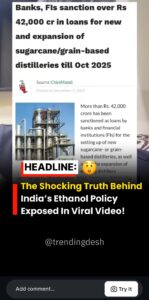
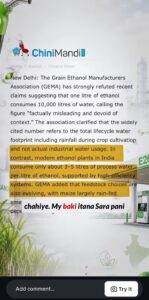
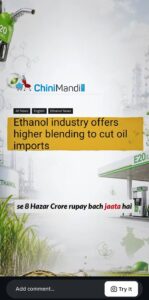
This begs most attention, and I’m glad to inform that several content creators have leveraged publicly available data and analyses that ChiniMandi has provided to illustrate the economic, environmental and technological value of an ethanol blend.
View this post on Instagram
View this post on Instagram
Their short videos, infographics and educational reels have helped demystify complicated policy issues for a wider audience, as digital platforms can be potent vehicles for public attention when information on the ground, not terror, moves the narrative.

Proactive communication from the government, oil marketing companies, automobile companies, research institutions, or industry bodies is what must happen.
National interest policies cannot be made targets of viral misinformation. So as India moves to a cleaner, more secure and self-reliant energy future, public confidence needs to be based on science, as well as transparency and proof, not lies meant for clicks and views.
For further inquiries please contact Uppal Shah, Editor-in-Chief, at uppal@chinimandi.com















