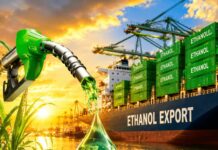
Ethanol Blended Petrol (EBP) Programme has emerged as a key pillar of India’s energy transition and biofuel strategy. It aims to improve energy security, support farmers, and reduce environmental impacts. The programme also promotes greater use of domestically produced renewable fuel, according to PIB release.
Under the EBP Programme, ethanol blending has increased from less than 1.5 percent in 2013-14 to 20 percent in 2025-26. India achieved the 20 percent blending target five years ahead of schedule. Ethanol procurement rose from about 38 crore litres in Ethanol Supply Year (ESY) 2013-14 to over 1,200 crore litres (projected) in 2025-26. Production capacity expanded nearly fivefold from 421 crore litres in 2014 to about 2,000 crore litres in 2026. This expansion has reduced crude oil imports and saved valuable foreign exchange. It has also lowered greenhouse gas emissions and strengthened farmers’ incomes through new market opportunities.

Strengthening Energy Security through Ethanol Blending
India imports close to 88.5 percent of the crude oil it consumes. That single number explains a great deal about why ethanol blending sits so high on the policy agenda. Every barrel of oil bought from abroad exposes the country to price swings and supply shocks that are entirely outside its control. Ethanol produced from Indian sugarcane, maize and rice offers a way to blunt that exposure using resources grown at home.
Since the ESY 2014-15 (up to May 2026), the programme has delivered results that go well beyond a policy target on paper.
Industry Voices of Confidence
Confidence in E20 is reinforced by leading automobile manufacturers and energy sector experts, drawing on extensive testing and real-world service data.
Some of the key observations from industry leaders are as follows:
· Vikram Gulati, Country Head and Executive Vice President, Toyota Kirloskar Motor: Vehicles undergo rigorous, independent certification worldwide. Ethanol is a proven, high-performance fuel, in use since the early 1900s. Decision to move to E20 was taken only after rigorous testing on older vehicles
· Rahul Bharti, Senior Executive Officer, Corporate Affairs, Maruti Suzuki: E10-designed vehicles have been tested extensively with E20 fuel. Across 2.84 crore vehicles serviced by Maruti Suzuki in FY 2025-26, more than 1.5 crore were over three years old and hence not E20-certified. Still no E20-related damage was found. On mileage, the real impact is small. For a car giving 20 km per litre, the drop is roughly 0.6 km. Driving habits and maintenance affect mileage far more than fuel type. Better acceleration and lower pollution offset this small difference.
· Ashutosh Varma, Chief Business Officer, Hero MotoCorp: Analysis of extensive service data found no incidence of higher damage in vehicles running on E20 compared to earlier fuels.
· Vartika Shukla, Former Chairman and Managing Director, Engineers India Limited: The ethanol blending programme was developed through extensive consultation with all stakeholders. It is supported by scientific evidence, rigorous automotive testing, and global best practices. E20 fuel meets BIS standards and BS-VI emission norms. It is available uniformly across retail outlets nationwide.
Across manufacturing and energy sectors, the message from industry leaders is consistent. E20 is safe, well-tested, and backed by real-world data.
Ethanol Blending Is a Globally Proven Fuel Strategy
India is far from alone in adopting ethanol blending. It is now a globally accepted practice. Several major economies have built ethanol firmly into their fuel strategy.
· United States: E10 is the standard ethanol blended fuel nationwide. E15 is expanding rapidly, backed by the US government. Millions of vehicles are already flex fuel capable. These can run on blends as high as E85.
· Brazil: Brazil remains the global leader in ethanol use. It currently mandates E27 as its standard petrol blend. This is being raised further to around 35 percent. Over 80 percent of new cars sold are flex fuel vehicles. These run on E27, E30, or pure hydrous ethanol.
· Japan: Japan has brought ethanol into its fuel mix too. This was done through a phased E10 rollout.
Countries including Canada, Thailand, and several European nations have also adopted ethanol blending as part of their clean fuel strategies.
Powering India’s Energy Future
The Ethanol Blended Petrol (EBP) Programme has evolved into a key pillar of India’s energy strategy. Its progress reflects scientific evaluation, phased implementation, and collaboration across government, industry, and research institutions. The programme has strengthened energy security, reduced emissions, and created new income opportunities for farmers. It has also reduced crude oil imports and promoted the use of domestically produced renewable fuel. The EBP Programme will continue contributing to a cleaner, more resilient, and self-reliant transport fuel ecosystem.