
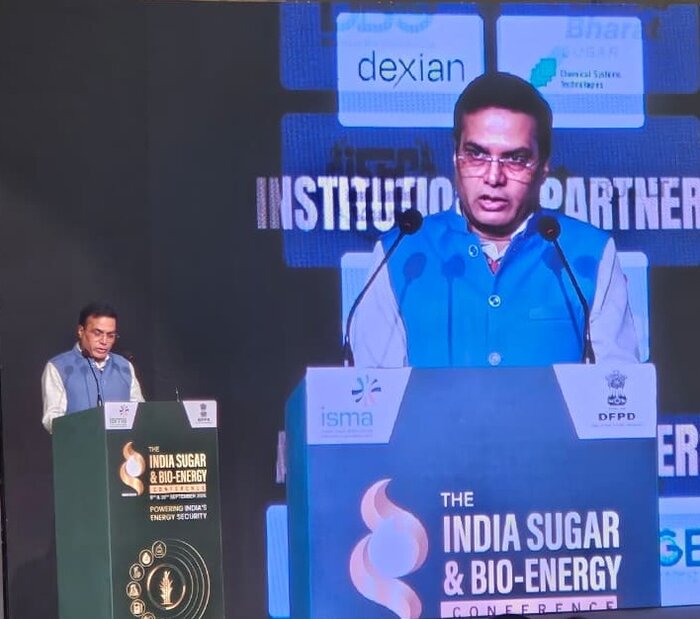
New Delhi: India’s sugar industry has significant scope to create new growth opportunities by expanding beyond conventional sugar and ethanol production into agriculture, bioenergy and bio-based products, Ashwini Srivastava, Joint Secretary (Sugar), Department of Food and Public Distribution (DFPD), said.
Srivastava said the government planned to advance the start of cane crushing this year to October 15, compared with the last week of October in the previous season. He said the earlier start would allow mills to produce additional sugar in October itself, adding to overall availability and stock levels ahead of the festive season. Sugar mills across the country have paid nearly Rs 1,11,270 crore, amounting to 97 per cent of the total cane price due for the ongoing season, to sugarcane farmers.

He said the government would seek additional monthly data from sugar mills, including estimated cane crushing for the remainder of the season and monthly sugar production figures, beginning October. According to Srivastava, the sugar balance sheet would be revised every month based on this data to support more accurate policy decisions.
Referring to the recent rise in ex-mill and retail sugar prices, Srivastava said the increase appeared to have been driven more by inventory build-up and expectations of stronger festive season demand than by actual consumption. He said a review of trading activity in August showed that physical offtake remained relatively limited despite firmer quotations.
To stabilise the market, Srivastava said the government had imposed stock limits on sugar dealers and bulk consumers, permitted duty-free export of 10 LMT of raw sugar, and allowed a one-time conversion under the advance authorisation scheme for domestic sale of refined sugar. He said these measures, along with stock verification and market monitoring, had eased prices as accumulated stock moved back into the market.
Srivastava said the government had held detailed consultations with stakeholders, including ISMA, the National Federation of Cooperative Sugar Mills and regional millers’ associations, before finalising these steps. He called on mills, traders and other market participants to act responsibly and avoid artificial scarcity, hoarding or speculative stocking, adding that the government would continue to monitor the market closely.
On farmer welfare, Srivastava said the long-term sustainability of the sugar sector would depend on improving cane productivity, sugar recovery and farm-level profitability through climate-resilient varieties, better irrigation, quality planting material and greater mechanisation.
He also said the industry needed to look beyond ethanol towards other value-added segments such as bagasse-based power, compressed biogas, bio-based chemicals and organic fertiliser, describing the shift from sugar production to integrated valorisation as the next phase for the sector. Srivastava said the government’s priority through the festive season would be to ensure sugar remains adequately available and reasonably priced for consumers.















I
am a sugar technologist. I am interested to know more and to share more. Kindly register me .