
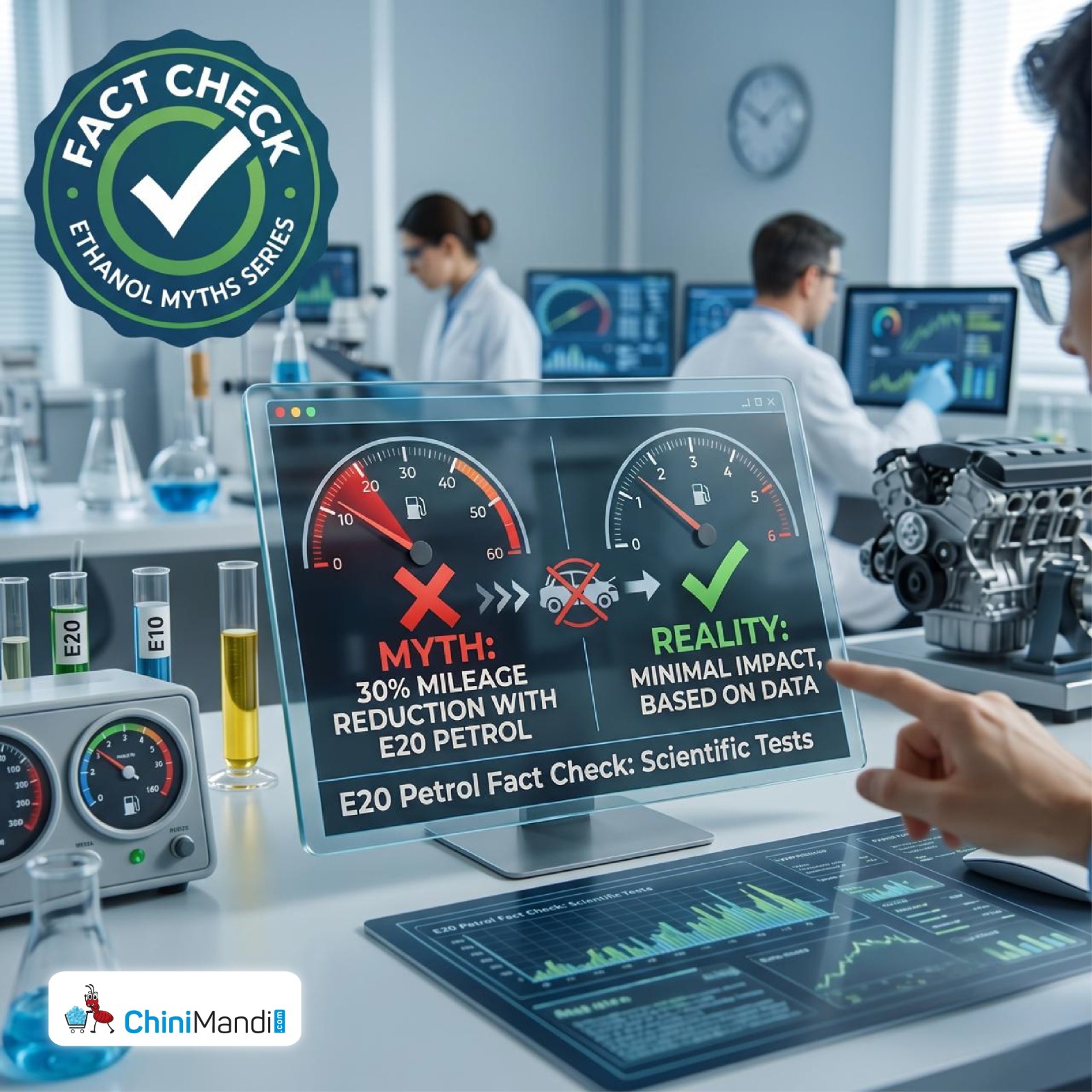
Several influencers on social media are creating a false narrative about ethanol fuel and its impact on vehicles. A gross piece of misinformation being spread concerns mileage loss. It has been alleged that, due to ethanol-blended petrol, vehicles will lose around 20-30% of their mileage.
However, this is unfounded. Let’s explain why.

The Government noted that the use of E-20 gives better acceleration, better ride quality, and, most importantly, lower carbon emissions by approximately 30% compared with E10 fuel.
Vehicles tuned for E20 deliver better acceleration, which is a very important factor in city driving conditions.
The Government’s report pointed out that vehicle mileage is influenced by a variety of factors beyond just fuel type. These include driving habits, maintenance practices such as oil changes and air filter cleanliness, tyre pressure and alignment, and even air conditioning load.
Extensive discussions have been carried out with the Society of Indian Automobile Manufacturers (SIAM) as well as prominent vehicle manufacturers. The efficiency drop (if any) in E10 vehicles has been marginal. For some manufacturers, vehicles have been E20-compatible since as far back as 2009. The question of any drop in fuel efficiency in such vehicles does not arise.
Scientific studies have shown that ethanol has a lower calorific value because it contains more oxygen. This does cause a mileage drop, but not as much as the 30–35% some reports claim. At 20% ethanol blending (E20), the reduction is only about 2–3%.
In an interview with ChiniMandi, Abinash Verma, Ethanol Expert, Public Policy Expert, Former Bureaucrat, Former DG ISMA, had said that “Importantly, the extra oxygen in ethanol allows petrol to burn more efficiently, lowering tailpipe emissions and making it less polluting than pure petrol. There is a minor drop in mileage, but improved combustion and reduced emissions are clear benefits. At blends of 10–15%, the effect on mileage is negligible”.
In February this year, the Government mandated the sale of petrol with up to 20% ethanol and a minimum Research Octane Number (RON) of 95 across all States and Union Territories from April 1, 2026.
Verma said that “Ethanol naturally has an octane rating of 107. When blended with petrol, it boosts petrol’s octane without adding harmful chemicals, hence improving engine performance and longevity. A higher octane rating is especially beneficial for high-performance or luxury vehicles that require premium fuel”.
The claims of a mileage drop are unfounded and appear to be spread with malicious intent. The ethanol blending programme is a game-changer for India’s economic progress and environmental protection. Science-based knowledge should lead the way in this big transformation from fossil to green energy.















India needs much much ethanol production ,in future for own use and export. India has huge capacity to produce ethanol to save foreign currency, big way. During war and war like situations, India needs more ethanol for use. It is a proven technology, worldwide. No problem for Ethanol upto E 85 or 100 per cent use. We need to develop our own machines to use maximum ethanol on the line of Brazil. We must build our strengths and Ethanol production will be prime to reduce import of gasoline. Best Wishes to Boosts Ethanol and Bio -Gas.