
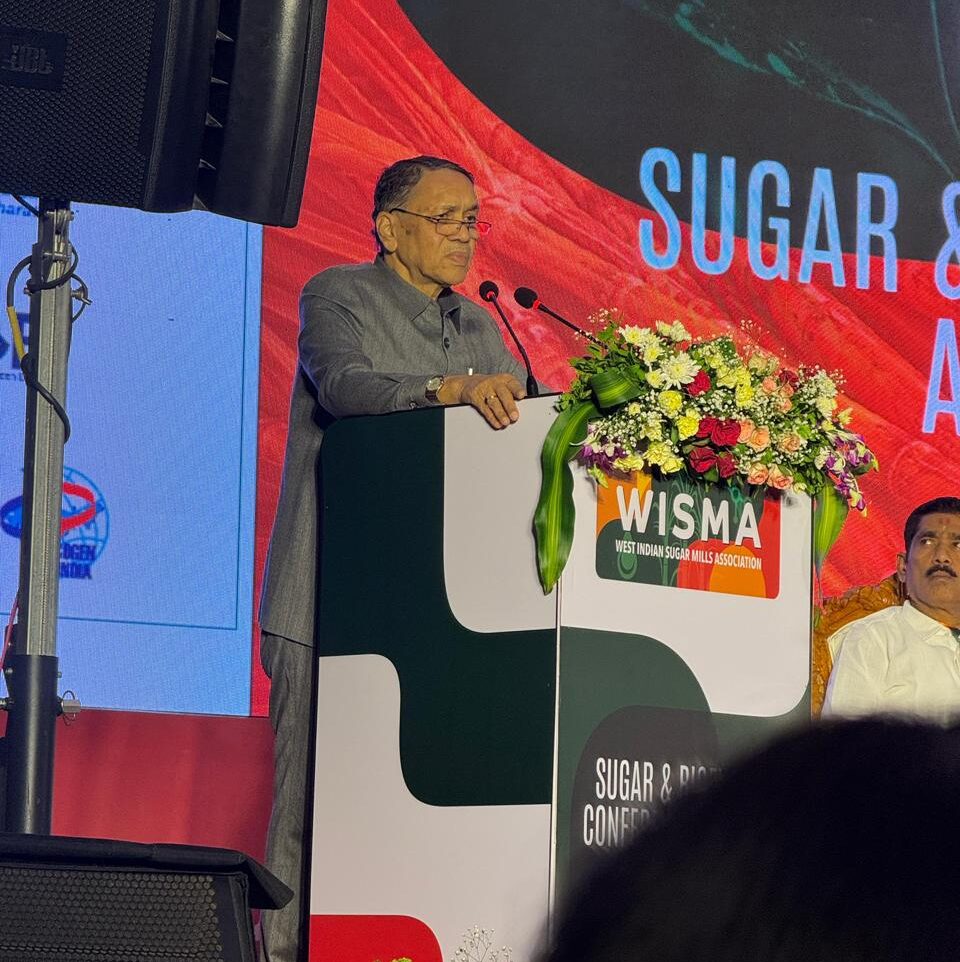
Pune: Former Maharashtra Cooperation Minister and Vice Chairman of the Vasantdada Sugar Institute, Dilip Walse Patil, has warned that the state’s sugar industry is facing one of its most challenging phases and requires urgent technological, financial and policy interventions to remain sustainable.
Speaking at the Bio Energy Conference organized by WISMA, Walse Patil said both cooperative and private sugar mills in Maharashtra are under tremendous pressure due to excessive capacity expansion, declining cane availability, rising production costs and uncertain market conditions.

He said many mills had expanded crushing capacities without adequately considering cane availability, creating intense competition for sugarcane and threatening the viability of smaller mills. Maharashtra’s average sugarcane productivity remains around 40-45 tonnes per acre, which he described as insufficient to support the industry’s growing capacity.
Highlighting the role of technology, Walse Patil said artificial intelligence-based farming practices being promoted by the Vasantdada Sugar Institute, with support from international universities, have the potential to increase cane productivity to 100-120 tonnes per acre. He urged the industry to adopt advanced technologies to boost yields, reduce costs and improve operational efficiency.
The former minister noted that sugar mills ideally need to operate for at least 160 days to remain economically viable. However, many mills during the last crushing season were able to operate for only 80 to 100 days due to inadequate cane supply, resulting in increased financial burdens from maintaining permanent staff and infrastructure.
Walse Patil also expressed concern over the ethanol sector. He said sugar mills had invested heavily in ethanol projects after government encouragement and concessional financing schemes. However, only about 30 percent of ethanol produced from sugarcane was procured by oil marketing companies last year, while nearly 70 percent came from grain-based and multi-feedstock sources. This has created financial stress for sugar mills that invested in ethanol production facilities.
He warned that the industry could face additional challenges due to the expected impact of El Niño, which may lead to below-normal rainfall and drought-like conditions in the coming year. He also cautioned that ongoing global geopolitical tensions and economic uncertainties could trigger a prolonged financial crisis affecting the sector for the next three to five years.
Emphasizing the importance of the sugar industry to Maharashtra’s economy, Walse Patil said the state has 210 sugar mills, including 103 cooperative and 107 private units. The sector generates an annual turnover of approximately ₹55,000 crore to ₹66,000 crore and contributes nearly ₹8,000 crore in revenue to the state government. It also supports the livelihoods of around 50 lakh farmers, 10 lakh cane-cutting workers and nearly 1.5 lakh factory employees.
Referring to a recent meeting chaired by Union Home and Cooperation Minister Amit Shah in New Delhi, Walse Patil said Maharashtra had strongly raised the industry’s concerns before the Centre. He pointed out that while the Fair and Remunerative Price (FRP) for sugarcane had increased by nearly 29.5 percent since 2018, the Minimum Selling Price (MSP) of sugar had remained unchanged at ₹31 per kilogram.
The industry has demanded an increase in the MSP to ₹43 per kilogram and sought a review of the ban on sugar exports. Walse Patil argued that policy inconsistency in sugar and agricultural exports has affected India’s credibility in international markets.
He further highlighted the challenges facing ethanol producers. Maharashtra currently has an installed ethanol production capacity of 424 crore litres, but the state received an allocation of only 116 crore litres last year. The industry has also sought an increase in ethanol prices to improve project viability.
Calling for a long-term and stable policy framework, Walse Patil said the sugar industry must diversify into bioenergy, ethanol and other value-added products while simultaneously improving farm productivity through modern technologies. He stressed that coordinated efforts by governments, industry bodies and sugar mills would be essential to ensure the long-term sustainability of the sector.
















Shri Patil, I agree with your assessment. I have the most advance technology to turn around troubled sugar industry, make it more profitable while giving higher sugarcane price to the farmers. I am NRI from USA returning to India after 50 years to implement this technology. Please contact me to discuss the way forward.