
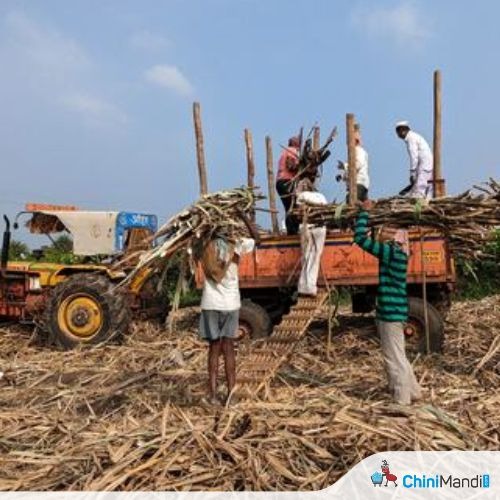
Maharashtra’s sugarcane transporters are facing mounting financial risks after allegedly losing Rs 257 crore to labour contractors, or mukadams, over advances paid to arrange harvesting workers, according to police cases recorded between 2022 and 2025, The Indian Express reported.
Pune, Kolhapur, Solapur, Satara and Sangli districts recorded 1,953 criminal cases involving alleged cheating by labour contractors during the period. Police have booked 3,162 mukadams in these cases.

Kolhapur reported the highest number of cases at 1,154, accounting for more than half of the total. Sangli recorded 235 cases, followed by Solapur with 216, Pune with 175 and Satara with 173.
For many sugarcane farmers, transporting cane during the crushing season is an additional source of income. Farmers who own tractors, trucks or other transport vehicles often take up the work because cultivation alone may not cover rising production, labour and loan costs.
The financial risk, however, can begin before the crushing season starts. Transporters typically pay large advances to mukadams, who are responsible for bringing groups of migrant sugarcane cutters to harvesting sites.
Most of these labour contractors operate through established networks in Marathwada and Vidarbha, where many migrant sugarcane workers come from.
Transporters allege that some contractors accept advances from several people for the same group of workers or disappear after receiving the money. When the workers fail to arrive, transporters are left with vehicle loans, fuel and maintenance costs and no cane to transport.
Many transporters also use their own savings or mortgage property to arrange advances when bank finance obtained through sugar mills does not cover the full amount demanded by contractors.
The losses can have serious consequences because vehicle loans and other financial obligations continue even when the promised labour does not arrive.
In Kolhapur, a sugarcane transporter died by suicide in November 2024 amid allegations of debt and financial losses linked to the labour-contracting system. The case involved an advance paid for harvesting and transportation, part of which allegedly remained with a labour contractor after the promised workers failed to arrive.
Farmer leader and former MP Raju Shetti said police had increasingly registered criminal cases of cheating since 2022, whereas such disputes were earlier often treated as civil matters.
He said criminal cases alone had not resolved the problem because accused contractors could obtain bail and return to the same business, leaving transporters to recover their money while dealing with financial pressure and, in some cases, threats and counter-cases.
Shetti said he had approached Chief Minister Devendra Fadnavis twice seeking government intervention. He also said a proposal for a separate law to deal with such fraud, including provisions for recovery of money, had been discussed during the tenure of the late Ajit Pawar as deputy chief minister but had not been implemented.
The problem has highlighted the financial risks that run through Maharashtra’s sugarcane supply chain. Sugar mills often enter into contracts with transporters and facilitate bank finance for vehicles and other assets. Transporters then use the funds to pay labour contractors.
This arrangement leaves transporters carrying much of the financial risk while depending on mukadams to secure the workers needed to harvest and move sugarcane.
The cases underline a wider vulnerability in Maharashtra’s sugarcane economy, where a crop widely regarded as a major cash crop can leave farmers and transporters exposed to debt when the labour supply chain breaks down.
For transporters, the failure of a single labour contract can therefore turn a seasonal income opportunity into a significant financial burden, with vehicle repayments, interest and operating costs continuing even when there is no cane to transport.















