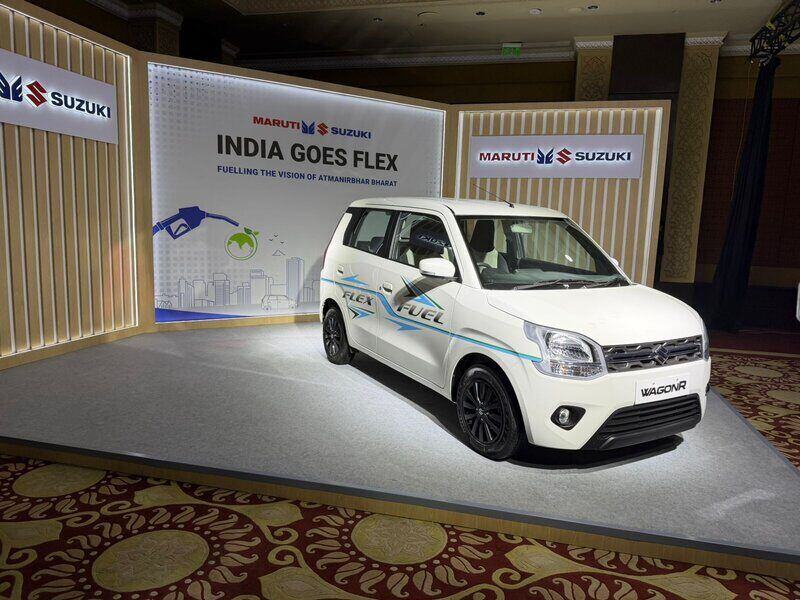
Maruti Suzuki on Thursday launched what it described as India’s first flex-fuel passenger car, positioning the technology as central to the country’s goals of reducing crude oil imports, cutting carbon emissions, and strengthening energy security.
The Economic Times reported that the company unveiled the flex-fuel Wagon R in the presence of Union Road Transport and Highways Minister Nitin Gadkari and Petroleum and Natural Gas Minister Hardeep Singh Puri, both of whom have consistently advocated the use of alternative fuels and domestic energy sources, The Economic Times reported.

Speaking at the launch event, Managing Director and CEO Hisashi Takeuchi said the introduction of the vehicle represented more than a new product. He described it as the beginning of a new chapter in India’s energy journey. Takeuchi said India required energy solutions that were cleaner, affordable, scalable, and rooted in the country’s own strengths, pointing to the nation’s continued dependence on imported crude oil.
“India has two national objectives: First, reduce dependence on imported crude oil. Second, reduce carbon emissions. Flex-fuel meets both. It is truly Atmanirbhar and clean,” he said.
Takeuchi credited Gadkari for pushing the automobile industry towards biofuels at a time when few believed in their potential, saying the minister had guided the sector to recognise that the produce of Indian farmers could replace foreign oil. He added that flex-fuel technology held the potential to generate wider benefits by supporting farmers, ethanol producers, and rural communities, effectively linking agriculture with clean mobility.
The Maruti Suzuki chief acknowledged that broad adoption of flex-fuel vehicles would require a coordinated effort across the supply chain, covering fuel availability, additional model launches, customer awareness, and competitive pricing. He said that in the absence of a fully developed ecosystem, it fell to the market leader to take the first step and encourage others to follow.
The company said the launch forms part of its broader multi-pathway emissions reduction strategy, which includes electric vehicles, strong hybrids, compressed natural gas (CNG), compressed biogas (CBG), and hydrogen. Takeuchi described CBG as a particularly promising route to net-zero emissions, noting that Maruti Suzuki has already announced nine CBG plants, of which two are currently operational.
The launch comes as India continues to expand ethanol blending in petrol and promote alternative fuels as part of its wider strategy to improve energy security and reduce dependence on imported fossil fuels.